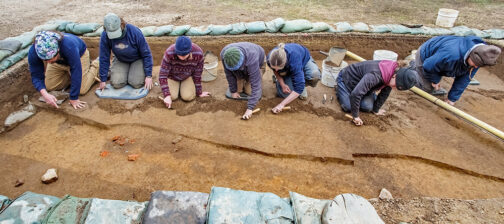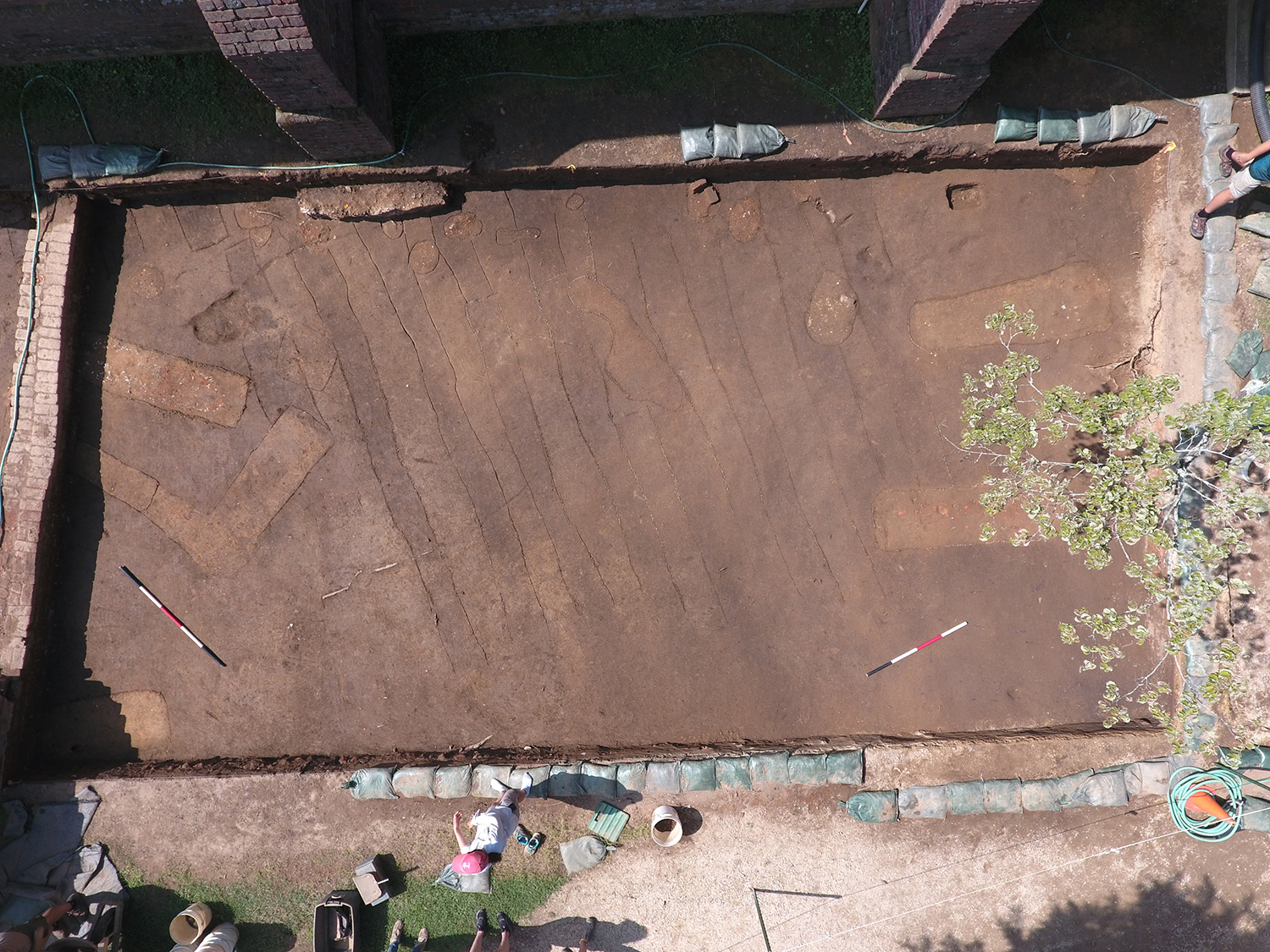
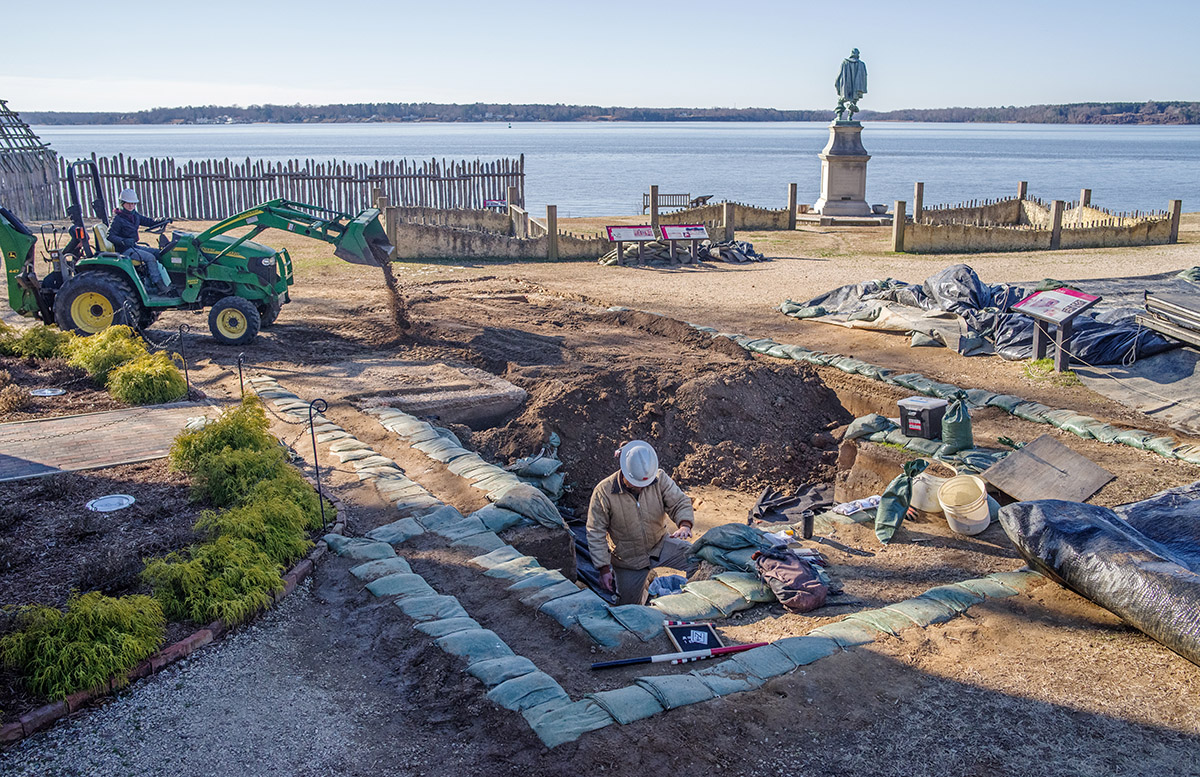
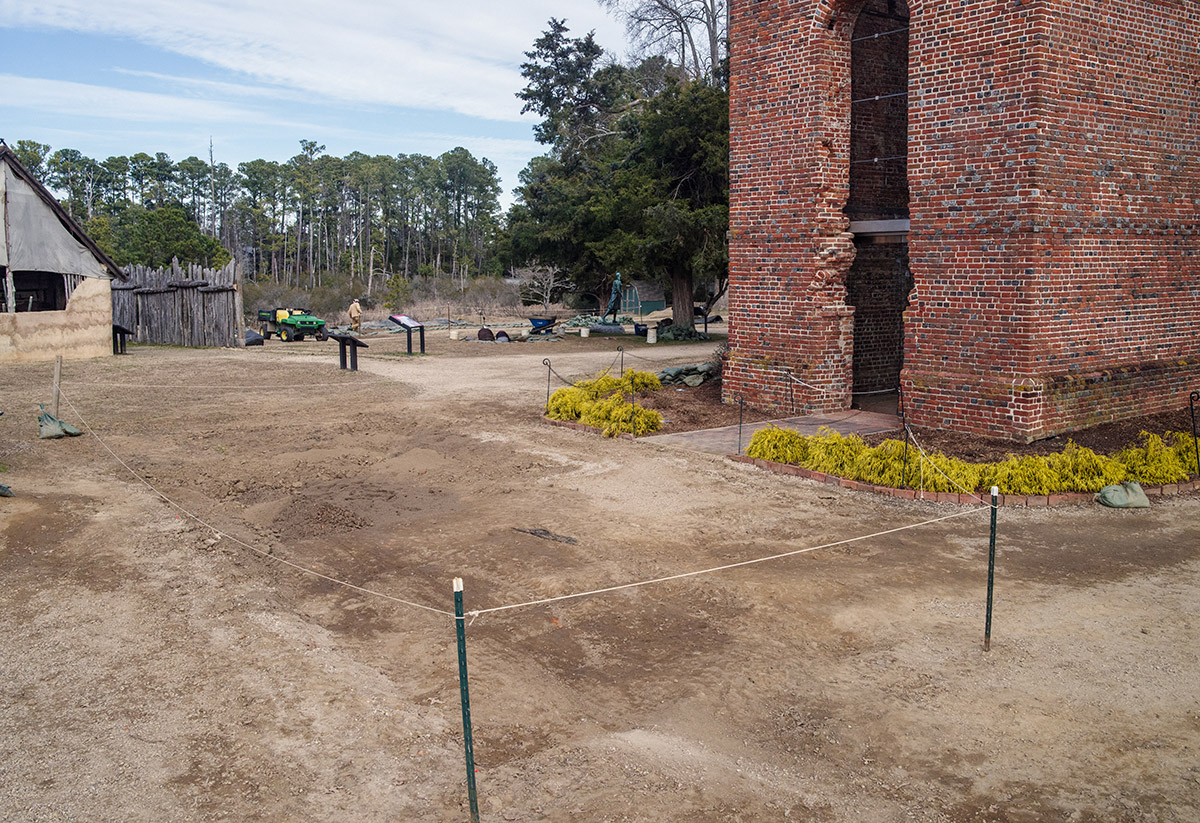
Jamestown’s archaeologists are excavating a series of 5’x 5′ squares in an area they’ve nicknamed “Pocahontas Plaza” because her statue is nearby. The location of the excavation is determined by the proposed course of a new walking path traversing James Fort and moving westward to the Dale House Cafe and Archaearium Museum. To avoid damaging any archaeological remains during the path’s construction, the team is excavating any areas that will be affected and which are as yet unexcavated. The path’s construction will disturb the soil to a maximum depth of one foot.
Three areas are open currently, all to the north of the Memorial Church. The team is in a time crunch, under the gun to get the archaeology done before the construction crew arrives in March. Because of this, they’re excavating only the areas directly affected by the walking path’s construction. Usually the team excavates 10′ x 10′ squares, but here they are digging in 5’ x 5’ quarters. Each quarter of the overall 10’ x 10’ impacted by construction will be dug, but any quarter outside the path footprint will be left unexcavated. This will save time and effort for the team. This excavation coincides with a palisade wall added in 1608. This wall expanded the fort to the east and changed its shape from a triangle to a pentagon. Though this wall of the 1608 extension was found in the early 2000s, the area on either side of it has never been excavated. Because of the proposed route of the pathway, the team will have an opportunity to investigate this wider area.
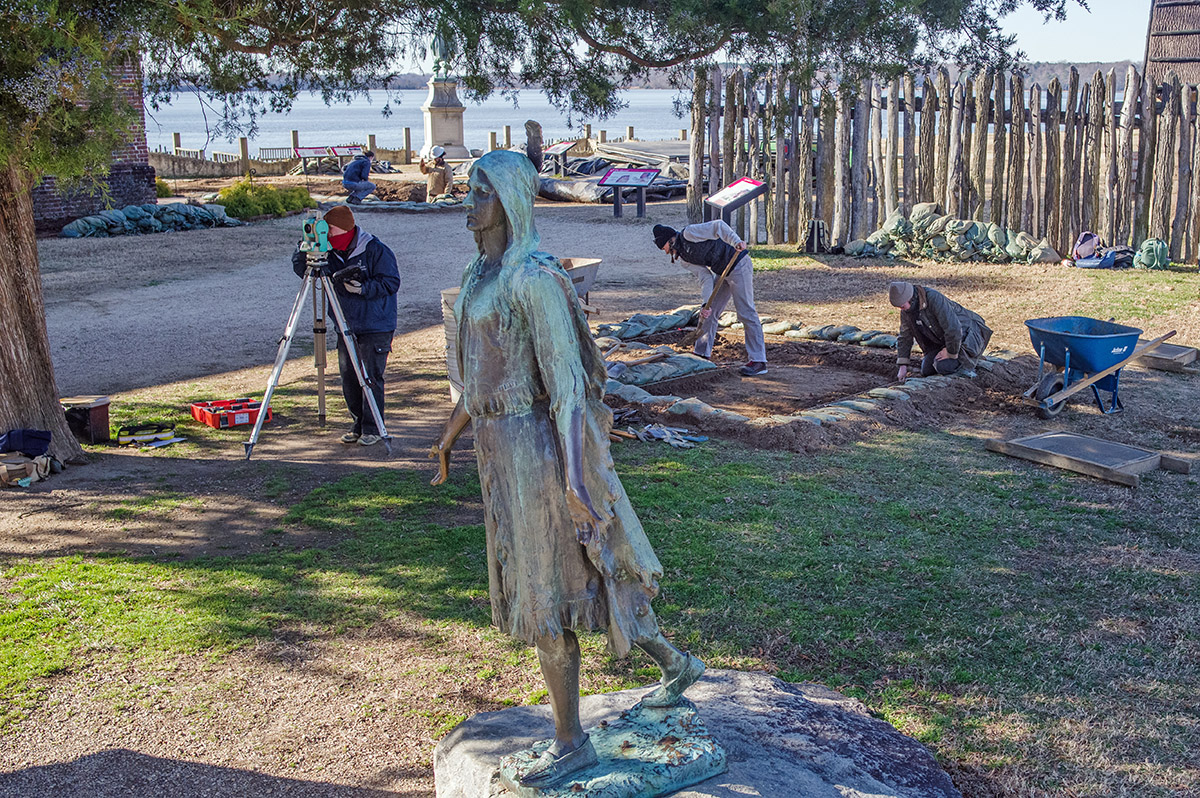
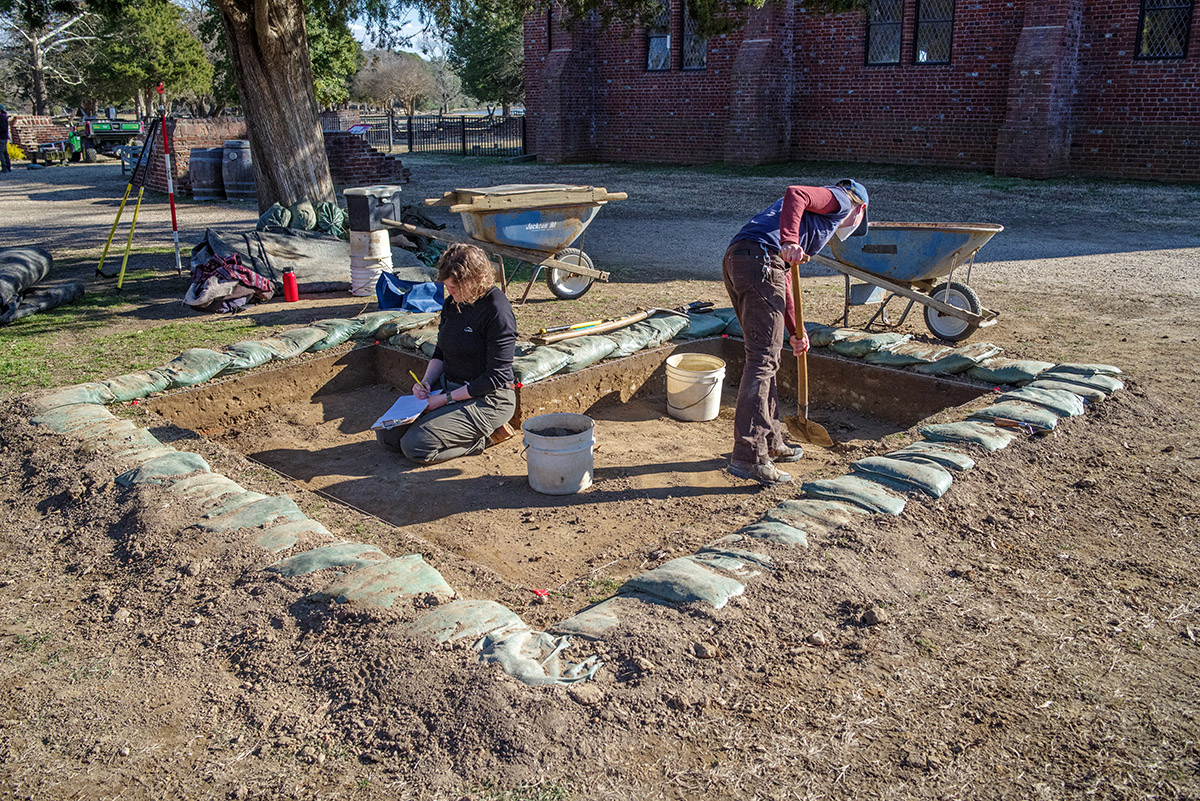
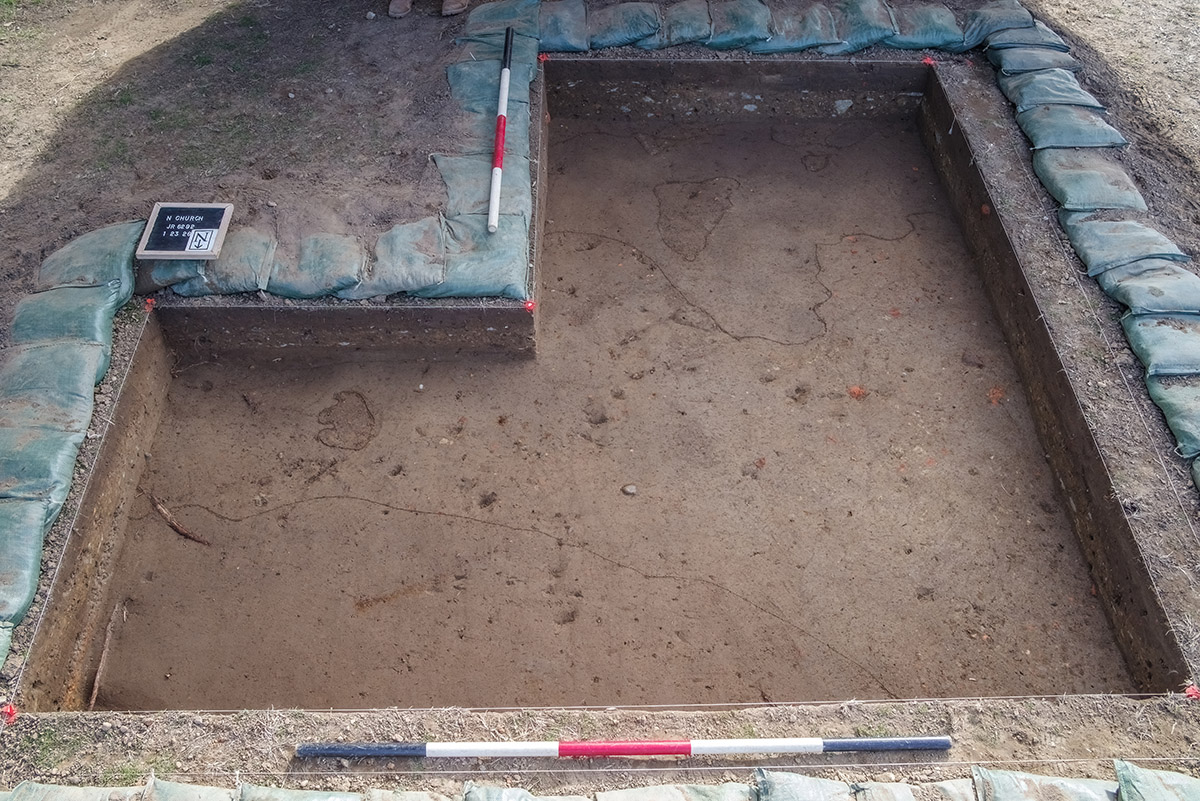
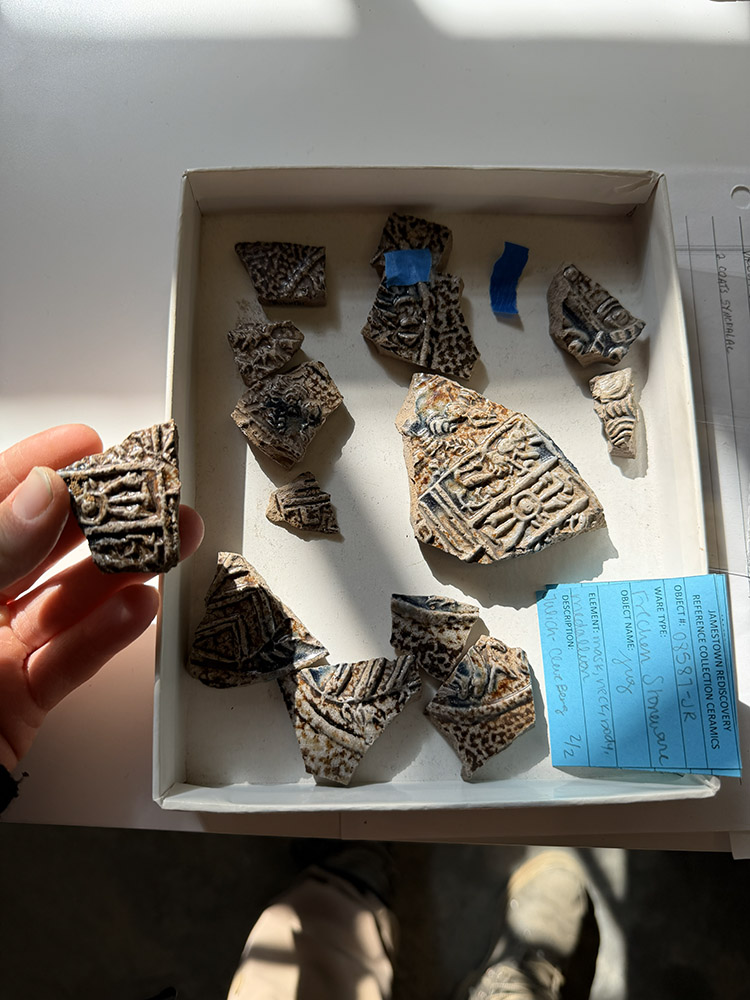
The west-most excavation area, just outside James Fort’s original eastern palisade wall, is a section of three conjoined 5′ x 5’s, all in the proposed footprint of the walking path. Staff Archaeologists Natalie Reid and Ren Willis and Archaeological Field Technician Eleanor Robb are digging here and they are currently high up in the strata, in landscaping layers from the late-19th through early 21st-centuries. Eleanor found several sherds of a Bartmann jug here, a drinking vessel made of a salt-glazed stoneware called Frechen, originating from a German town of the same name. Frechen has been found in large amounts at Jamestown.
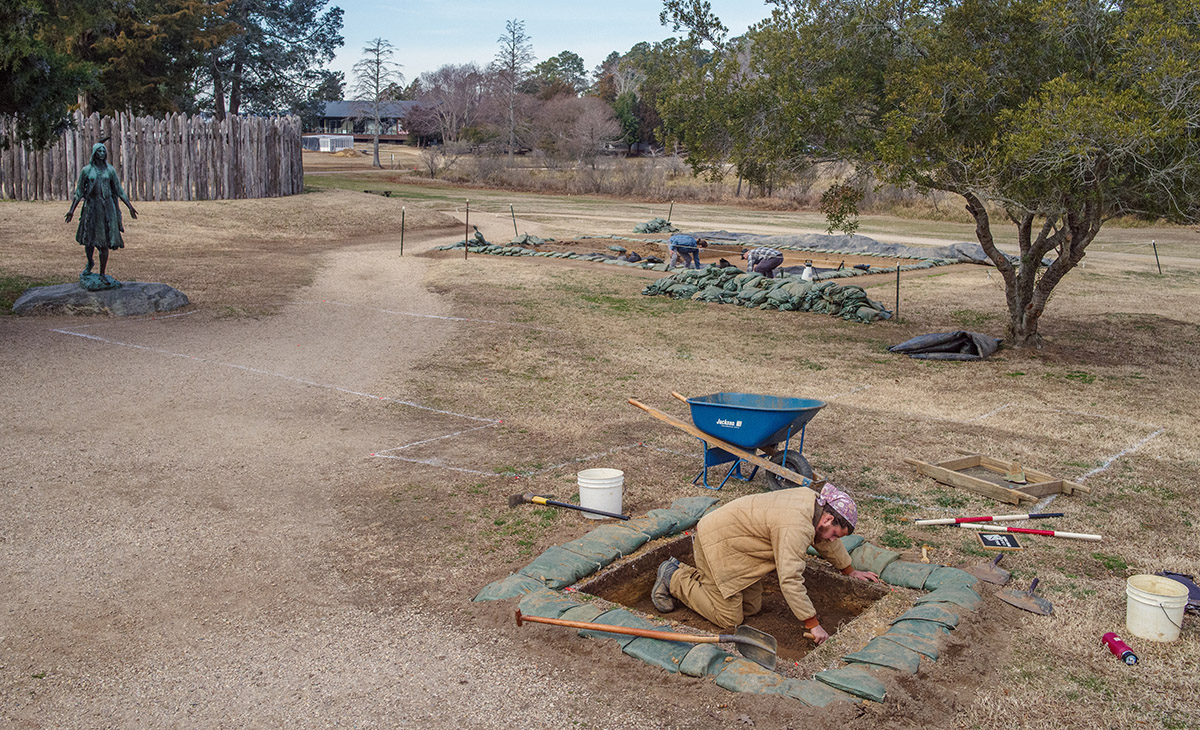
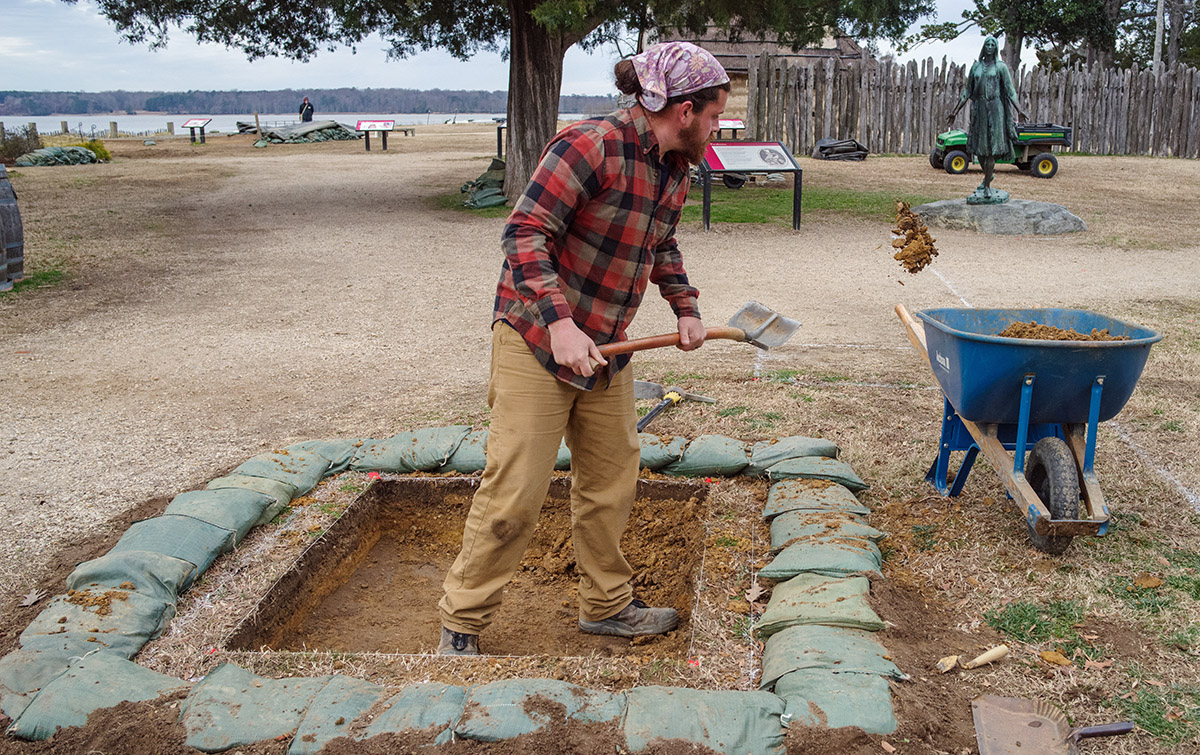
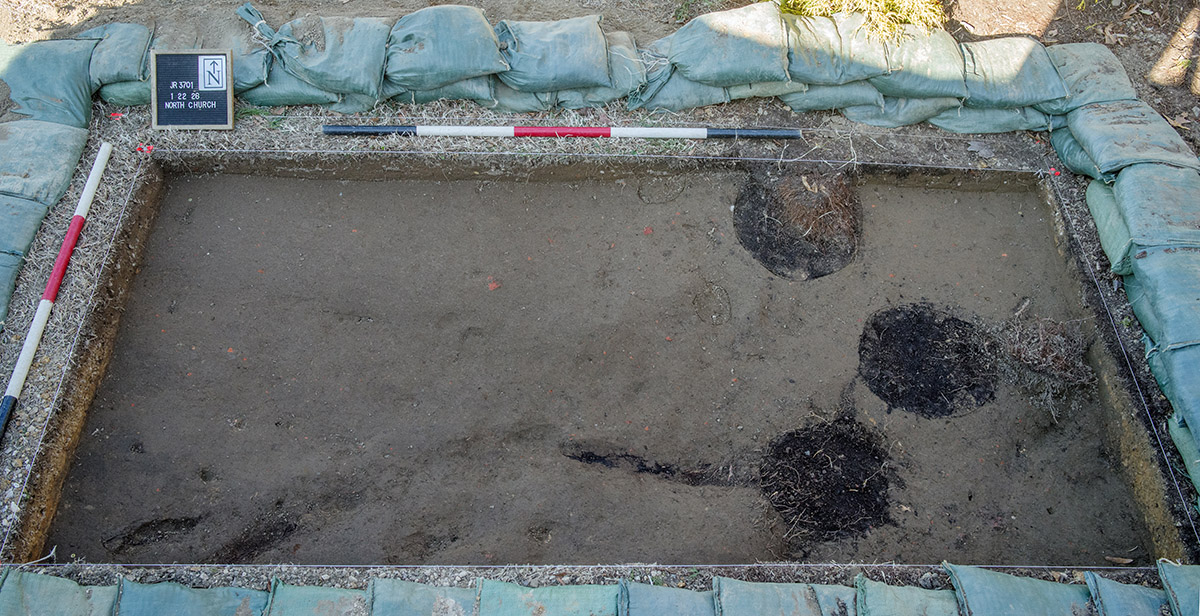
Just a few feet to the east, another excavation area has been opened up, this one just a single 5′ x 5′. As with the first area, this one, primarily being excavated by Archaeological Field Technician Josh Barber, is in its beginning stages, with Josh excavating landscaping layers created after the APVA (now Preservation Virginia) bought this part of the island in 1893. Josh is concerned that there may not be much of the 17th-century layers left because the earth here was robbed to build Fort Pocahontas in 1861. Because adjacent squares have been excavated, we know that a grave and a planting furrow should continue into Josh’s square. The grave belongs to the churchyard, and the furrow is part of one discovered during excavations in the 2010s.
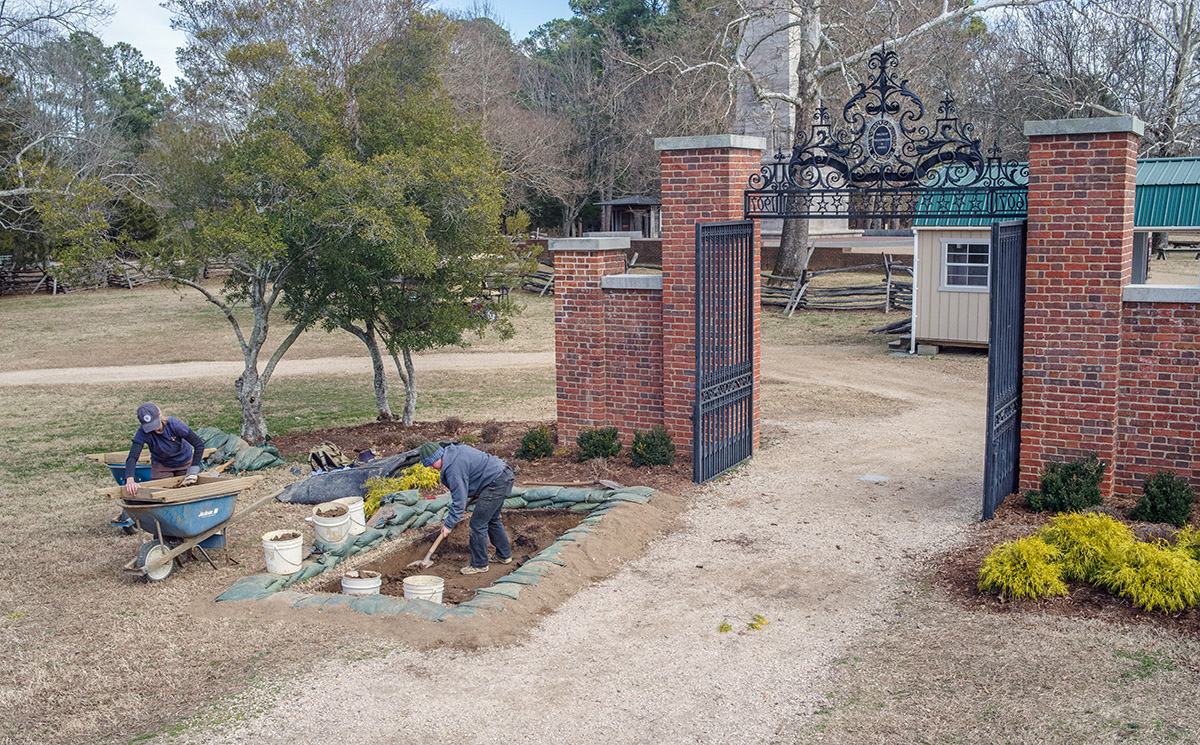
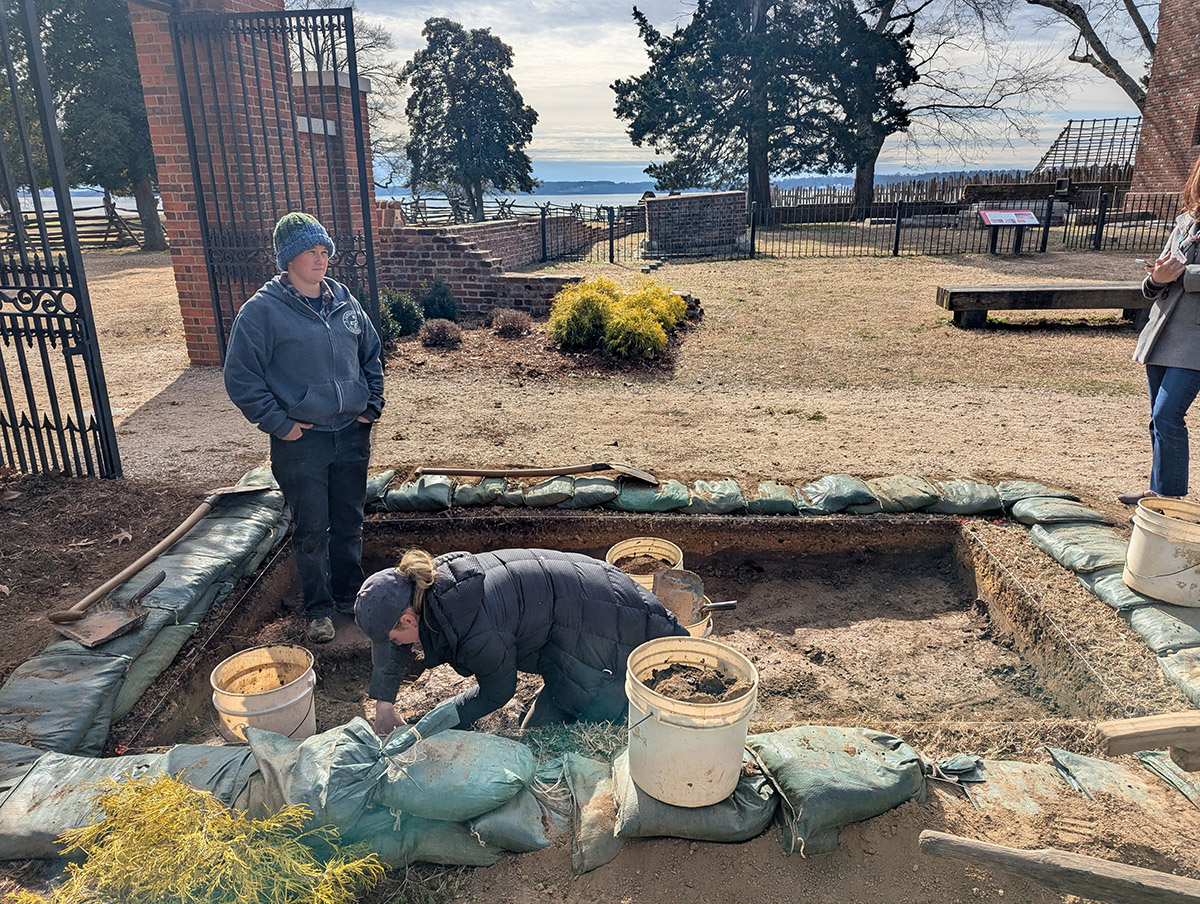
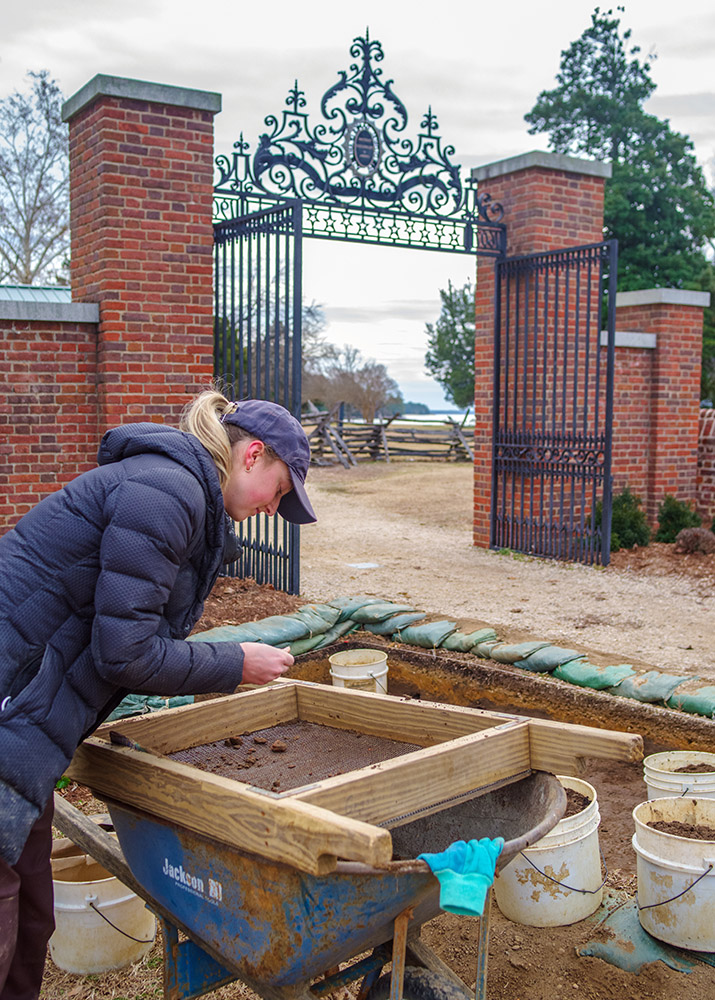
Heading east again brings us to the final excavation area, butting up against the Jamestown Memorial Gates erected in 1907 by the Colonial Dames of America. These gates are near the property line between the Preservation Virginia portion of the island and the National Park Service (NPS) portion. As with the other two excavation areas, this dig is just underway, with the crew currently in modern layers. As they dig deeper, Staff Archaeologist Caitlin Delmas and Archaeological Field Technician Katie Griffith should find a 17th-century ditch. The ditch delineated the churchyard from the property of colonist John Howard. Another section of the ditch was discovered in 2013; a complete horse skeleton was found in the ditch in June of that year. Caitlin and Katie have found a variety of artifacts in the modern layers including scrap copper, nails, glass, and pipe stems.
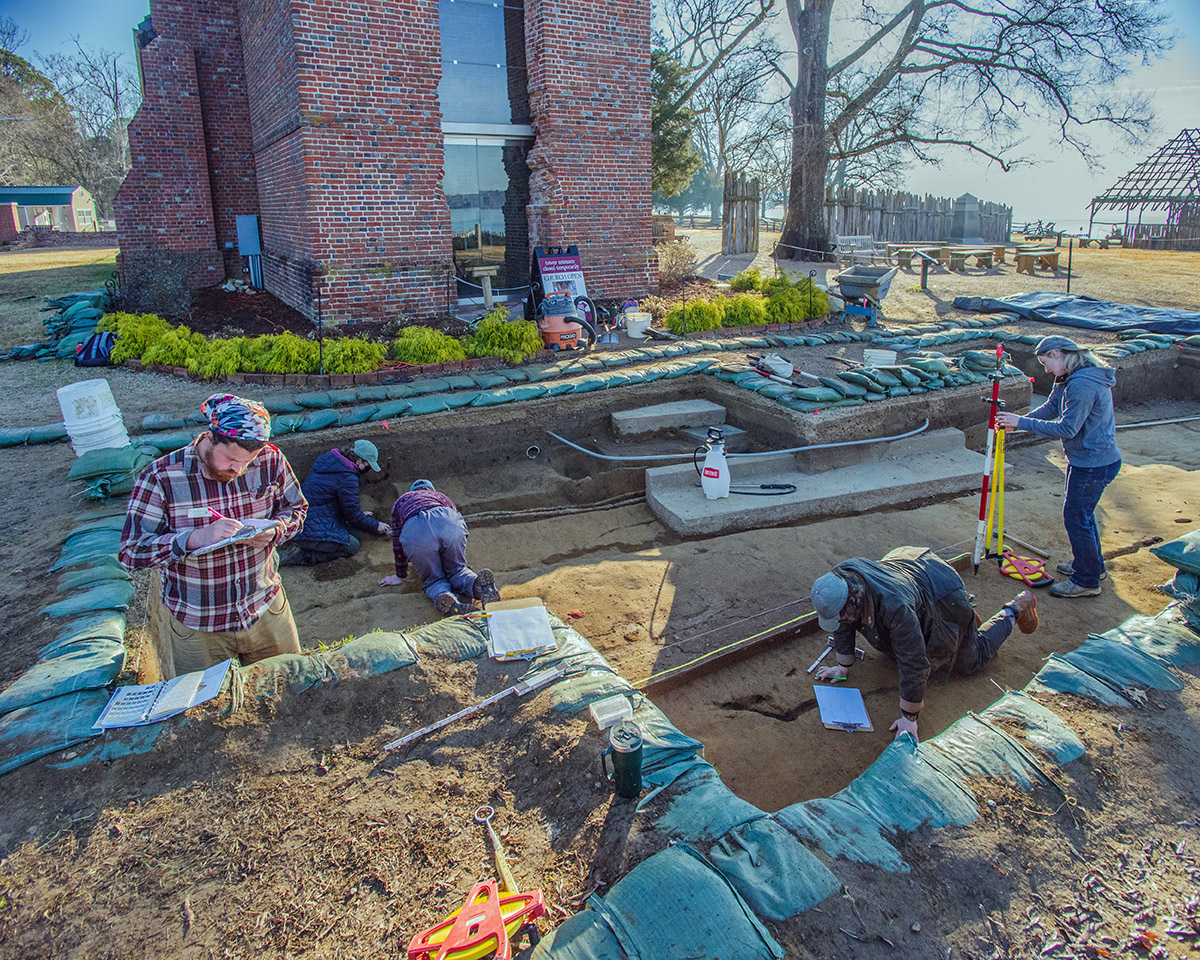
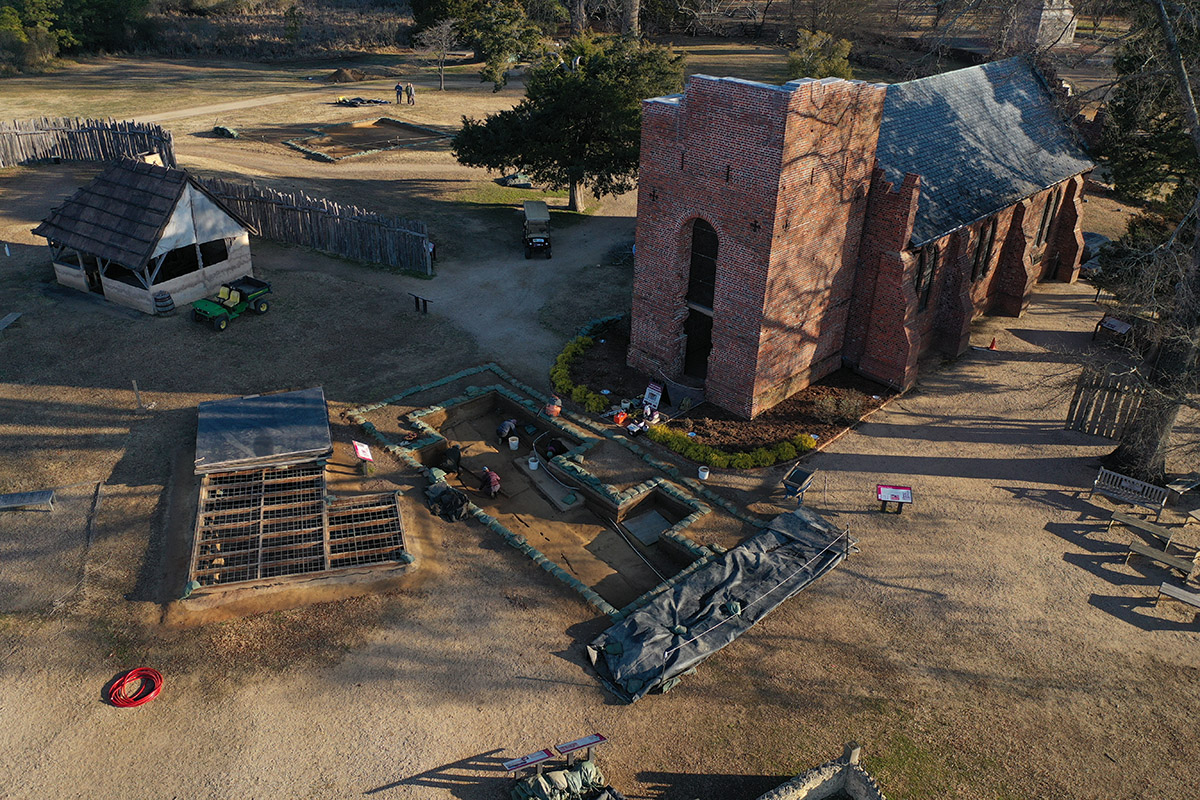
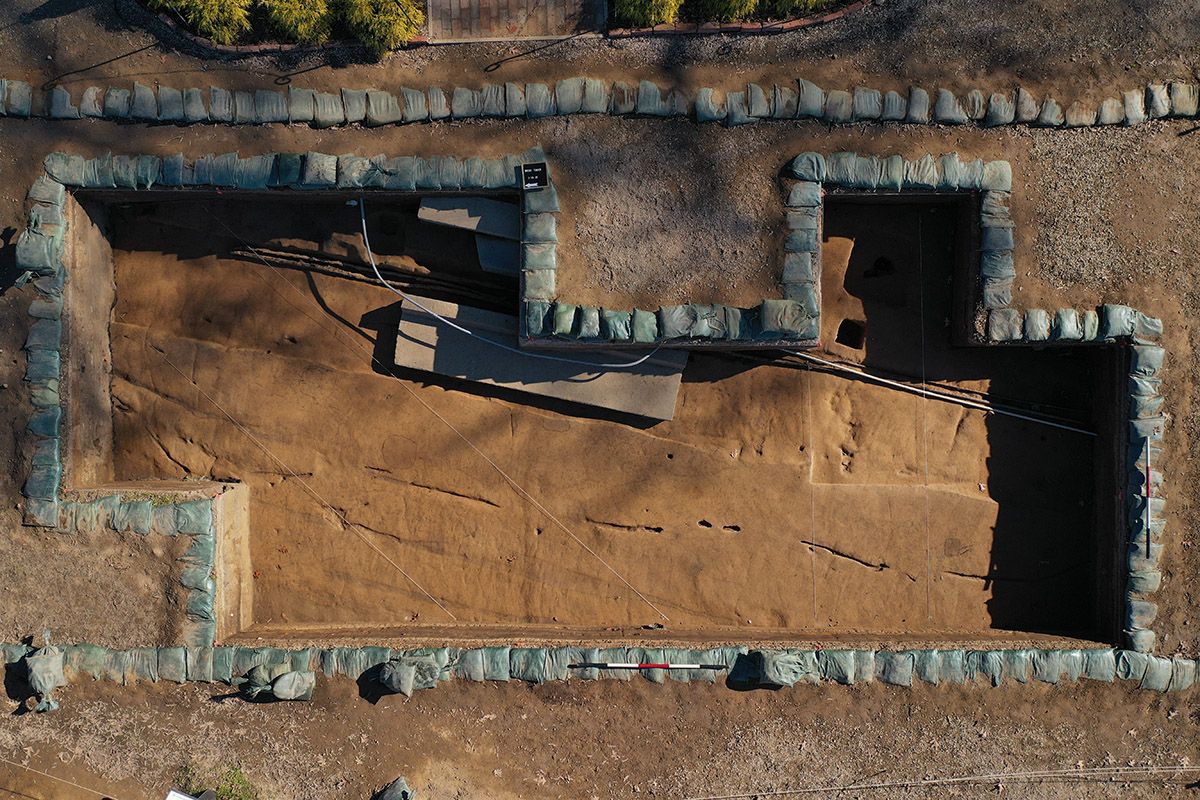
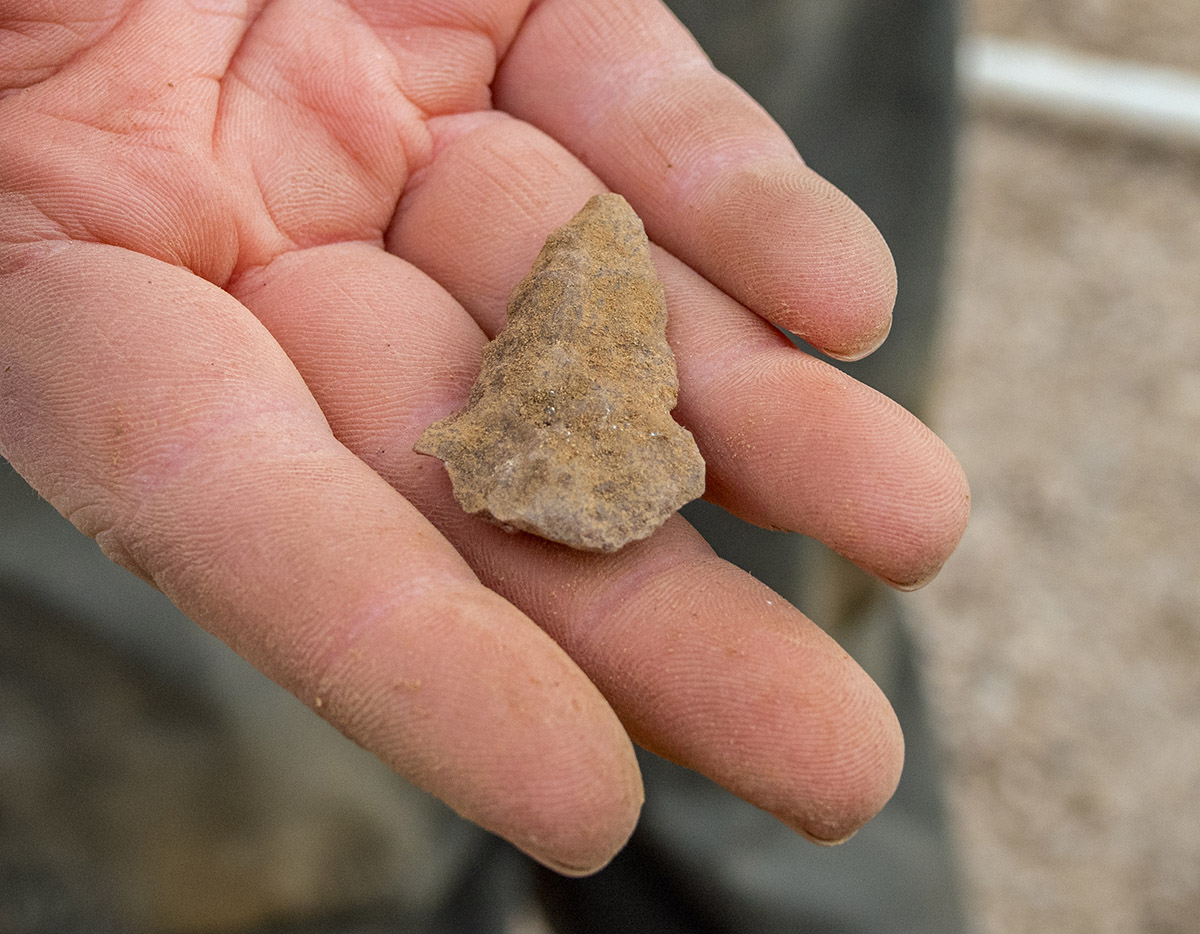
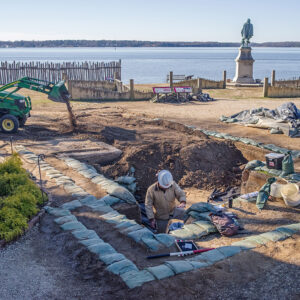
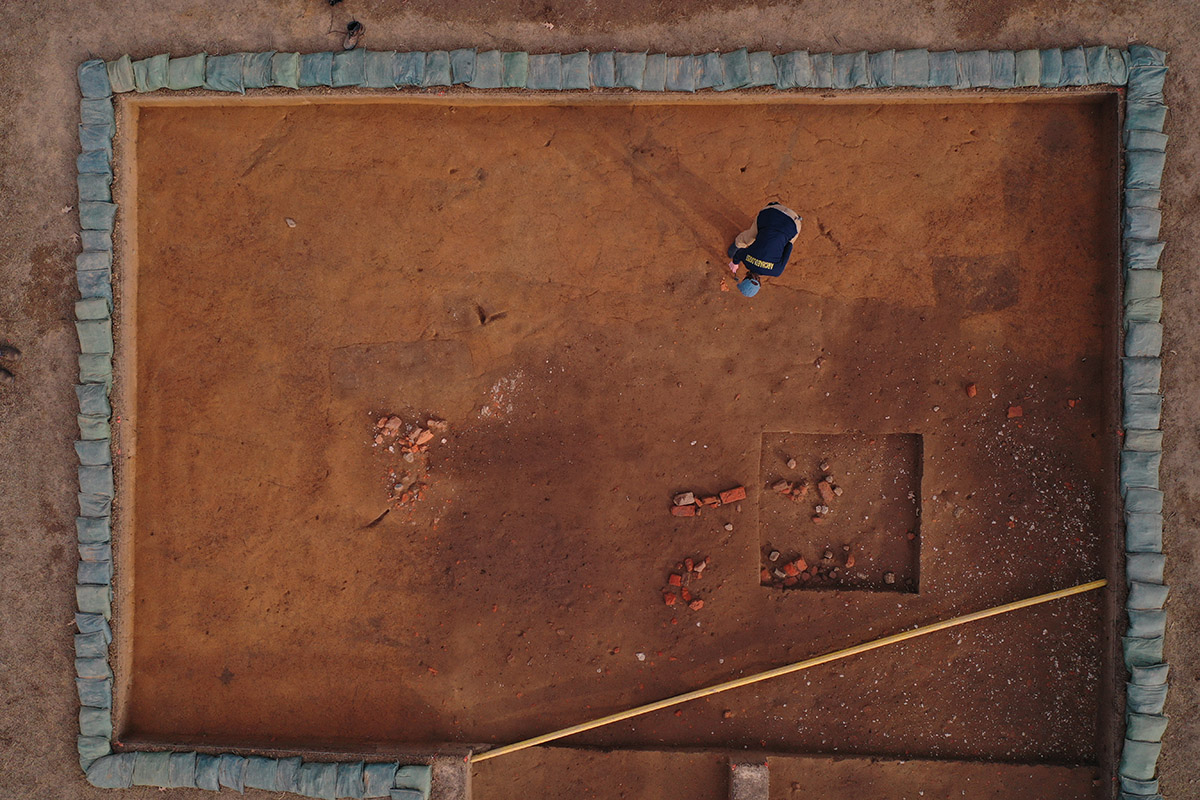
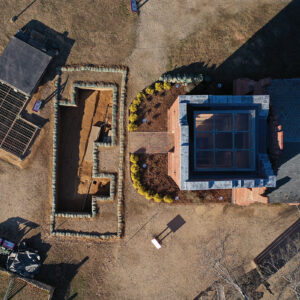
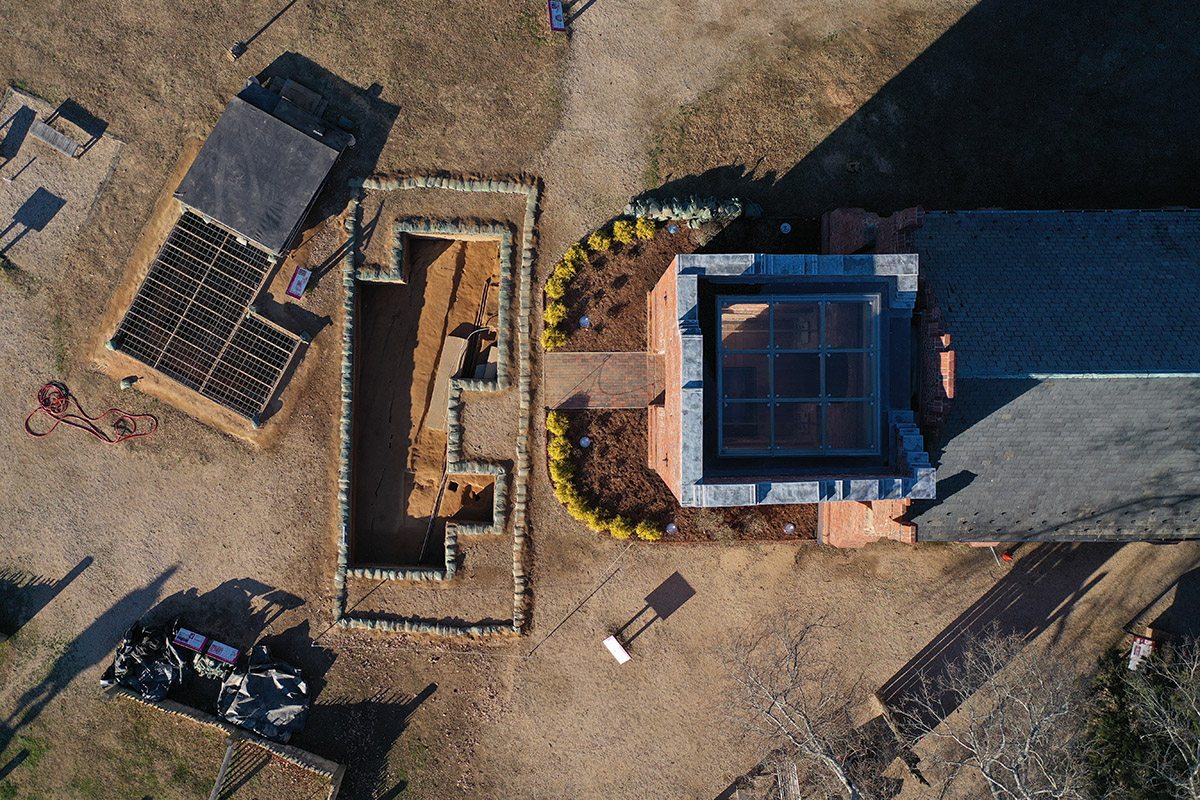
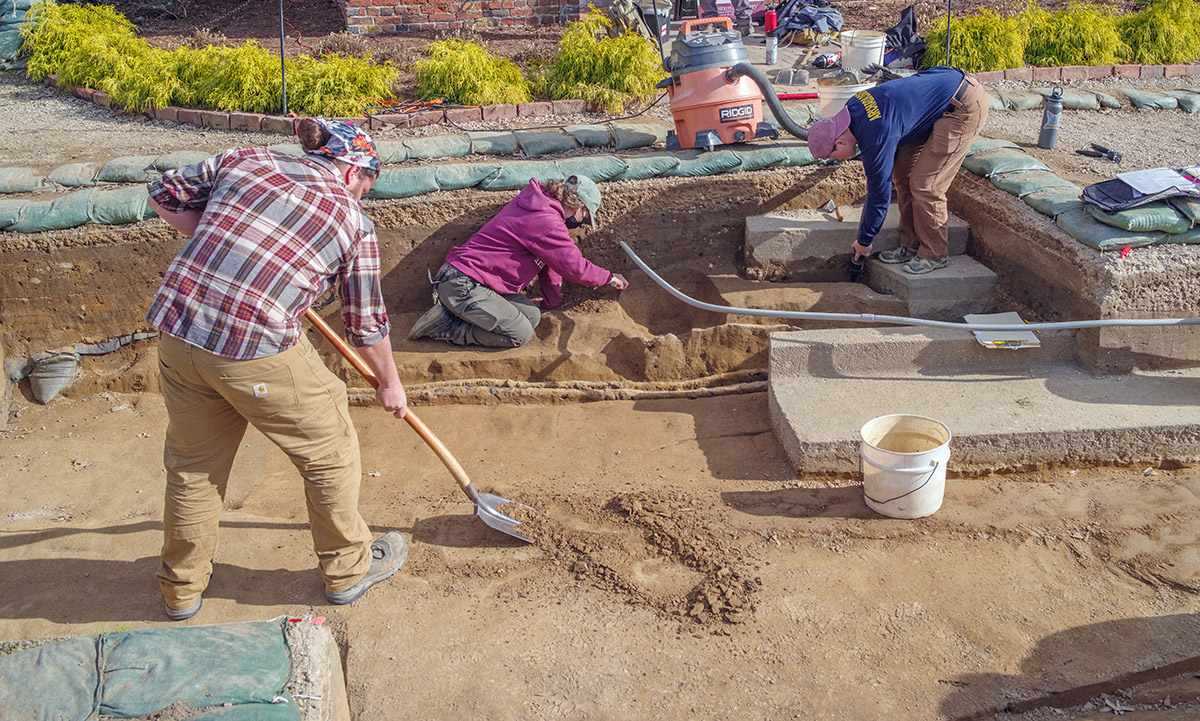
The archaeological team has finished their excavations just outside the entrance to the Church Tower. They found the southwest-most posthole of the Quarter, an early fort-period building just inside the eastern palisade wall. Interestingly the archaeology suggests that when this posthole was dug in the 1600s, dirt was added back to it, probably to make the post level with the rest of the building. It’s believed that the southern end of the Quarter extended to where the Church Tower currently sits. Excavations inside the Church Tower in 2023/24 didn’t reveal any evidence of the Quarter, but it may have been destroyed by the Tower’s builder’s trench. Several other postholes have been found during these excavations, with some likely related to fencing along the road that was here from the late 1800s until the late 20th century. A few of the other postholes discovered during the dig are currently of unknown purpose, including one found under a concrete step built in the early 20th century. As with every other feature found at Jamestown, these are all recorded into mapping software. This allows the archaeologists to get a bird’s-eye view so that patterns are more readily discernible. While features such as postholes might not make sense now, future discoveries may provide the missing pieces to the puzzle. A projectile point was found here this month, of a style predating the arrival of the colonists. Some of the hundreds of projectile points found by the archaeologists date to thousands of years before the arrival of the English. Now that the excavations here are complete, they’ve laid filter fabric and backfilled it, using a front end loader and tampers to compress the soil and prevent future settling as much as possible.
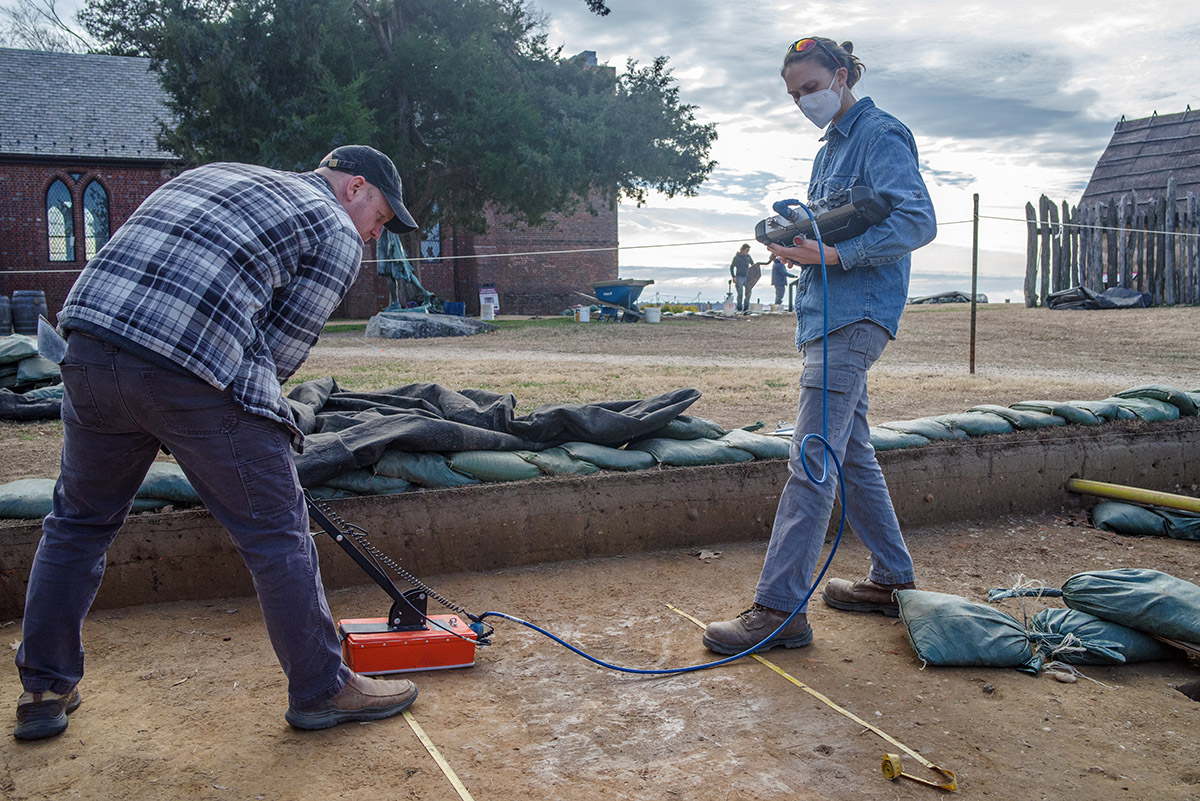
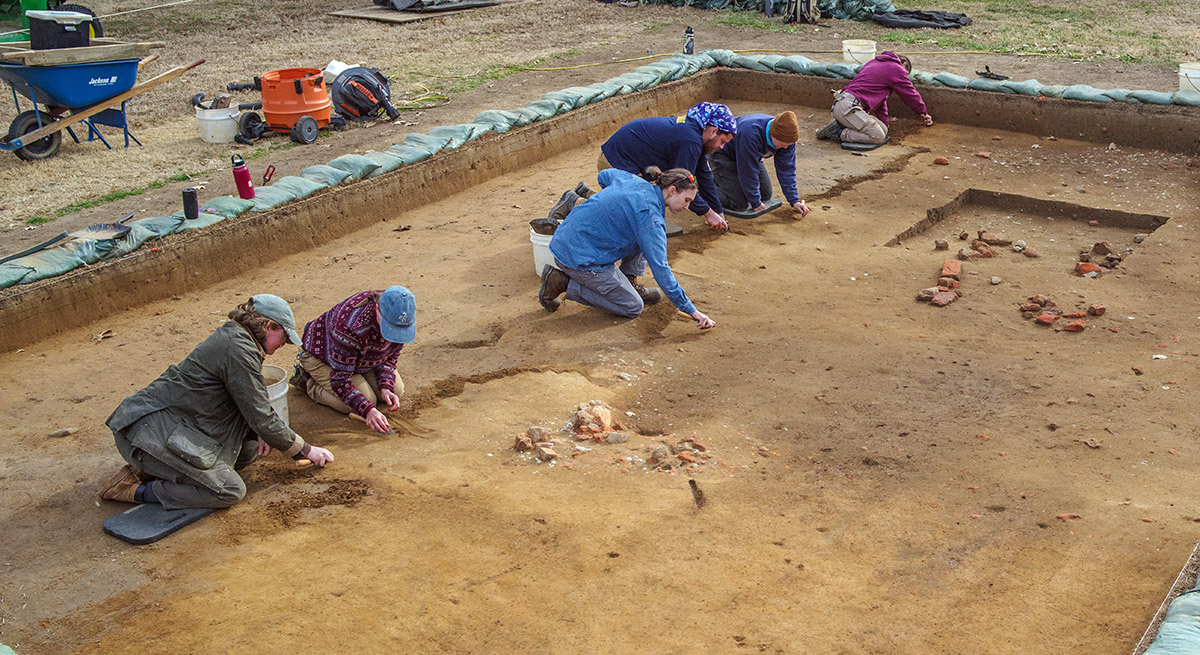
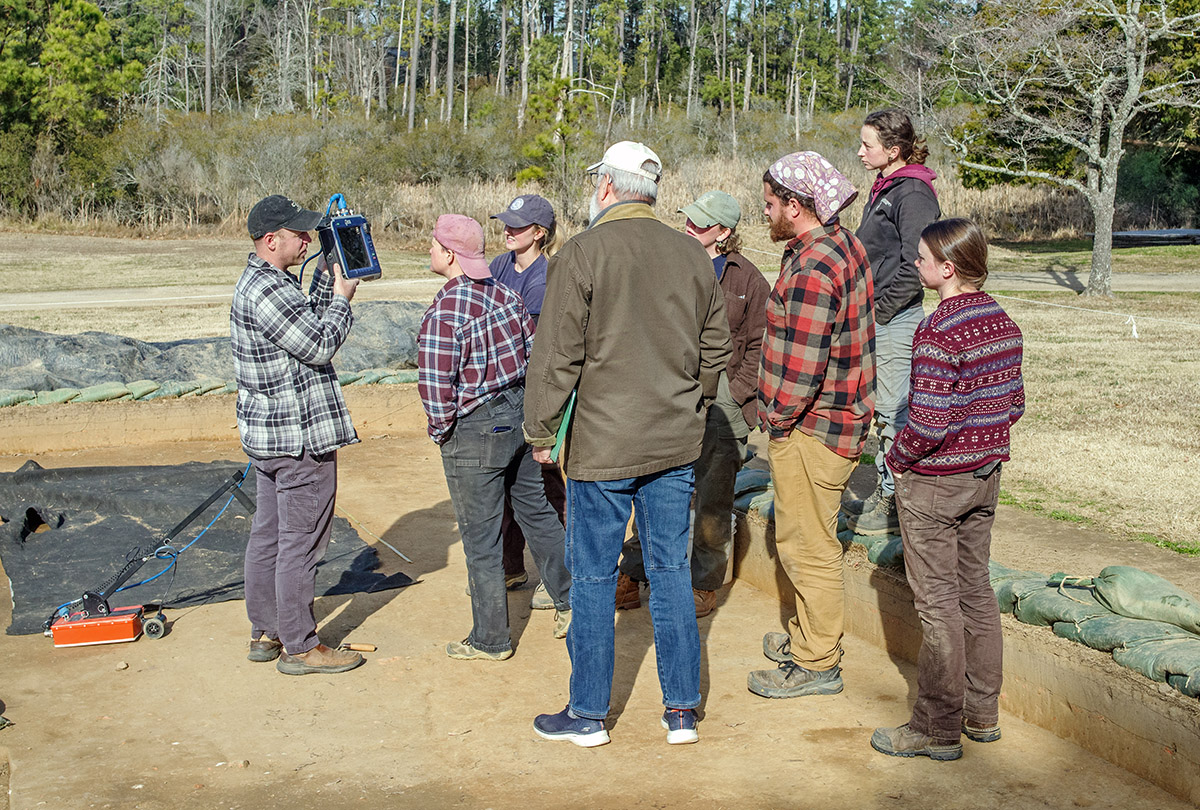
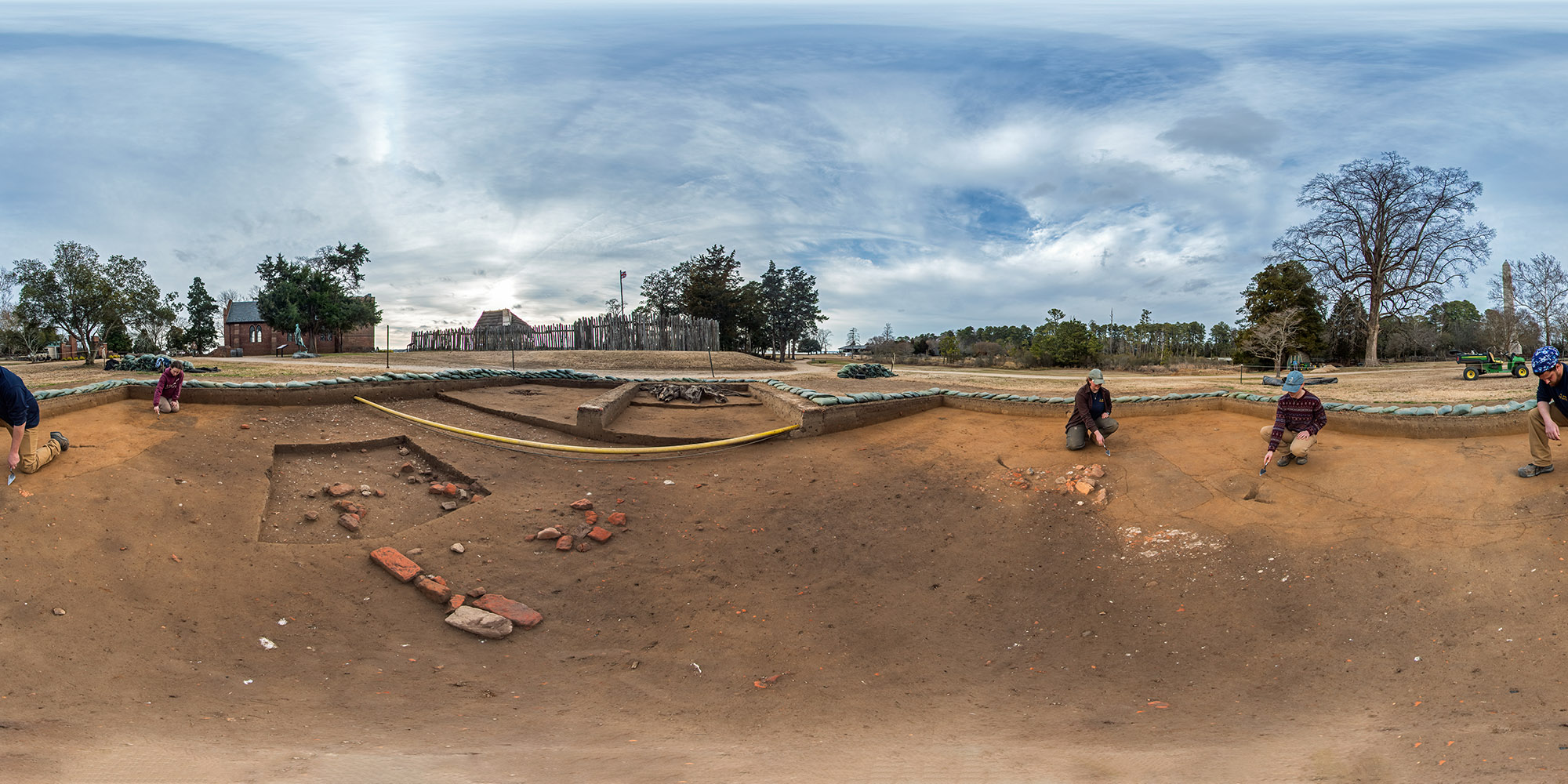
Another archaeological site wrapping up (for the time being) due to the imminent walking path construction is a cellar thought to date to the late 17th century. The cellar is on the property of John Howard, a tailor who patented this land in 1694, though we don’t have archaeological evidence that this structure was his and the dig is too early in its course to date the cellar with precision. The team is looking forward to continuing the dig here, but protecting the site comes first. They are backfilling the excavations to protect them from construction machinery that will soon be using the adjacent road to reach the walking path construction site. After construction is complete, archaeologists will continue these excavations. Before finishing things up for now, the team used ground-penetrating radar (GPR) to survey portions of the site. The scan of a possible burial was inconclusive with more analysis needed. Two scanned postholes appear to be of the same size and shape indicating a possible relationship. These could be part of a structure above the cellar. Finally, the GPR surveys appear to indicate the presence of brick walls in the cellar, a finding that would lend credence to the theory that the structure was built later in the 17th century. This possible discovery is intriguing and they’re going to run additional GPR surveys to look for more evidence once the backfilling of the site is complete.
Under a time crunch because of the upcoming path construction, the archaeologists are looking for ways to speed up the process. Impressed with the screens their peers at the William & Mary Center for Archaeological Research (WMCAR) use, the team consulted with them to build shaker screens for finding artifacts in excavated soil. Currently Jamestown Rediscovery archaeologists and volunteers use stationary screens which require using their hands to rub the soil through the screen’s holes. The team is eager to use shaker screens instead, whereby the archaeologist or volunteer would grab wooden handles and shake the whole device back and forth, with the resultant action causing most of the soil to fall though.
In the Vault, Collections Assistant Lindsay Bliss is sorting through the light fraction of floated soil excavated from Pit 5. Pit 5 is a fort-period feature located just north of the Factory. It may have been a building’s cellar though later churchyard burials have destroyed evidence of any possible structure above. Dozens of early artifacts were excavated from the pit, including beads, coins, drug jars, and gun parts. Lindsay is continuing her months-long search through the tiniest objects from floated soil whereby water is used to separate objects by density. Seeds and botanicals tend to float to the surface and thus end up in the light fraction. An exciting discovery she made this month was the presence of several burned cereal grains. The fact that they were burned enabled them to survive 400 years underground. Cereals like wheat, barley, oat, and rye are not native to North America and so Lindsay’s work has revealed some of the earliest artifactual evidence of transplanted European crops in English North America.
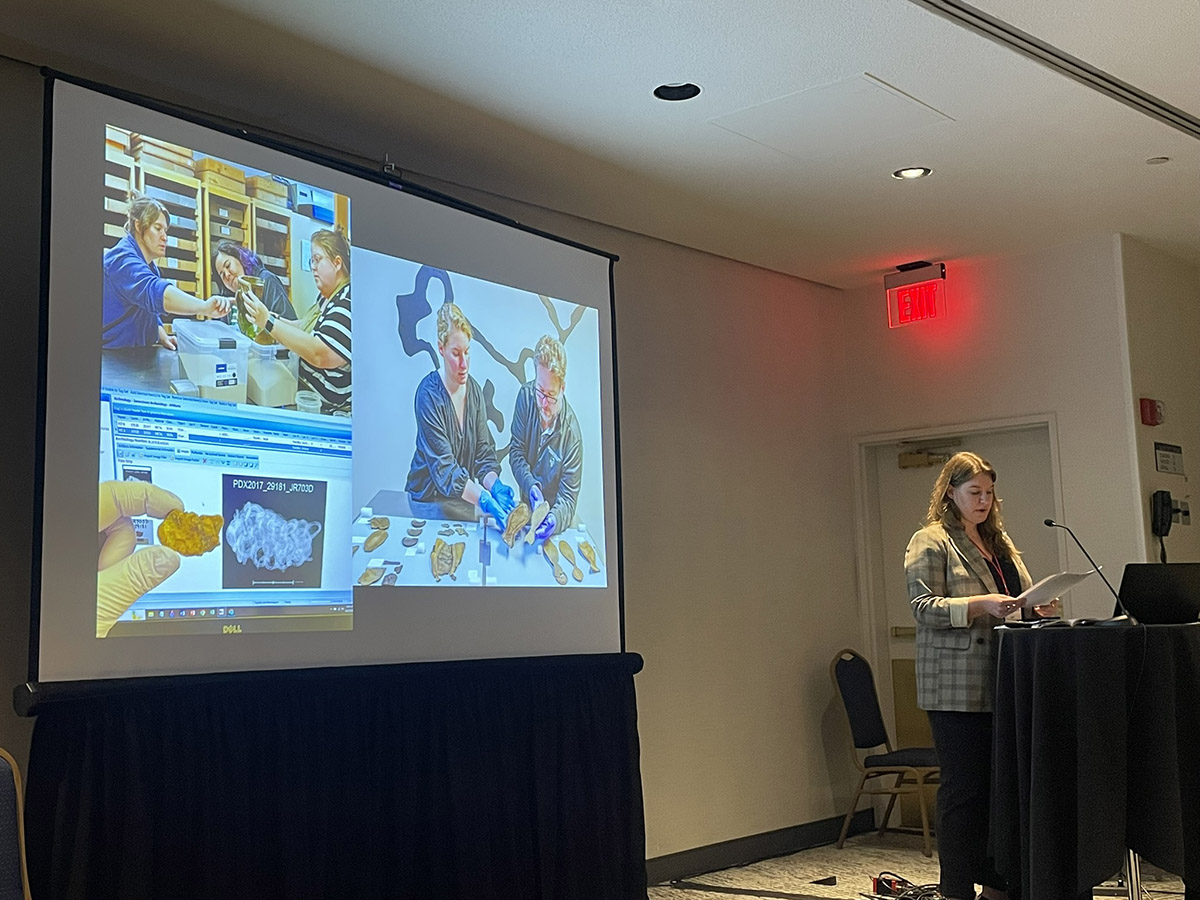
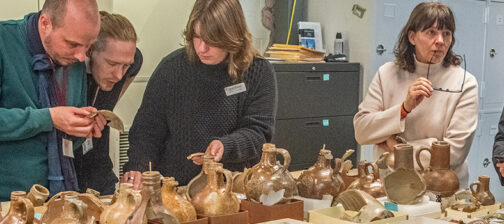
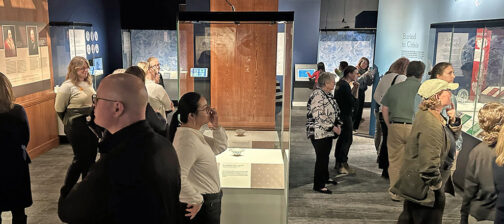
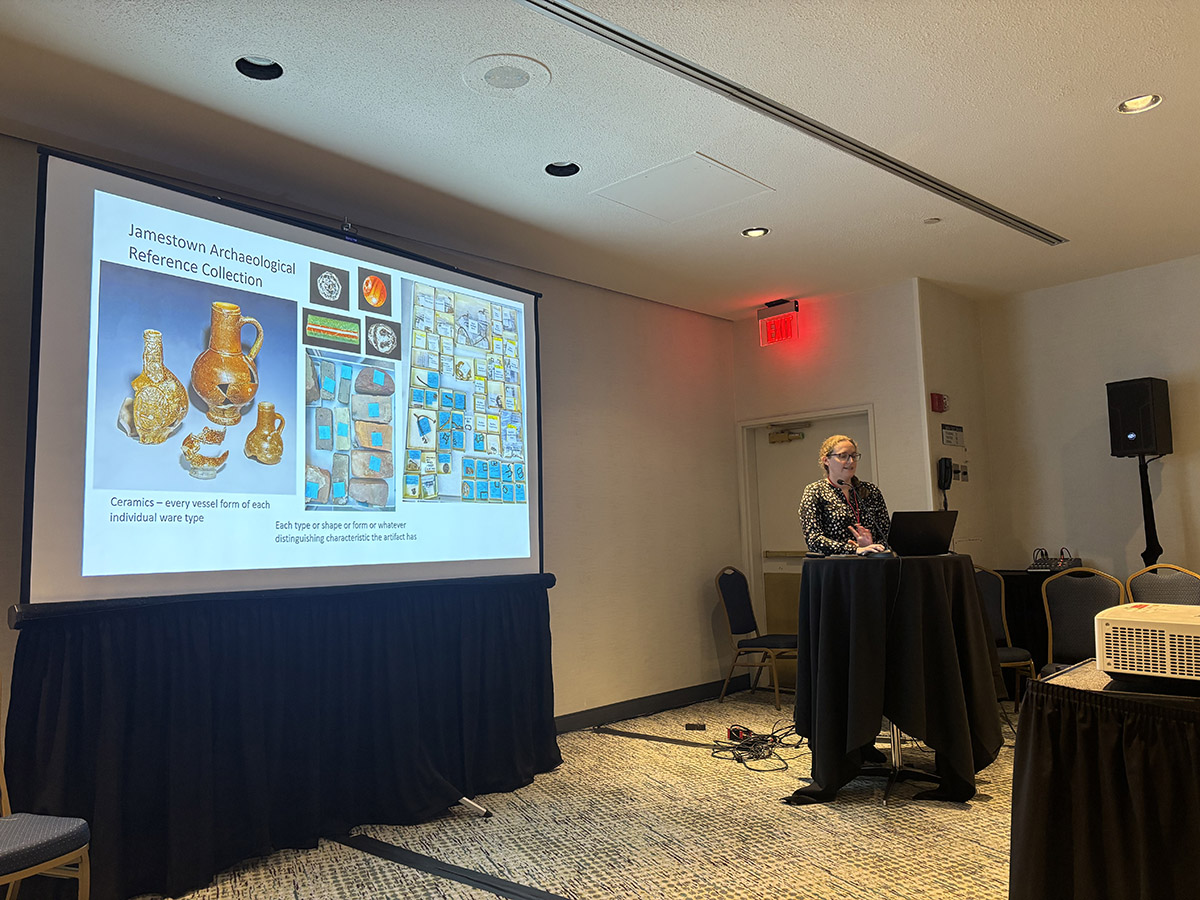
Jamestown Rediscovery curators just returned from Detroit and the Society for Historical Archaeology conference. Senior Curator Leah Stricker and Associate Curator Janene Johnston presented as part of a session on Managing Collections. For the past several years, our curators have been working to build a comprehensive reference collection, distilling our 5 million artifacts (and counting!) into helpful resources for researchers and future curators. This is a huge task, but is vital to understand the breadth and depth of Jamestown history. Leah and Janene were joined for the session by researchers and curators from Historic St. Mary’s City, the Boise Chinatown Collection, and Shaker Village of Pleasant Hill.
related images
-
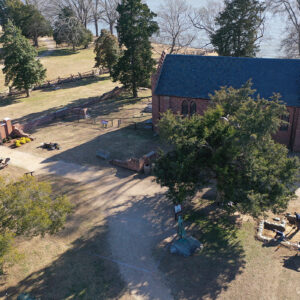
- A drone overview of the excavations at “Pocahontas Plaza”. The white spraypainted rectangle highlights future excavations.
-
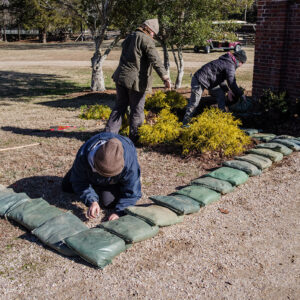
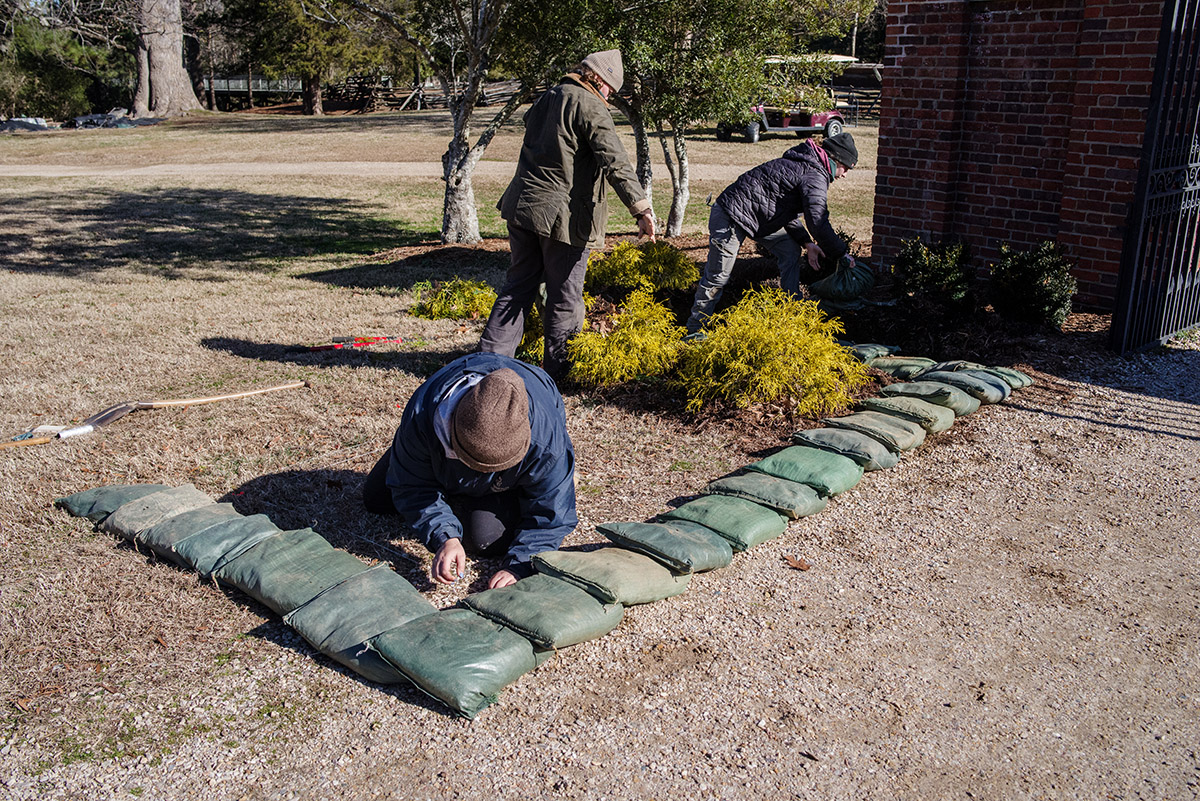
- Staff Archaeologist Caitlin Delmas, Archaeological Field Technician Eleanor Robb, and Staff Archaeologist Ren Willis prepare the area near the Colonial Dames of America gate for excavations.
-
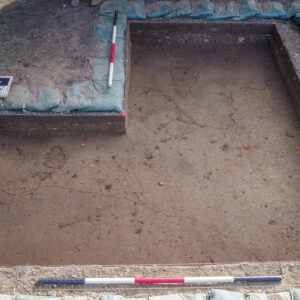
- A record shot of the westmost “Pocahontas Plaza” excavations while still in modern layers
-
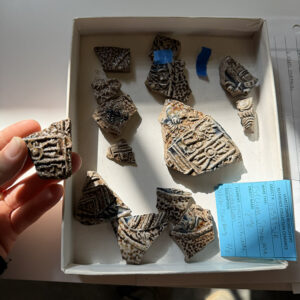
- Sherds of a Bartmann Jug found by Archaeological Field Technician Eleanor Robb in the westmost excavation area of “Pocahontas Plaza”. The partial medallion on the largest piece is the coat of arms of the United Duchies of Jülich-Cleves-Berg, located in present-day Germany and the Netherlands.
-
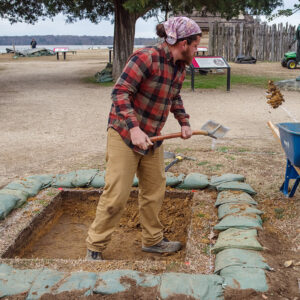
- Archaeological Field Technician Josh Barber at work in “Pocahontas Plaza”.
-
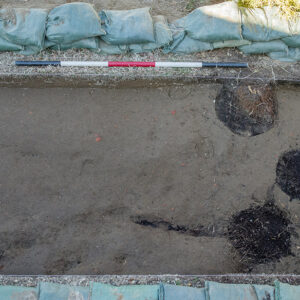
- A record shot of the excavations close to the Colonial Dames of America gate. The dark circles mark where landscaping plants were prior to being removed.
-
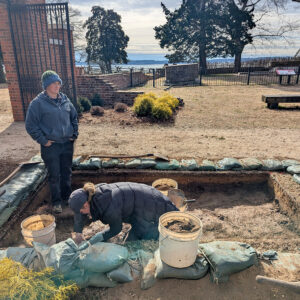
- Staff Archaeologist Caitlin Delmas and Archaeological Field Technician Katie Griffith at work in the excavations near the Colonial Dames of America gate.
-
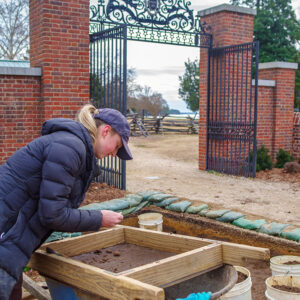
- Archaeological Field Technician Katie Griffith screens for artifacts near the Colonial Dames of America gate.
-
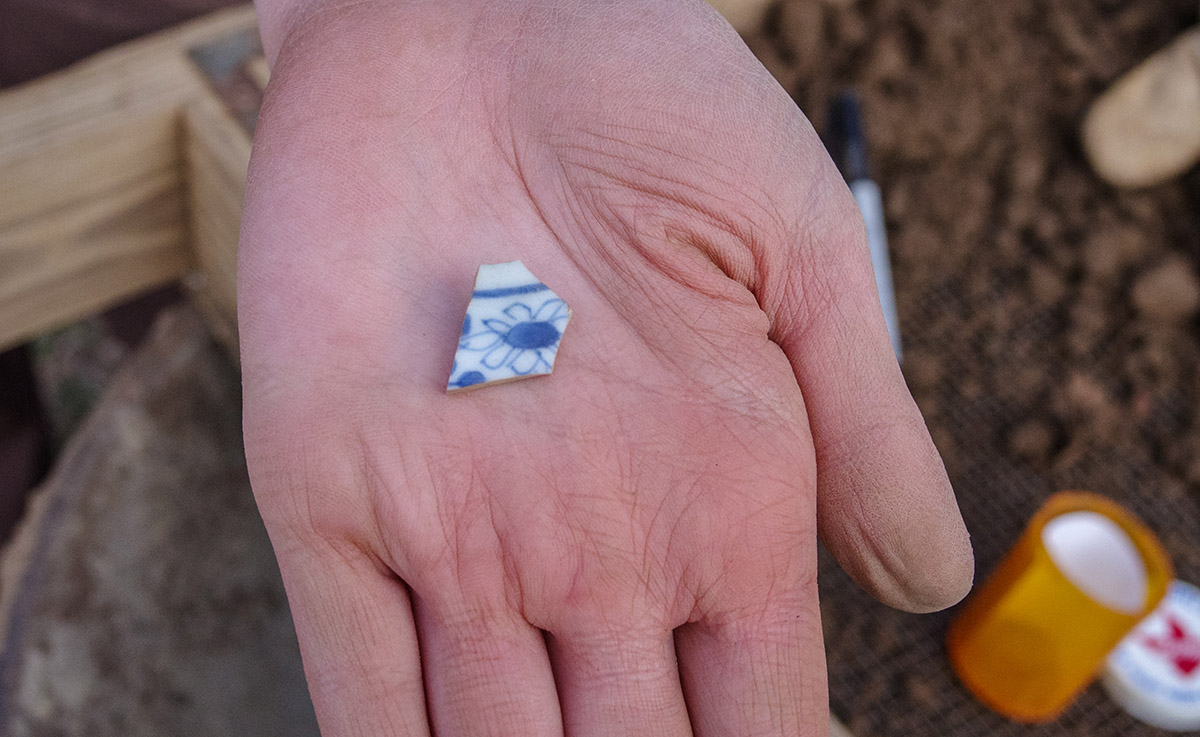
- A sherd of porcelain found in the “Pocahontas Plaza” excavations
-
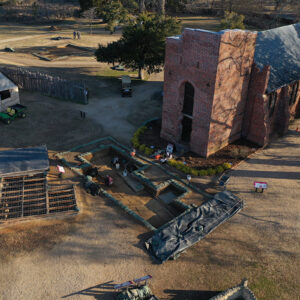
- A drone shot of the excavations west of the Church Tower. The cellar excavations can be seen at rear.
-
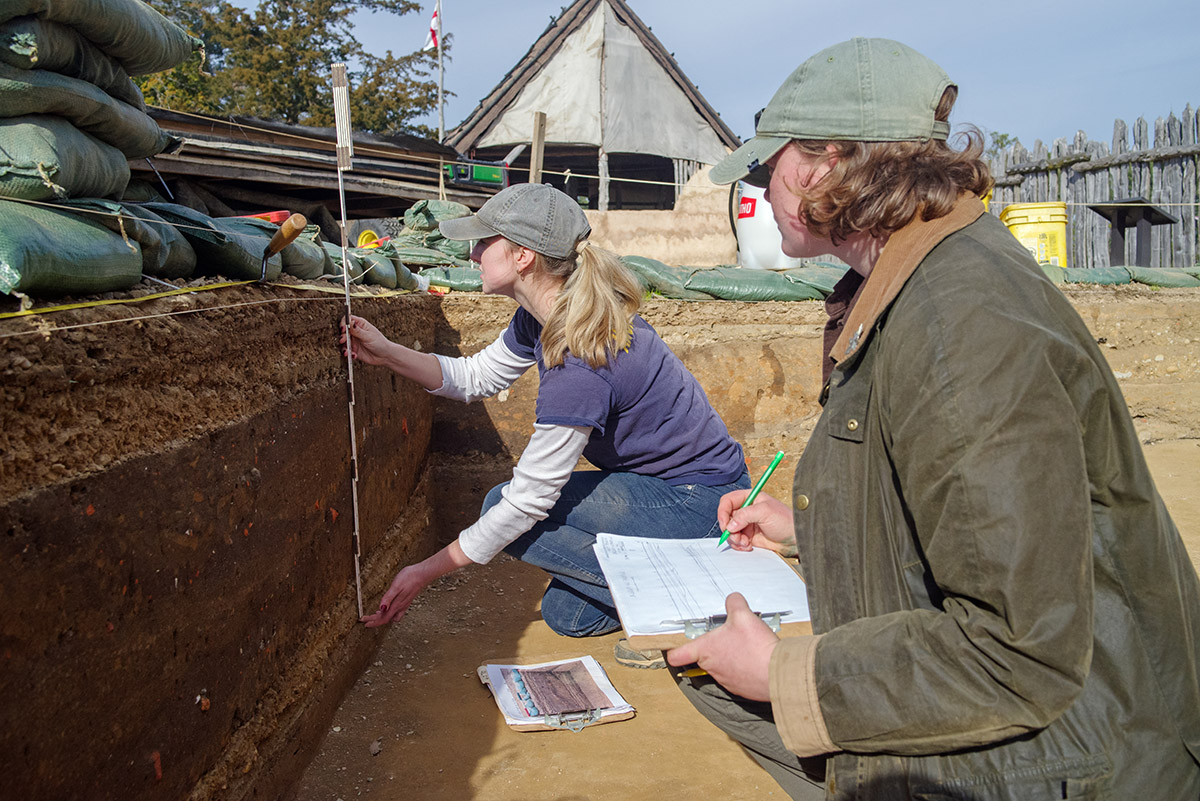
- Archaeological Field Technicians Katie Griffith and Eleanor Robb take measurements of the different soil layers to properly illustrate the excavations west of the Church Tower.
-
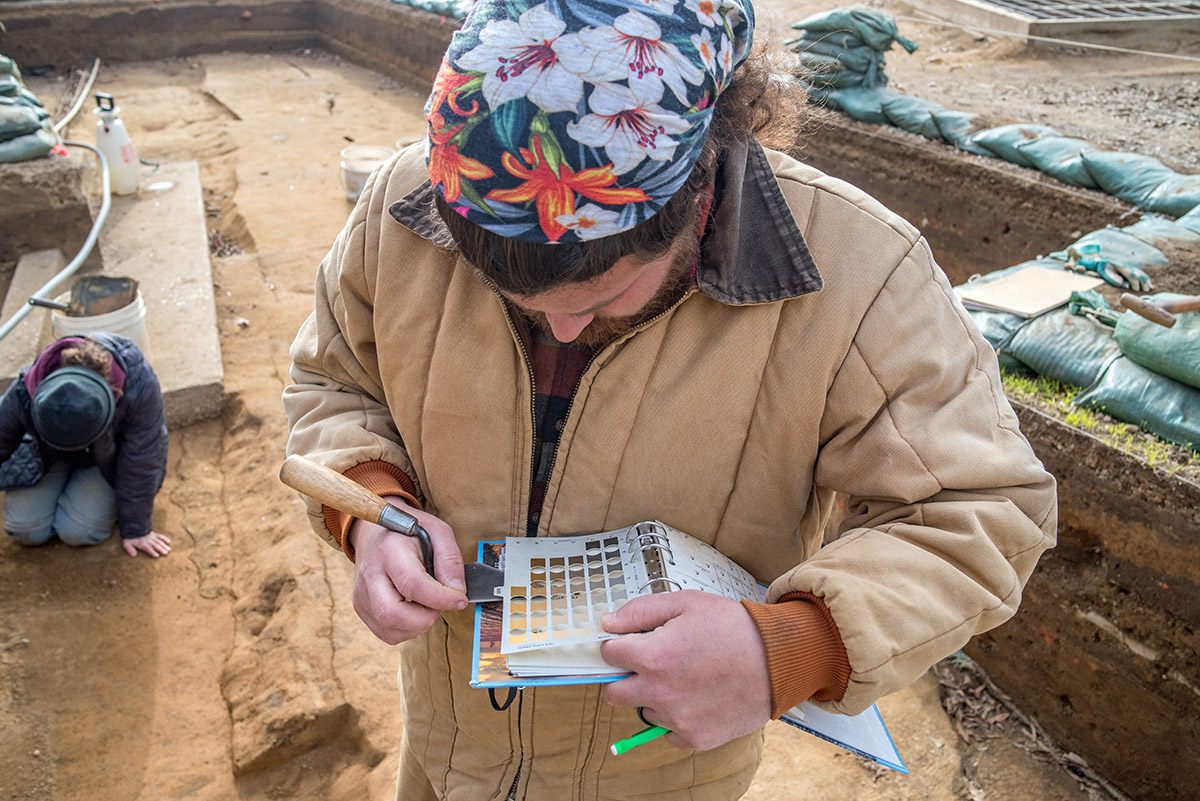
- Archaeological Field Technician Josh Barber uses a Munsell Soil Color Chart to classify the color of soil he excavated from the excavations west of the Church Tower.
-
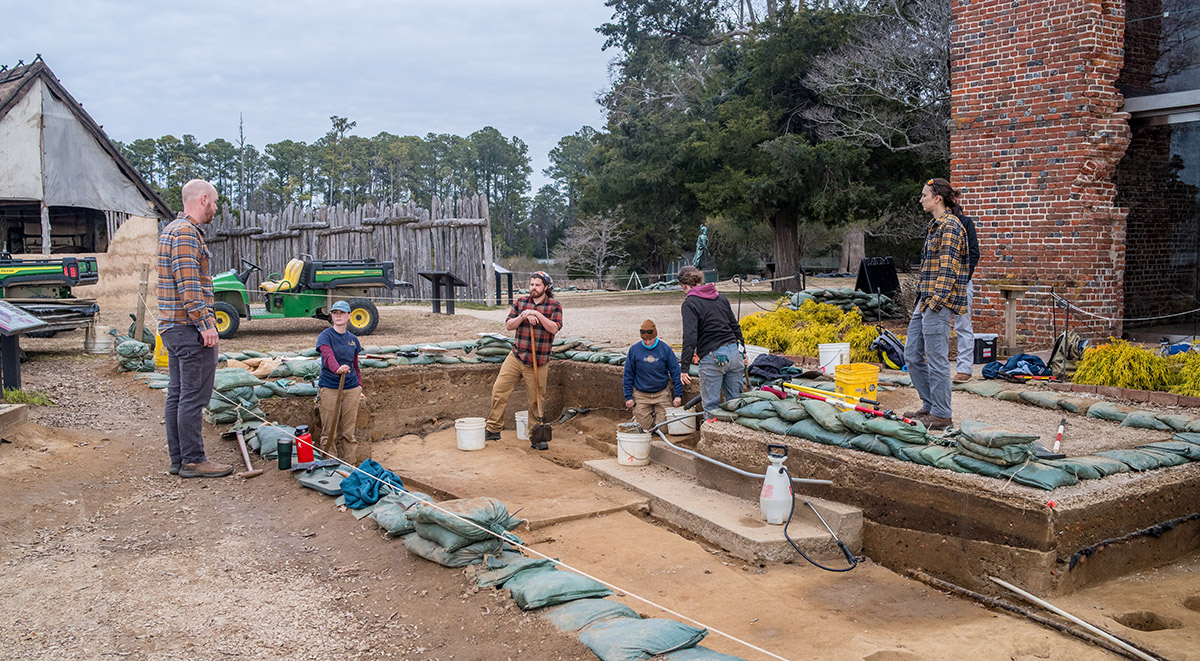
- The archaeological team discusses the excavations west of the Church Tower.
-
- A drone record shot of the excavations west of the Church Tower
-
- A projectile point found in the excavations west of the Church Tower
-
- Archaeological Field Technician Josh Barber finishes up the excavations west of the Church Tower as Staff Archaeologist Ren Willis uses a front end loader to backfill a completed section.
-
- A drone overview of the cellar excavations
-
- A drone shot of the excavations west of the Church Tower
-
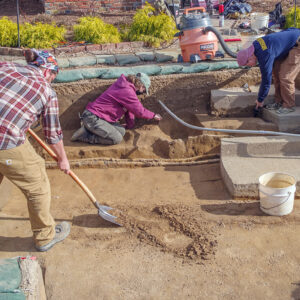
- Archaeological Field Technician Josh Barber and Staff Archaeologists Ren Willis and Caitlin Delmas at work in the excavations west of the Church Tower.
-
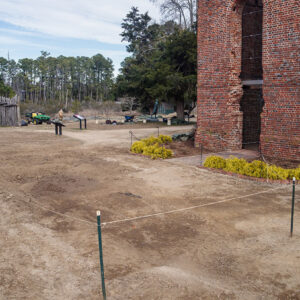
- The backfilled excavations west of the Church Tower
-
- The archaeological team at the cellar excavations
-
- Director of Archaeology Sean Romo discusses GPR data from the cellar excavations with staff.
-
- A panoramic shot of the cellar excavations
-
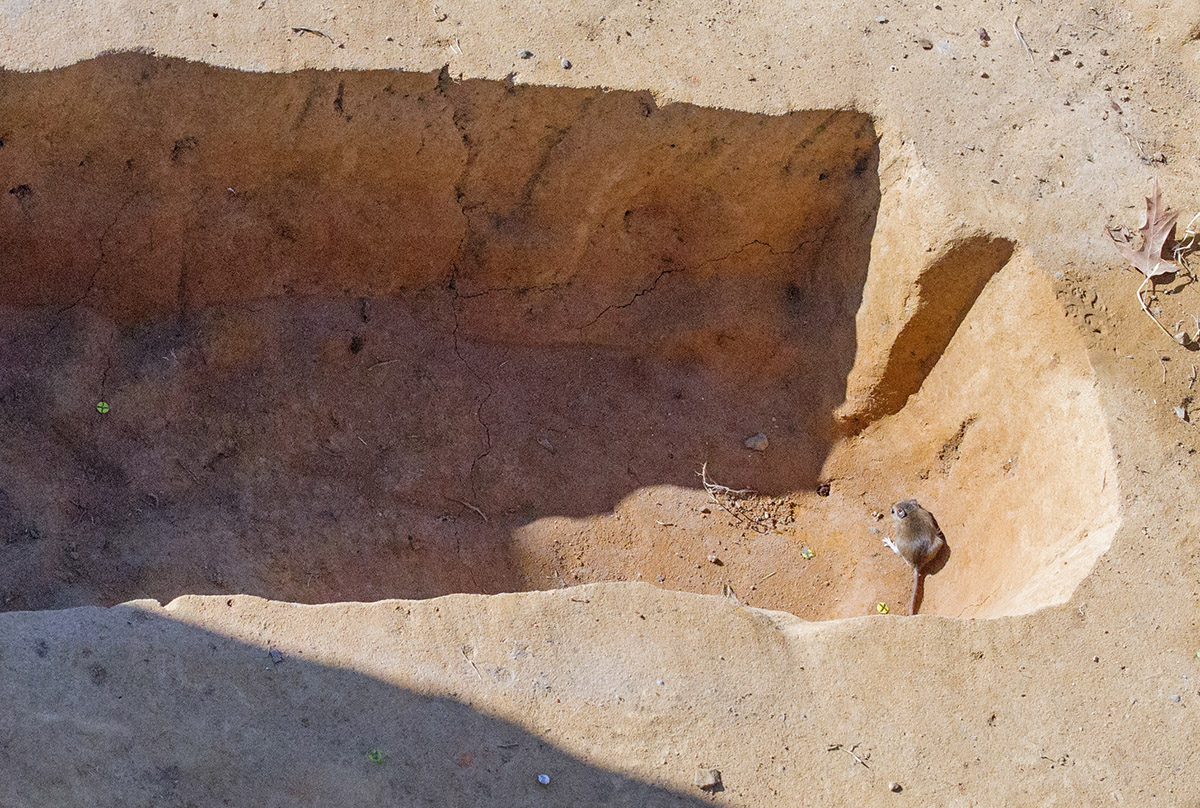
- A mouse trapped in a burial in the 1607 Burial Ground
-
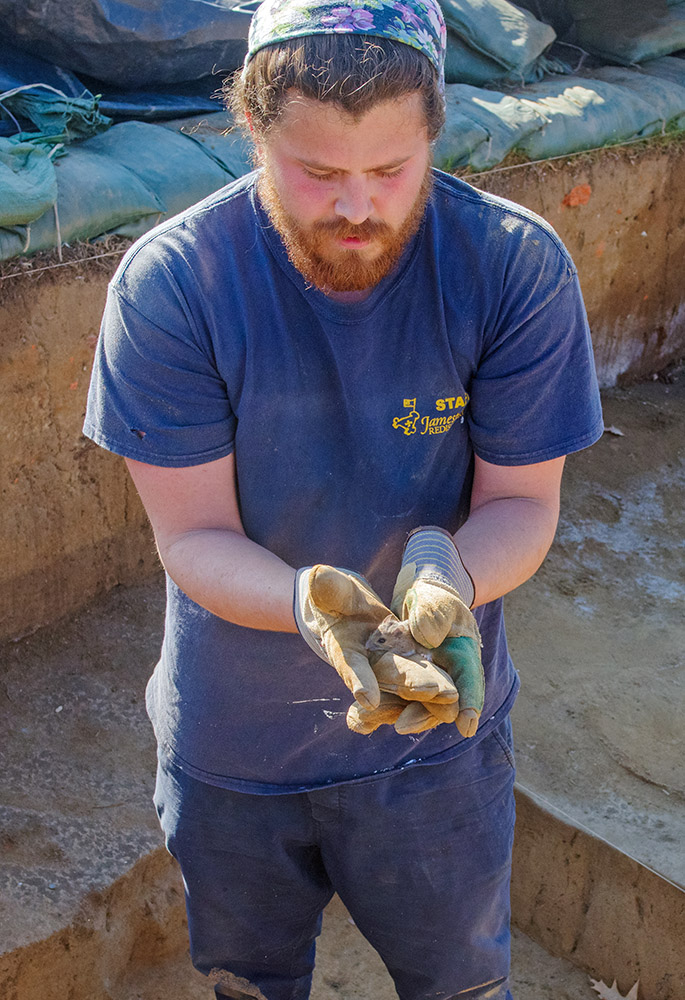
- Archaeological Field Technician Josh Barber rescues a mouse stuck in a burial in the 1607 Burial Ground.
-
- Associate Curator Janene Johnston gives an overview of the collection during her presentation on bandoliers at the Society for Historical Archaeology conference in Detroit.
-
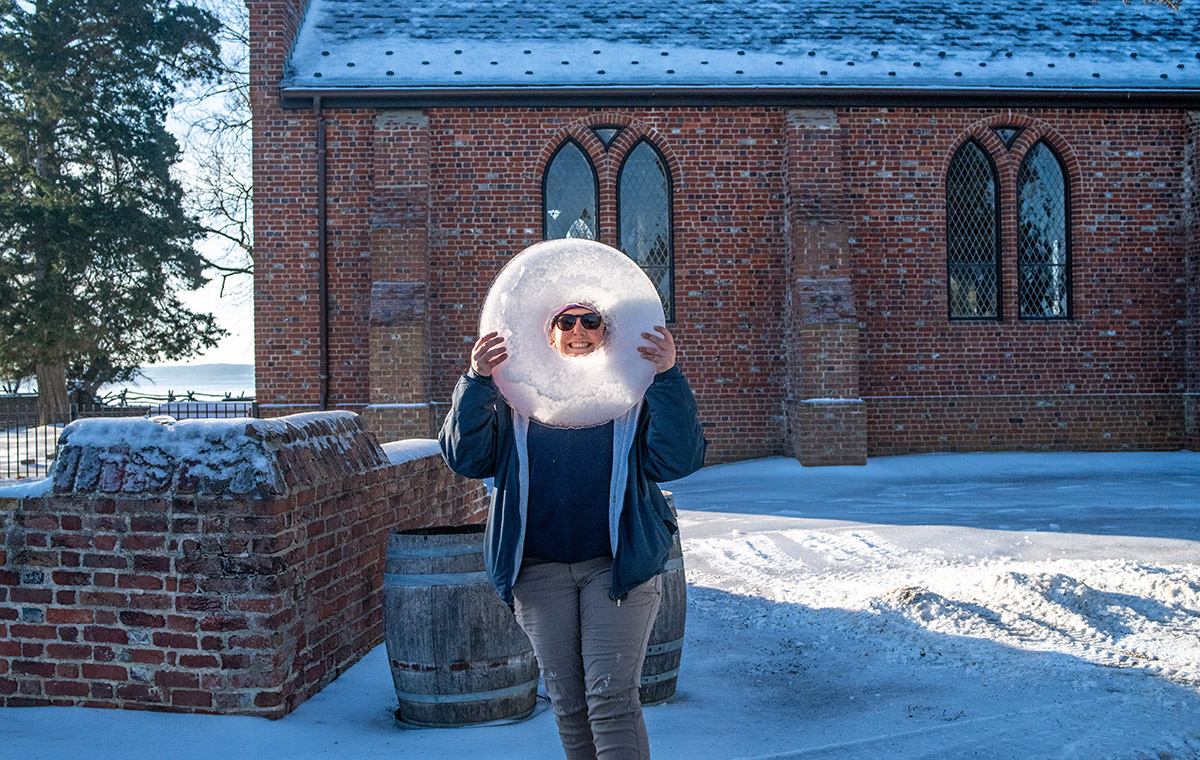
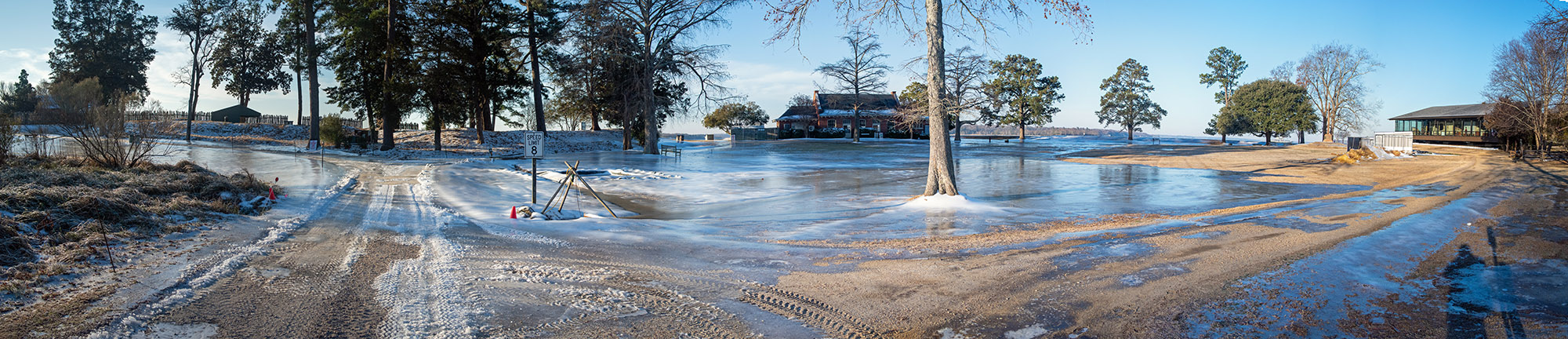
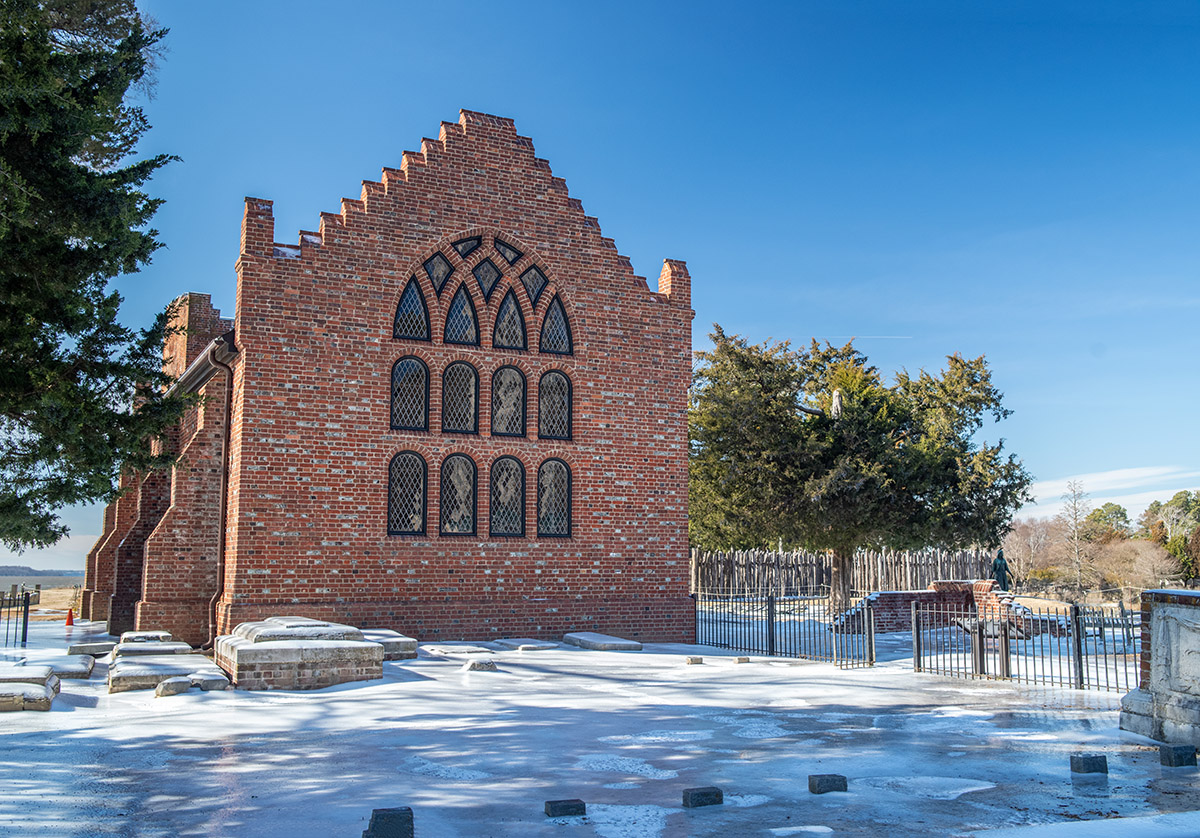
- The Memorial Church’s graveyard covered in ice from a January storm
-
- A winter storm has turned much of Jamestown into an ice rink.
-
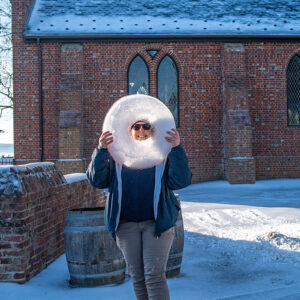
- Archaeological Field Technician Hannah Barch found a frosted doughnut in a trashcan near the Memorial Church.