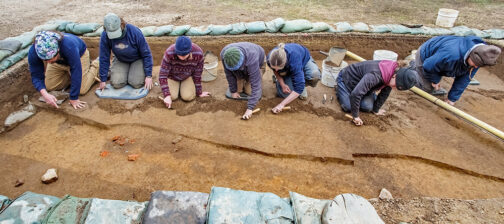
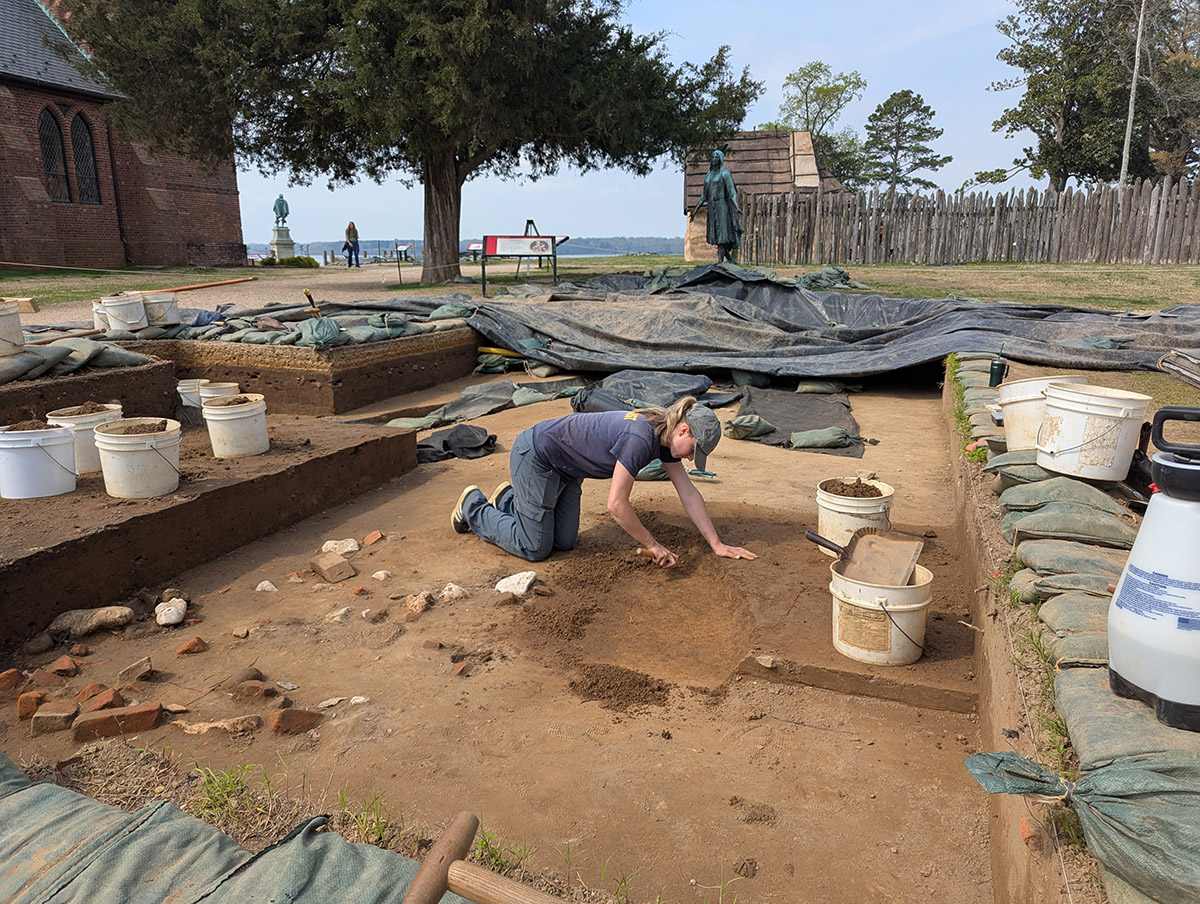
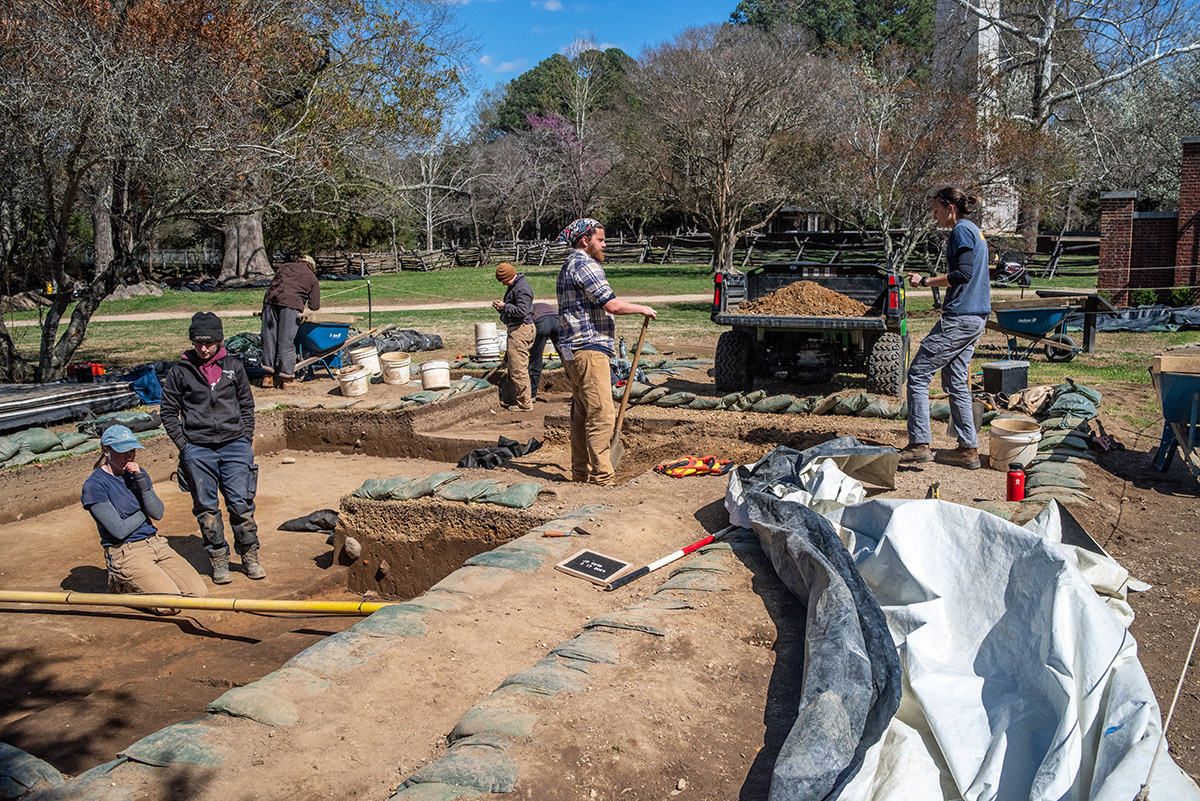
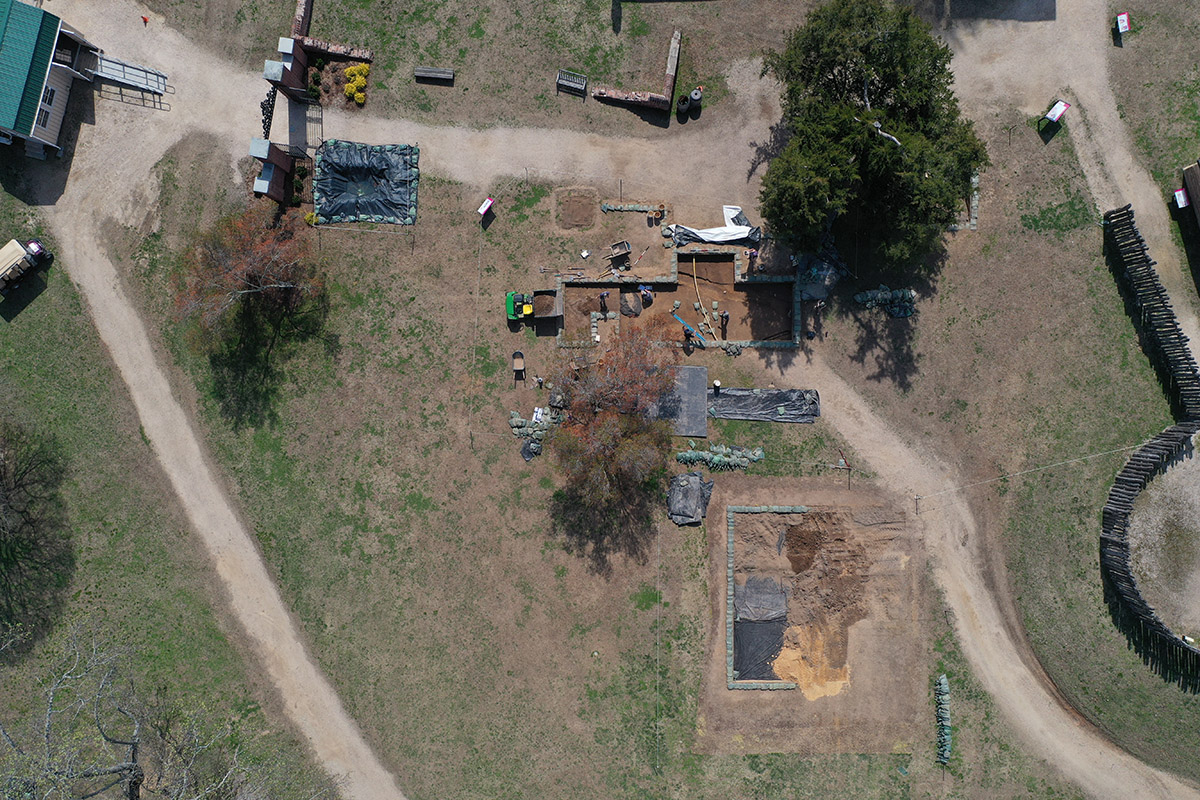
There have been some exciting developments this month at the dig north of the Memorial Church (the site called “North Church” by the archaeologists). A well was found, and possibly another, though the latter is only partially exposed and its identification remains uncertain. The archaeologists are working to meet deadlines, excavating areas that will be affected by the construction of a pathway connecting the fort area to the Archaearium museum. Before the construction crew can lay down the path’s foundation and the rock aggregate surface, archaeologists are digging and identifying features in previously-unexcavated areas in the proposed route.
Wells at Jamestown are typically archaeological treasure chests, full of thousands (or hundreds of thousands) of artifacts because the colonists used the deep holes as trash pits once the water became unpalatable. You can learn about the excavations of past wells, such as the fort’s first (the John Smith Well), second, the Smithfield Well, or the Governor’s Well and the artifacts found therein by visiting those features’ webpages. And as much as the archaeologists are chomping at the bit to excavate the newly-found well (and the possible second one), time does not permit it. To keep the pathway project on schedule, archaeologists are recording the location of these features, covering them with filter fabric, backfilling them, and moving on to the next squares in the course of the pathway. These significant features will be excavated at a later date.
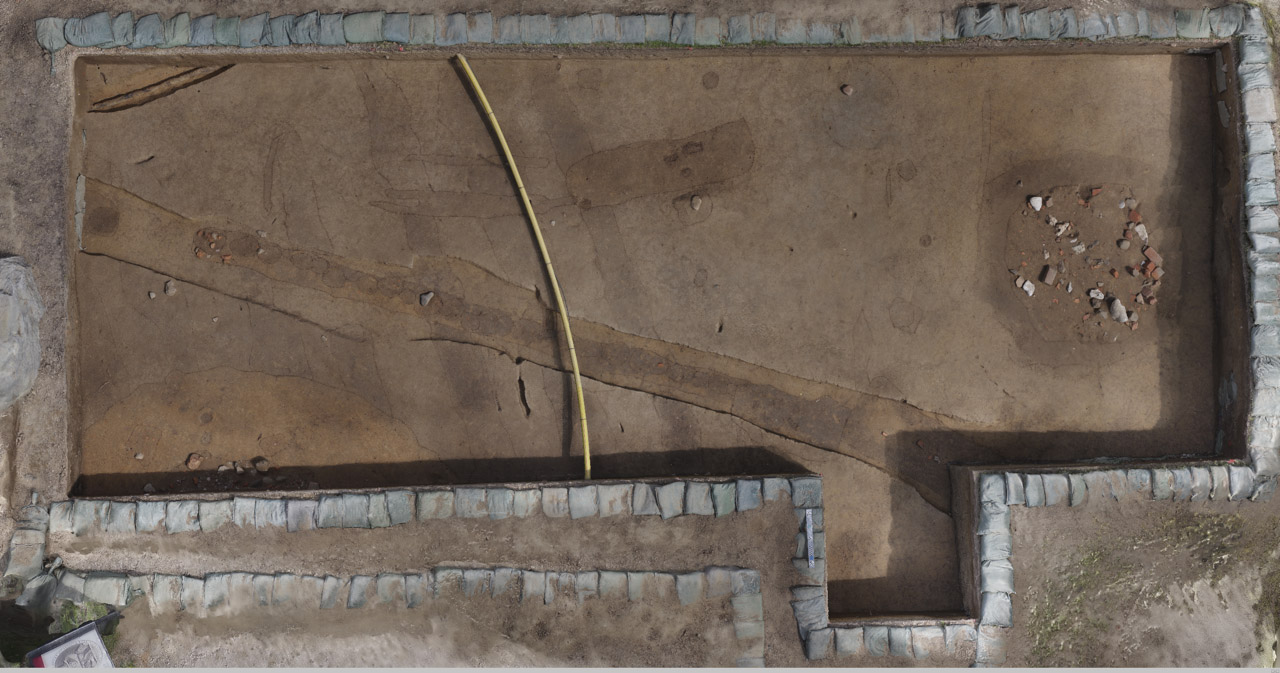
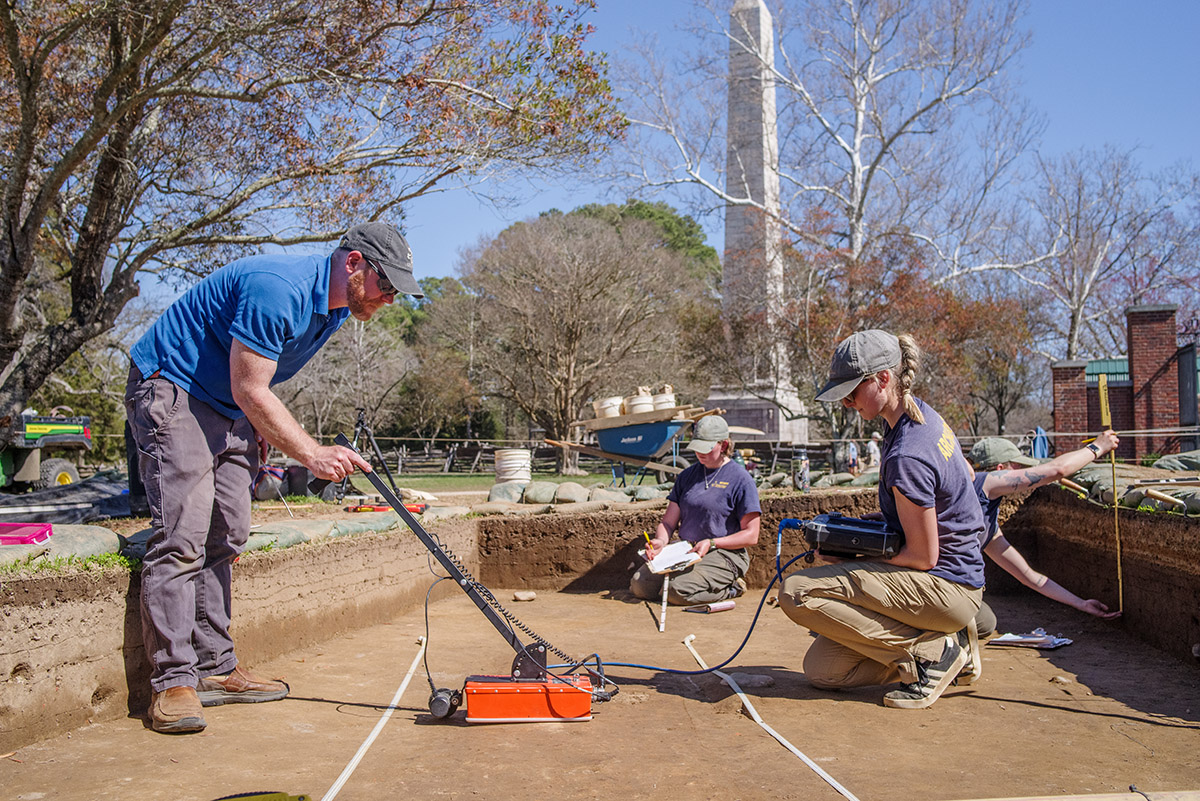
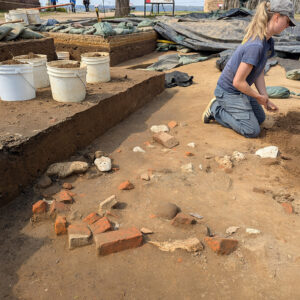
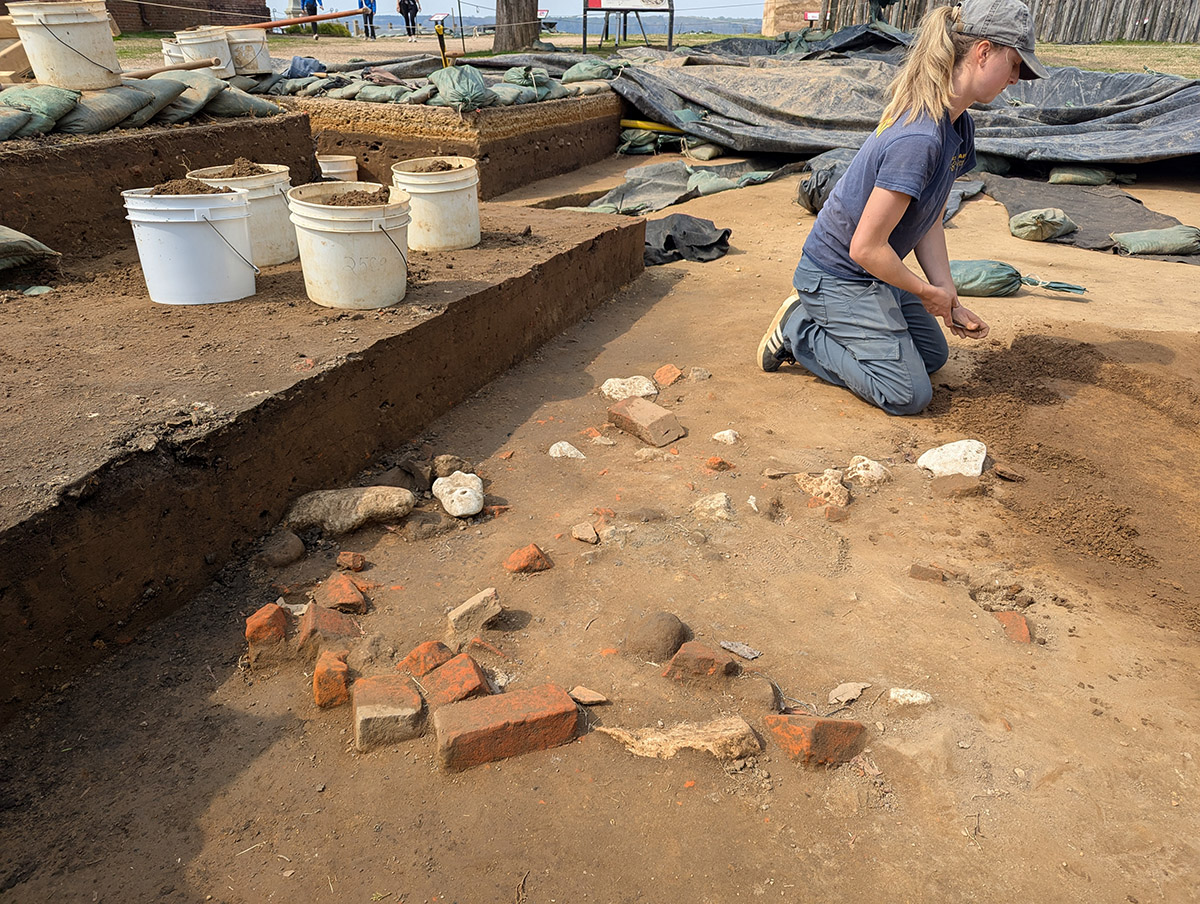
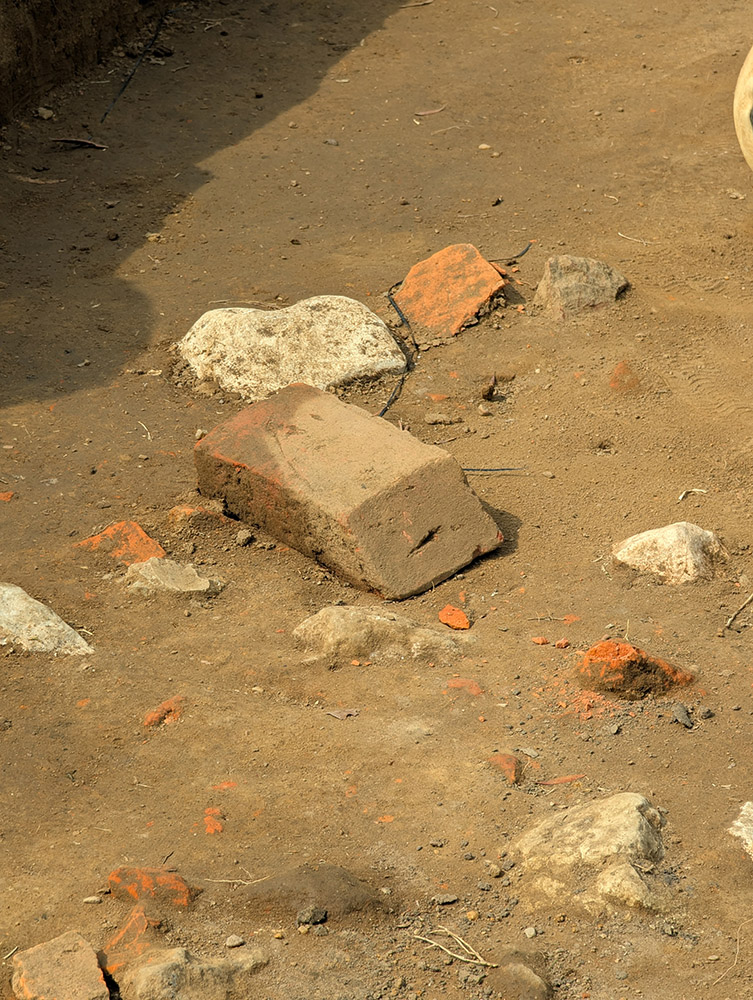
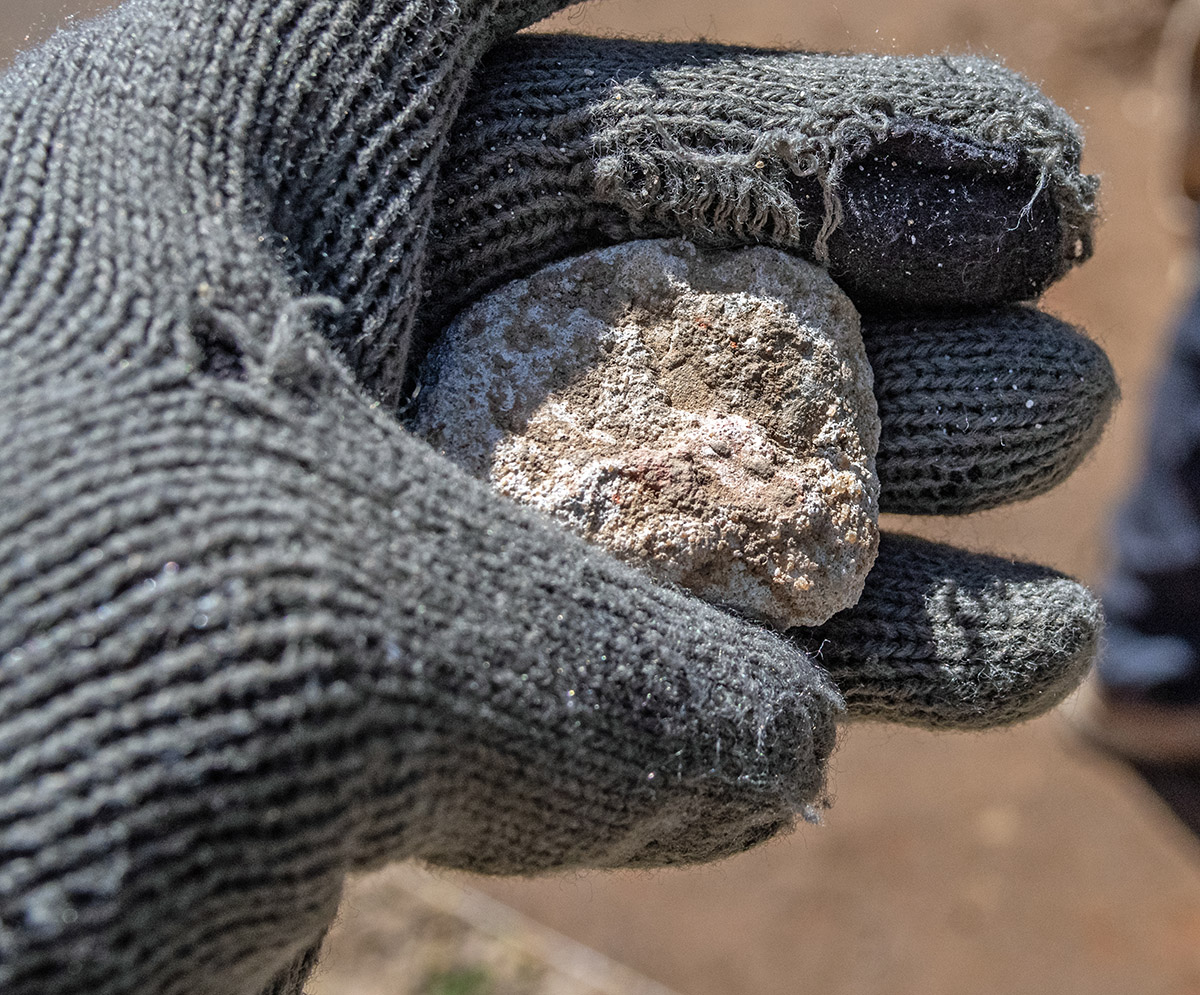
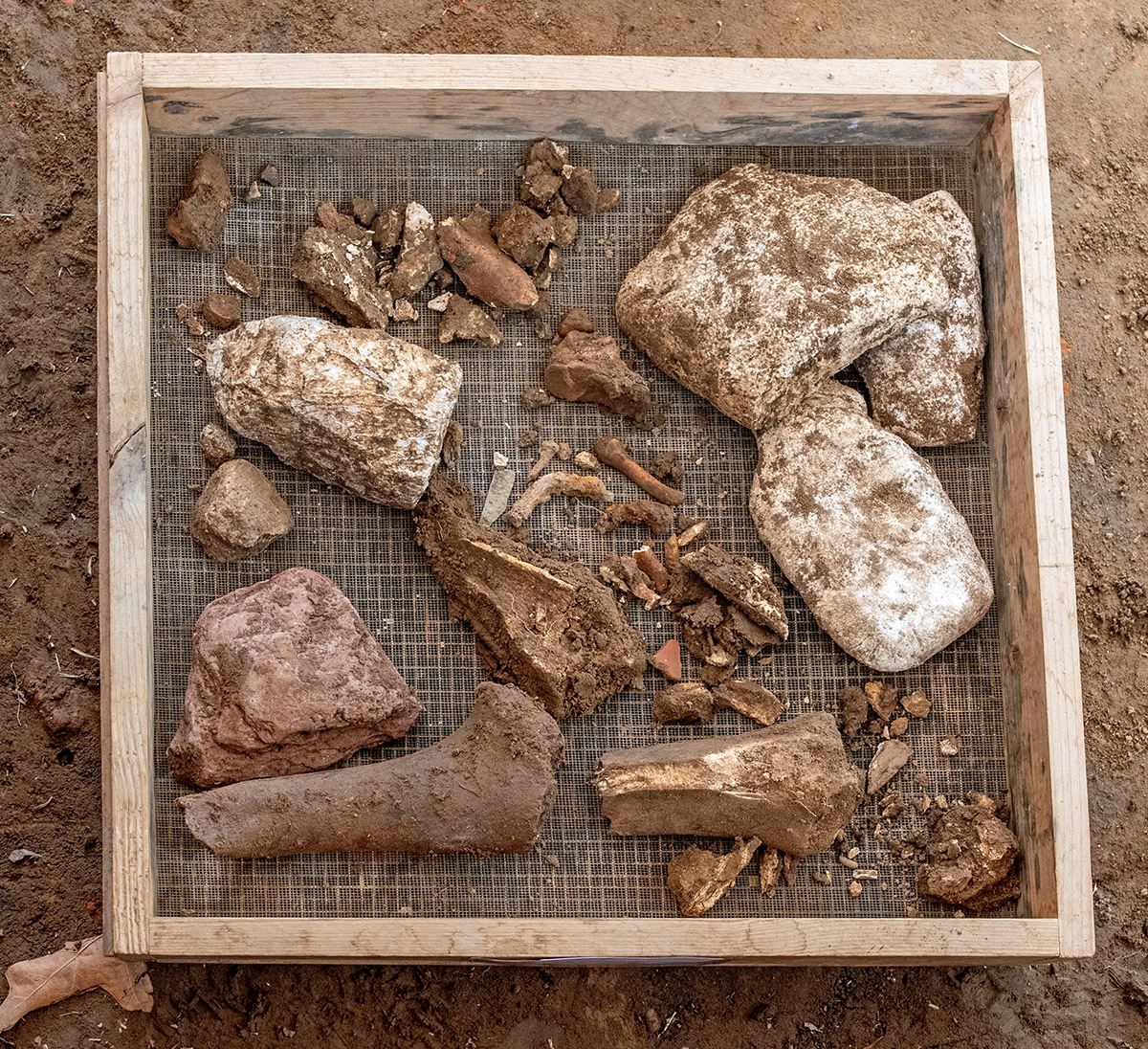
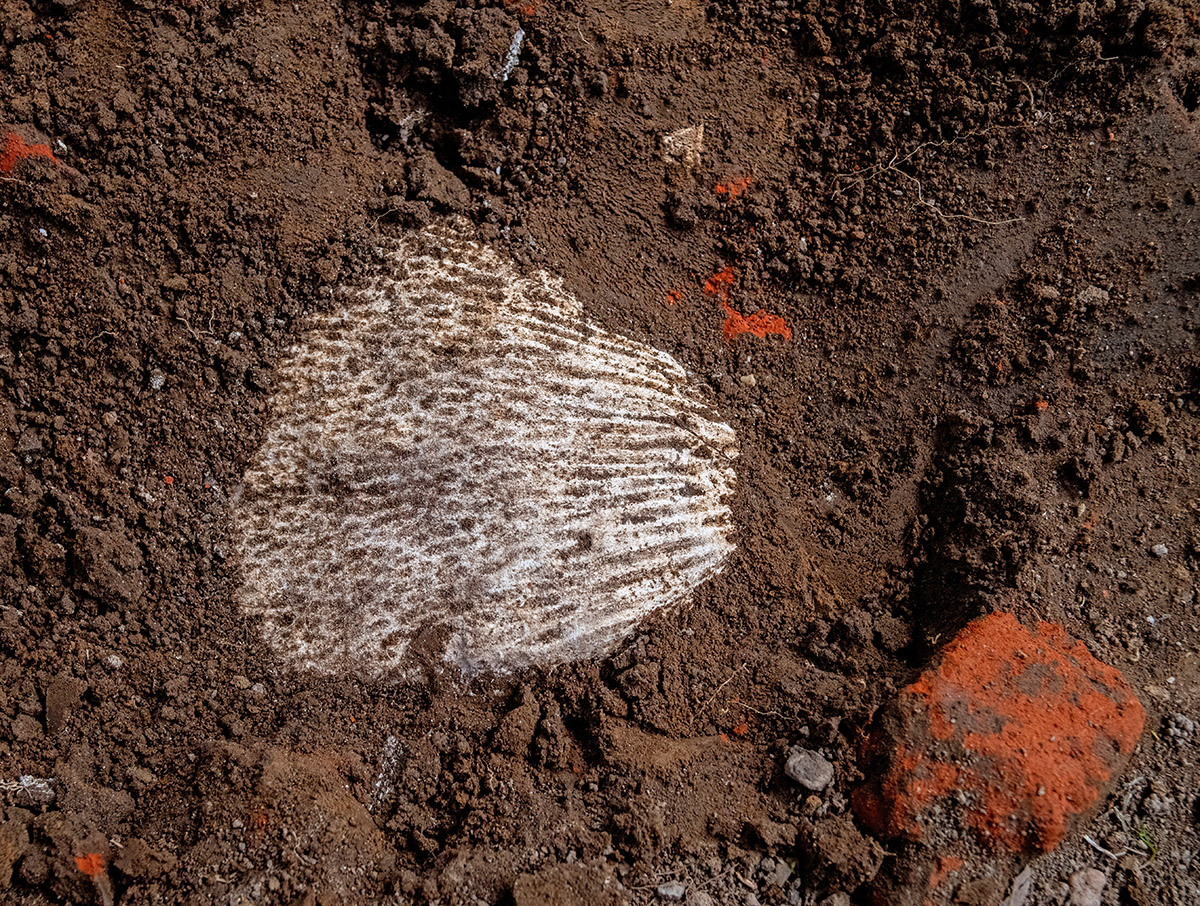
The first feature, almost certainly a well, is circular on the surface, and about eight feet in diameter. Director of Archaeology Sean Romo has completed a GPR survey of the well and preliminary analysis indicates that the feature is at least as deep as it is wide. Archaeologists found a clay cap at the top that is readily visible as a lighter color mottled soil in the center, while the rest of the well surrounding it is a dark brown. Prominently strewn in large numbers within the cap are all sorts of architectural materials including bricks, roof tiles, coral and limestone cobbles, and standalone mortar pieces. The material may be debris from the construction of the second church, which was also the first brick church in the area. This indicates the cap was filled when the well fill was settling, so the land could be reused.
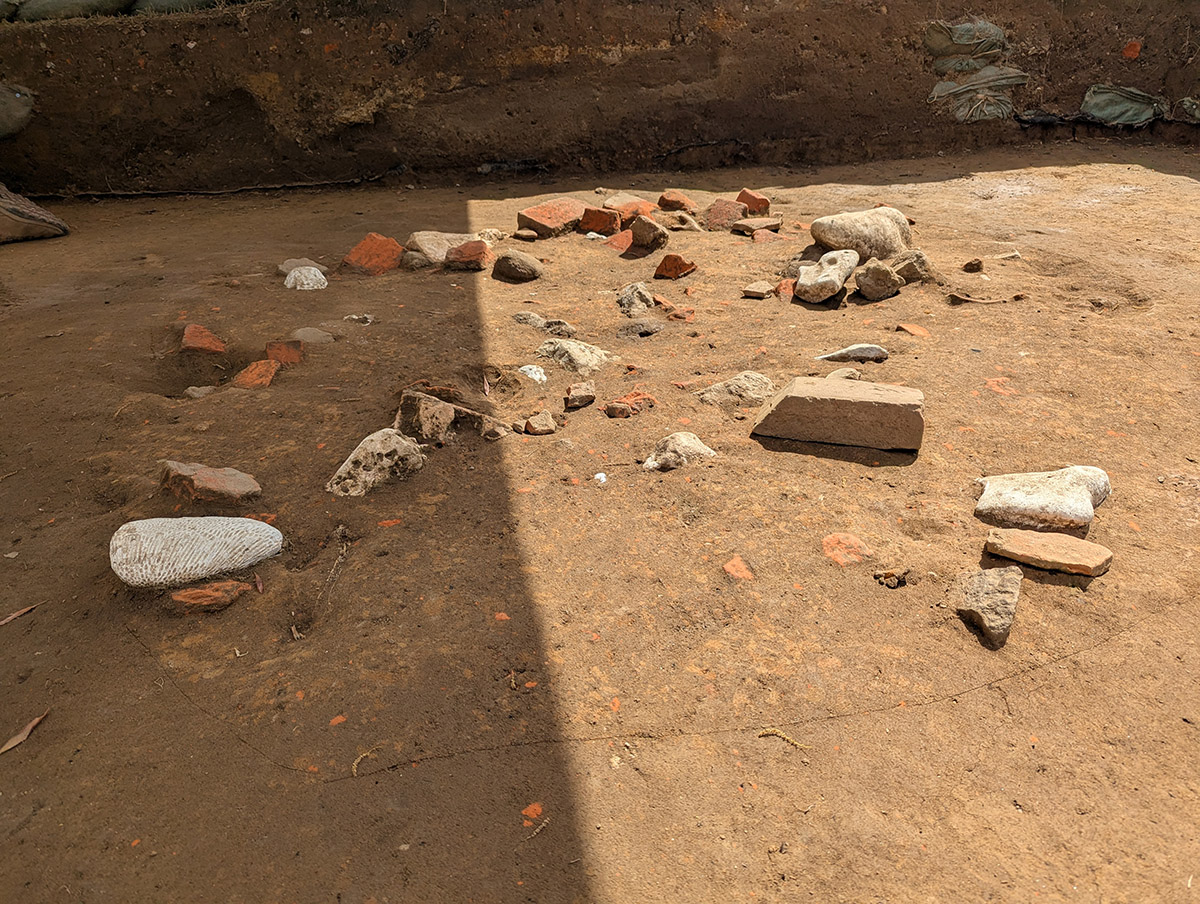
Curiously, the bricks do not have any mortar attached to them, indicating they were never used. Though the colonists often reused bricks from dismantled or collapsing buildings, traces of mortar are retained on reused bricks. Since these bear no trace of mortar, this deposit likely was a dump of leftover unused materials from a nearby construction project. The limestone and coral are similar to cobbles used in the foundations of the 1610 “two fair row of houses” and the nearby ca. 1617-1619 church. Perhaps they were considered for uses as a source of lime for creating mortar before being discarded.
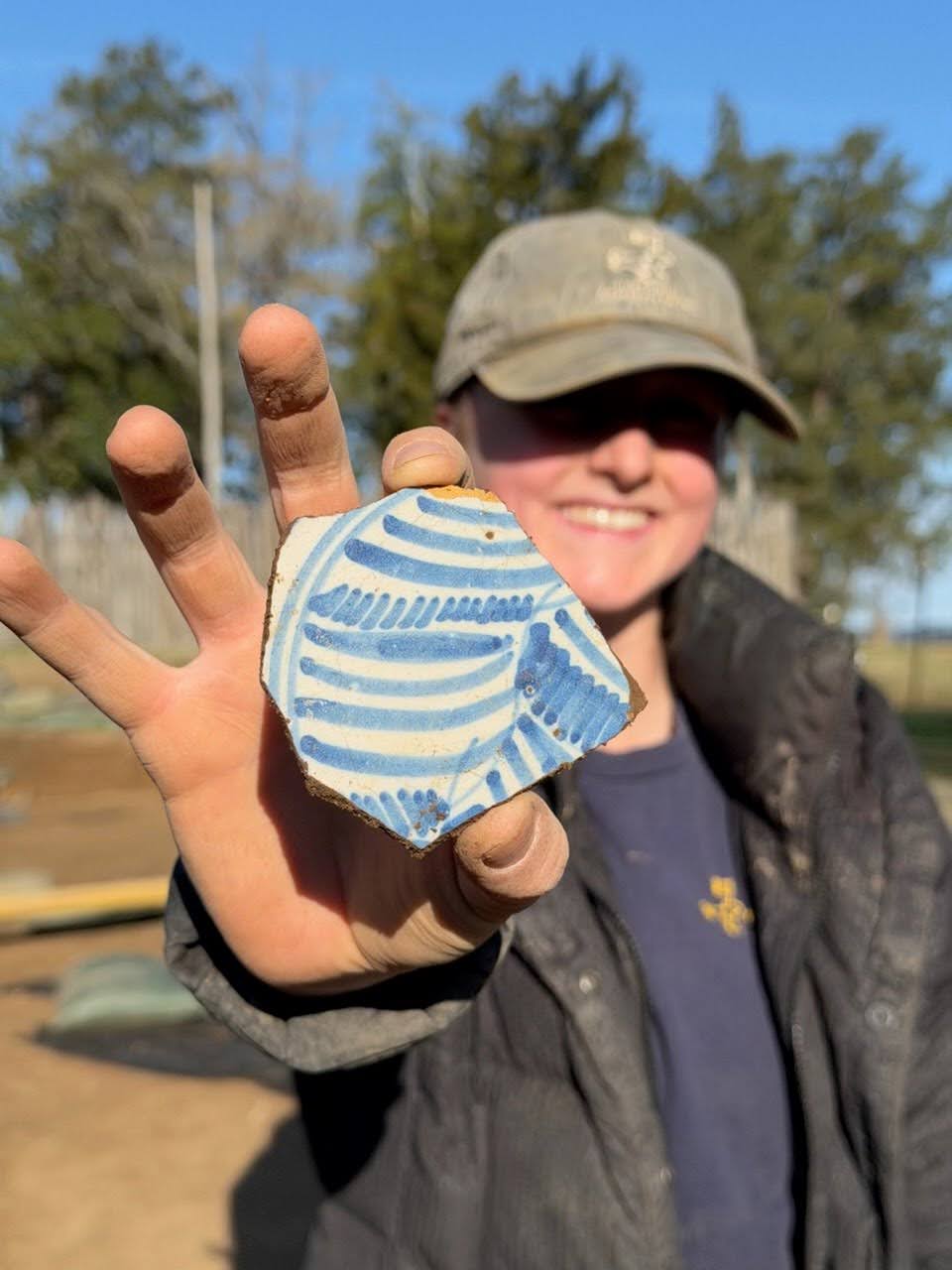
The artifacts found in the top deposits of the cap suggest it likely dates to the second quarter of the 17th century. Finds include animal bones, Italian slipware, Portuguese faience, Frechen stoneware, and Prince George Indigenous pottery. Also recovered are ceramics made by the so-called Jamestown potter (dating to 1620 at the earliest), pottery attributed to Thomas Ward, who made vessels downriver at Martin’s Hundred in the 1620s and 1630s, and a Charles I farthing (more on this below). The discovery of the well means the construction crew will need to reroute some of their underground electrical infrastructure paralleling the pathway so as not to damage the feature, as well as to leave enough open space around it for future excavation. This project is an excellent example of why archaeologists conduct mitigation work before construction.
The second possible well, which remains too obscured to identify with confidence, is significantly larger, measuring approximately sixteen feet in diameter including its builder’s trench. An edge of the feature was uncovered in excavations dating to the first decade of the 2000s. Rocks and bricks are sinking into the feature indicating settling of the soil. Unexcavated squares obscure the majority of the feature, thus further excavation is needed to positively identify it. The pathway will not traverse the unexcavated squares, so we will return to it later.
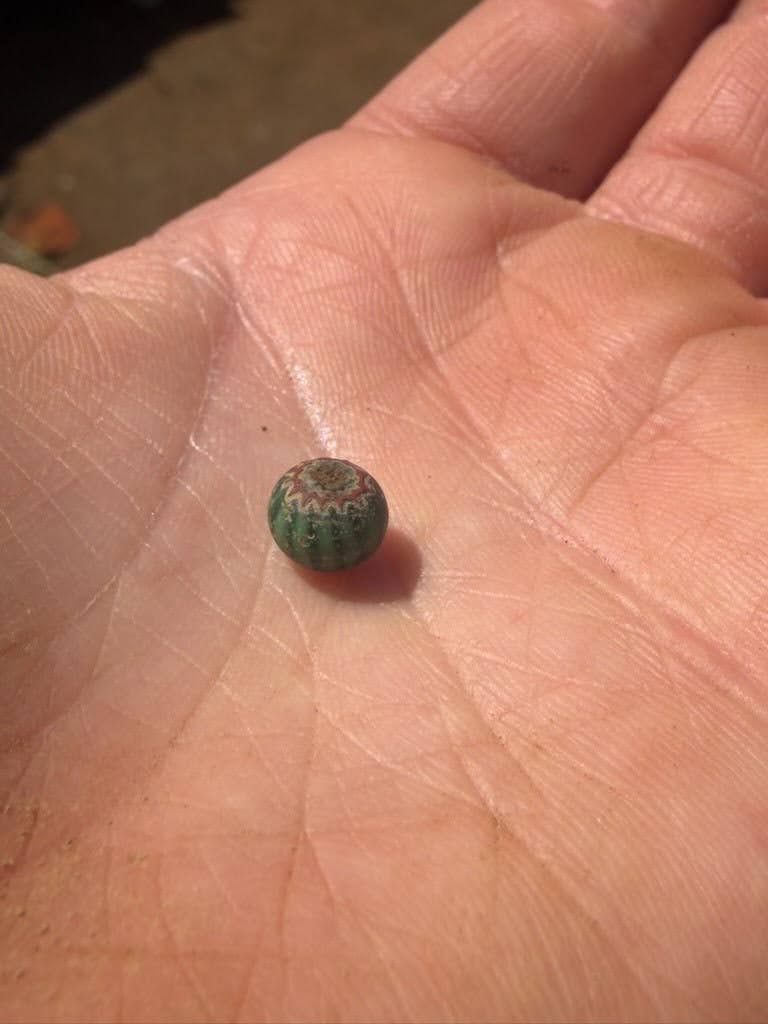
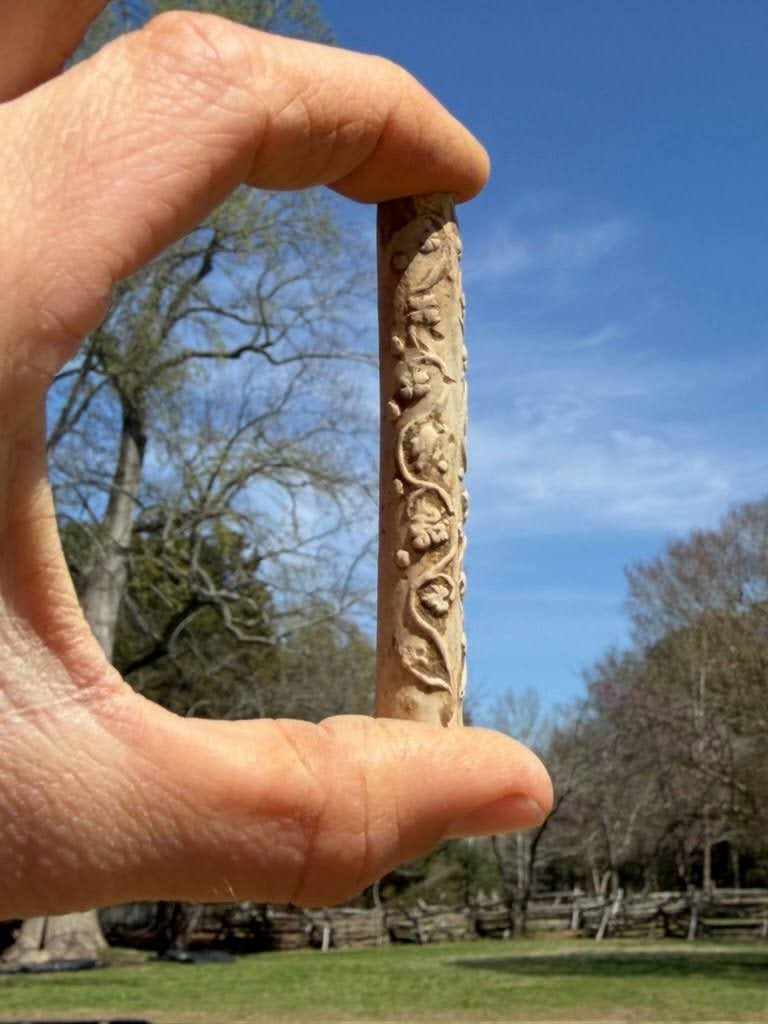
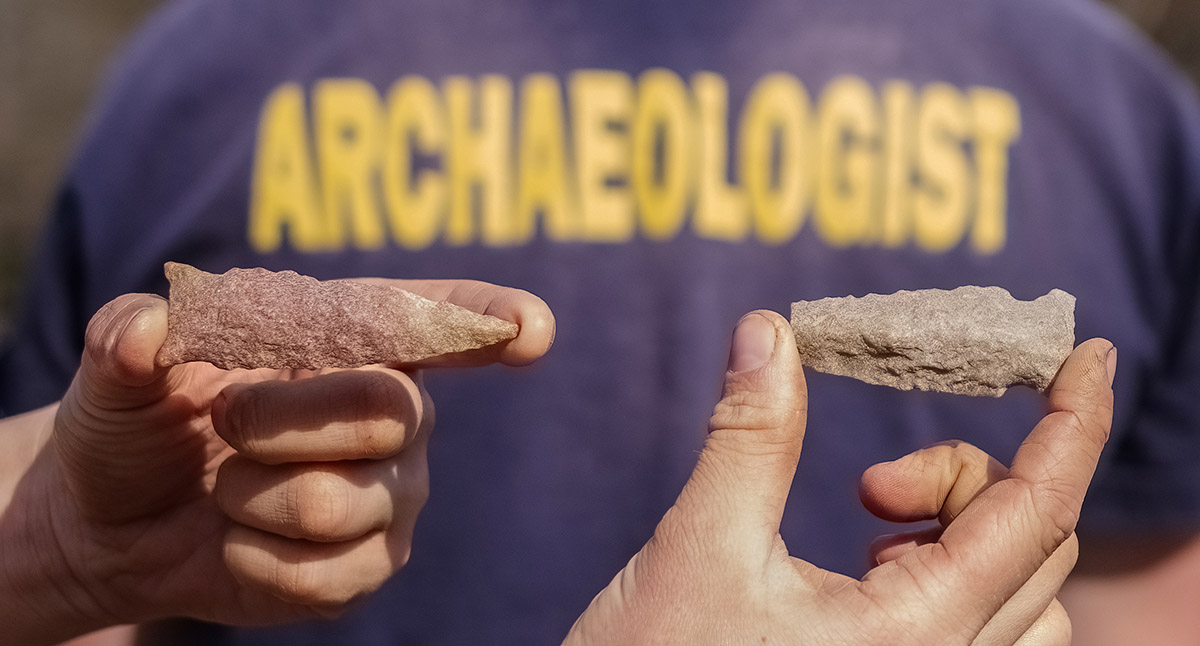
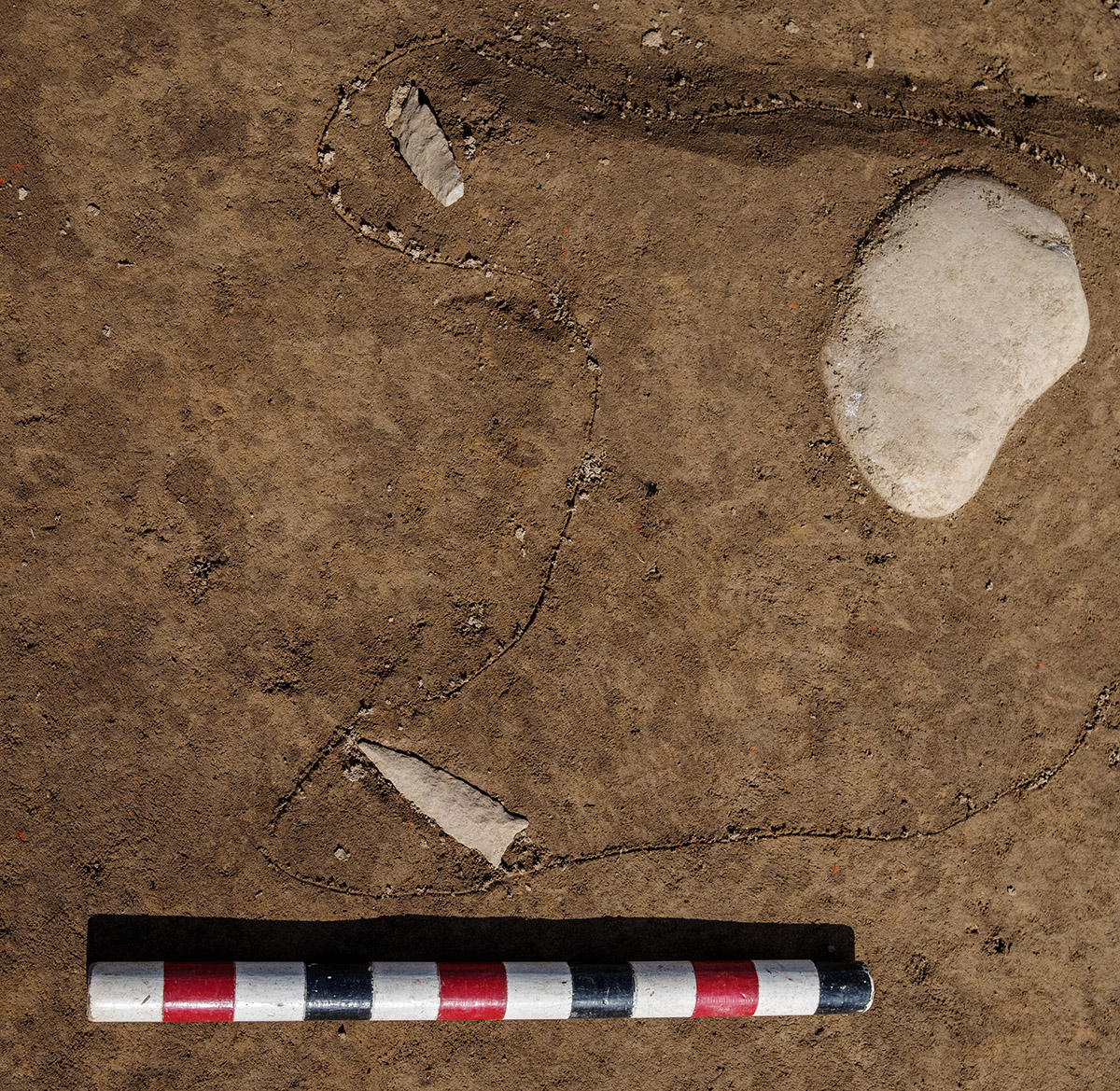
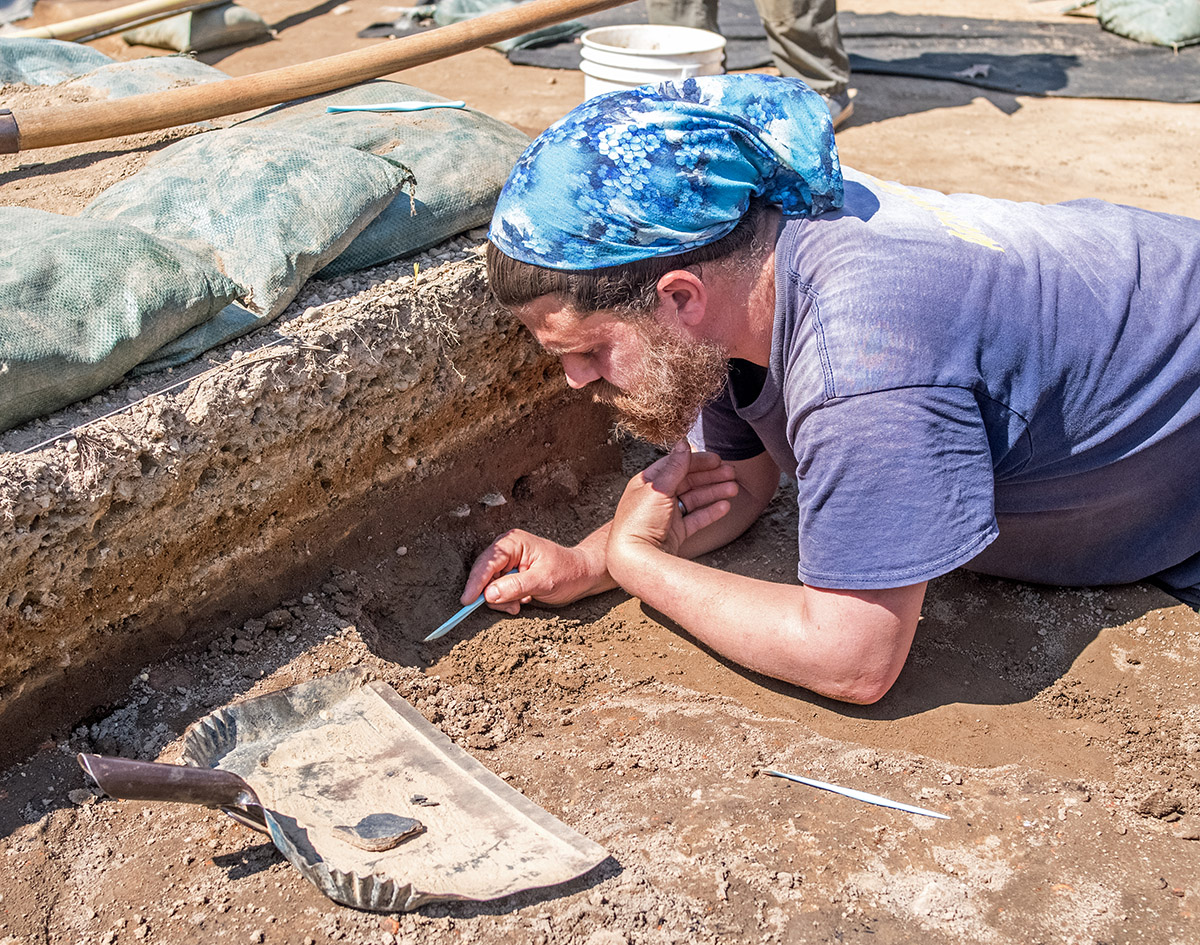
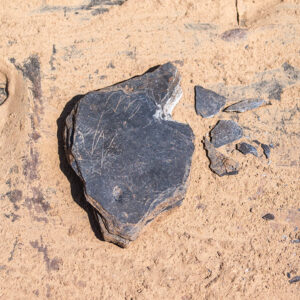
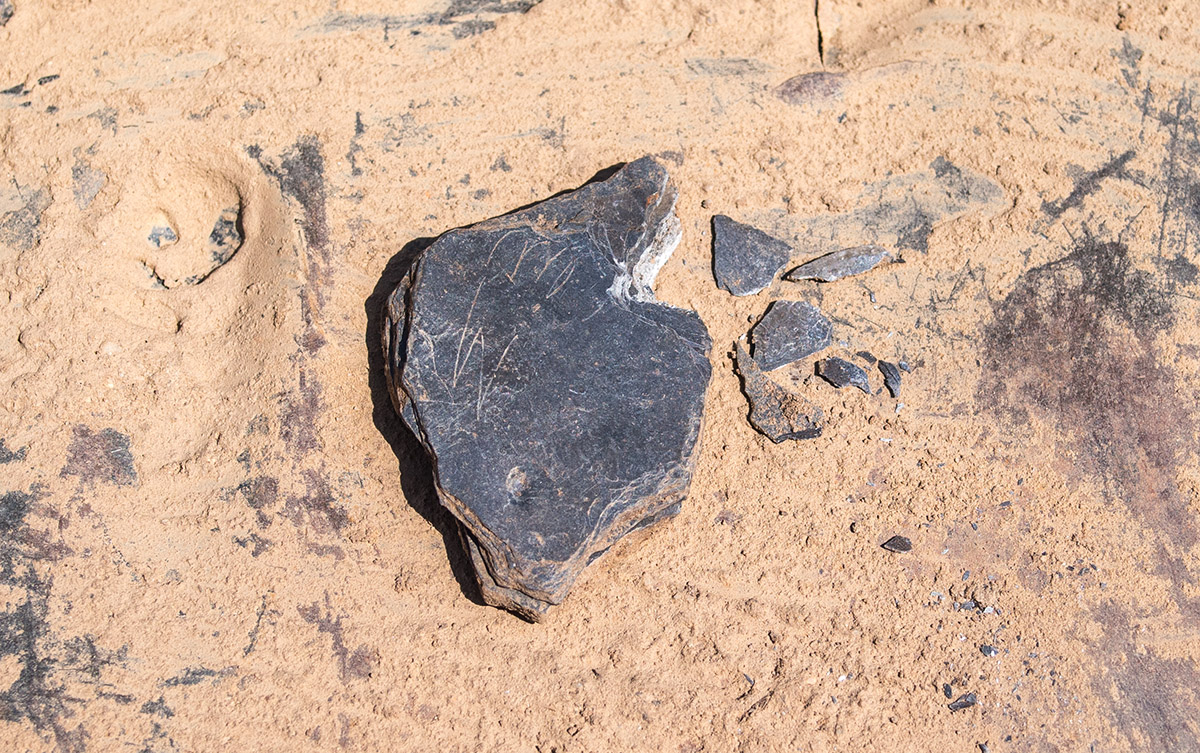
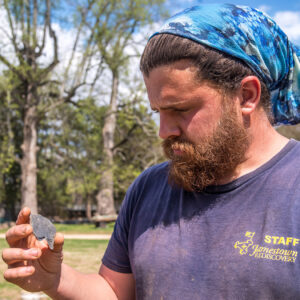
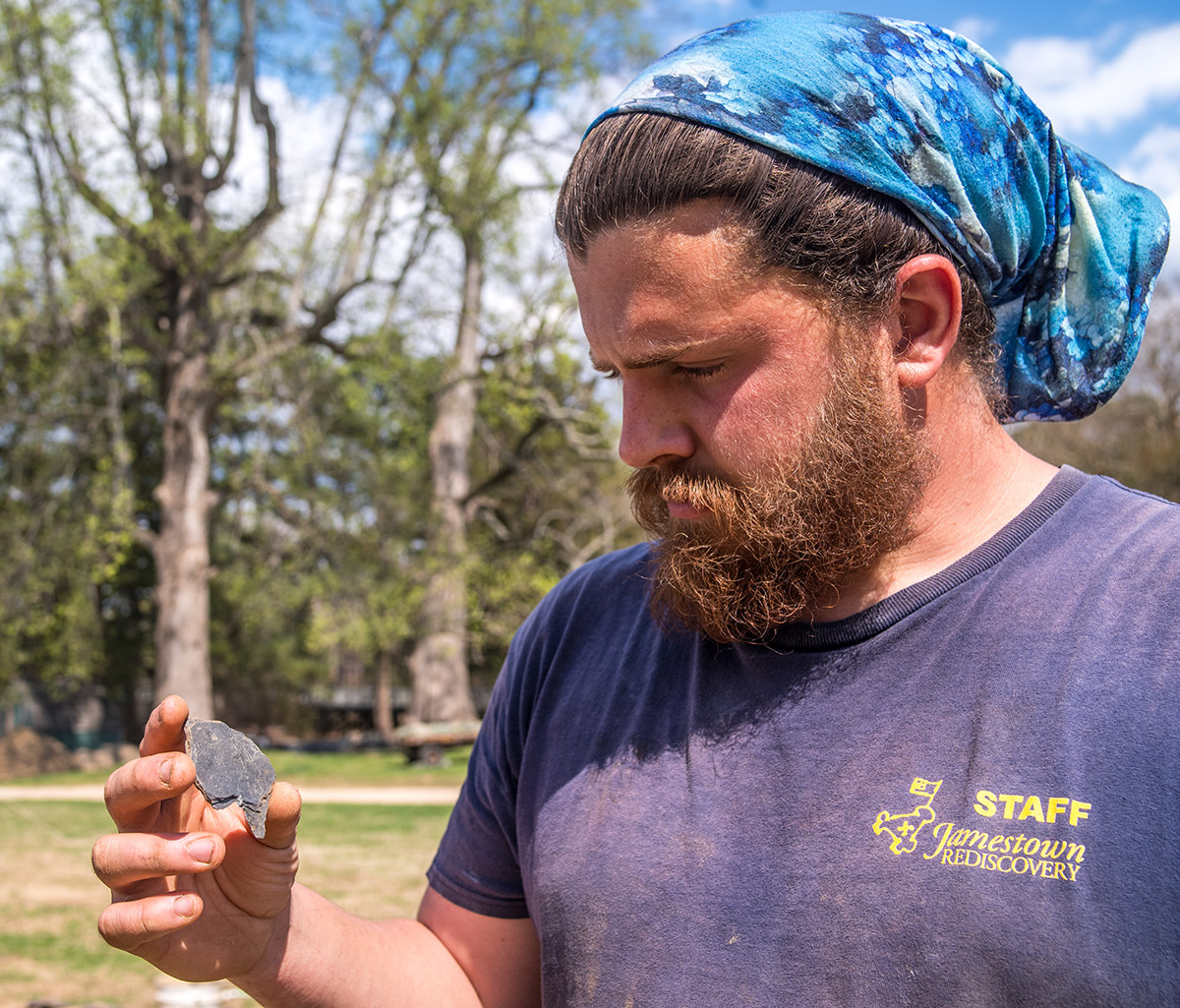
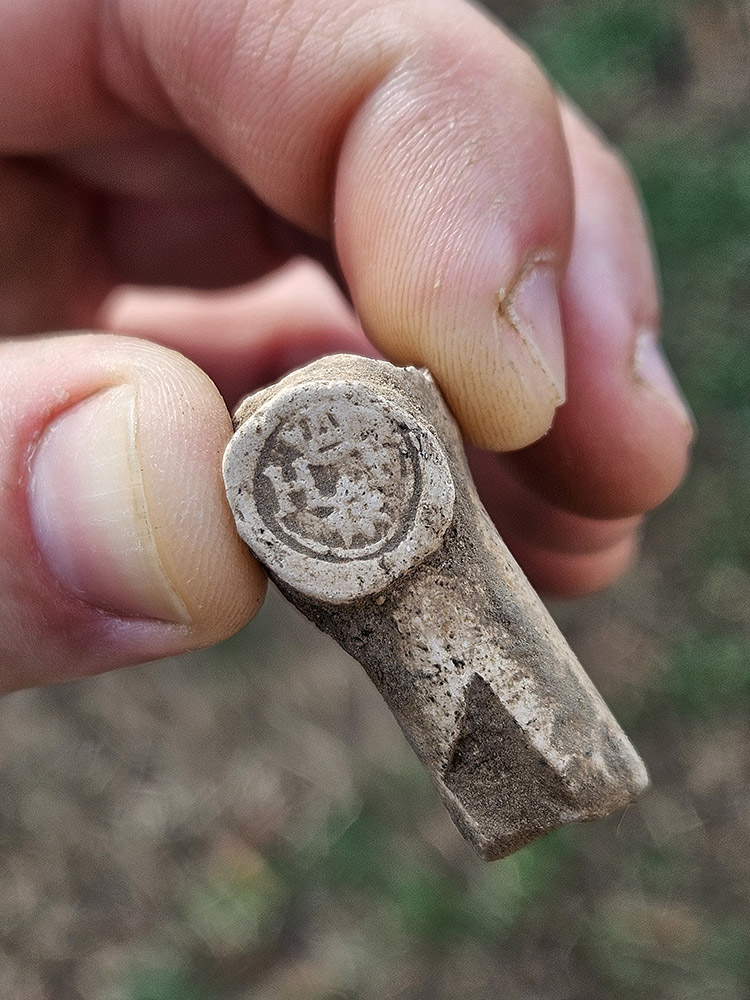
During his excavations at the North Church site, Archaeological Field Technician Josh Barber found a fragment of slate. There are scribbles and possibly an “M” or “W” on one side. Nearby, Staff Archaeologist Ren Willis found two Virginia Indian projectile points, one intact and one missing its point. These are likely from the archaic period, making them thousands of years old. Other artifacts of note include a highly decorated Dutch pipe stem, two stamped European pipe bowls, and a green chevron bead with its distinctive watermelon-like coloration.
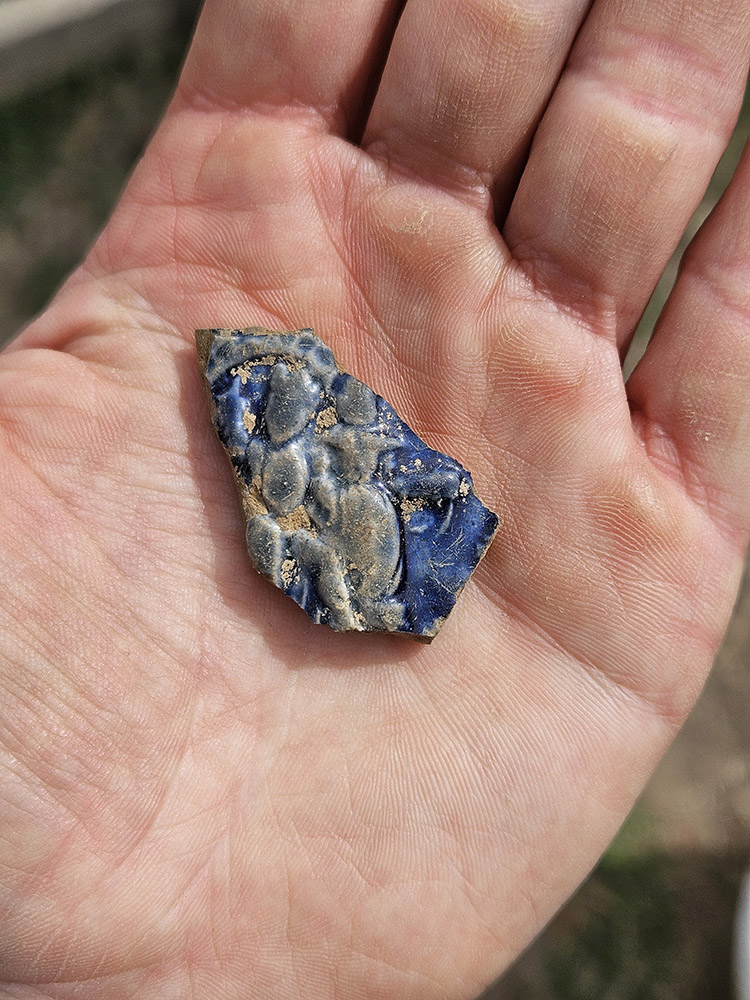
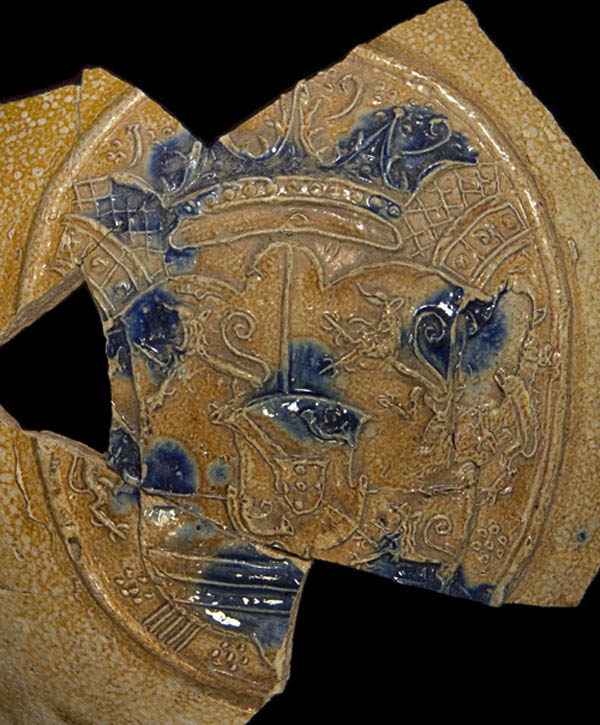
Senior Staff Archaeologist Anna Shackelford found a sherd of Westerwald stoneware in the well. The sherd belongs to a partial Peasants’ Wedding jug already in the collection that was found in a fort-period cellar close to the current excavations. Although it was probably made a decade later, the jug bears the date 1597 and depicts a wedding scene based on a print series by Sebald Benham, an artist from Nuremburg in present-day Germany. Our curators are excited to add another piece to the collection and are crossing their fingers that more will be found.
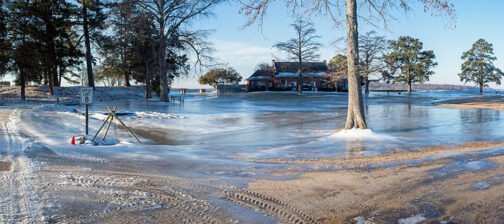
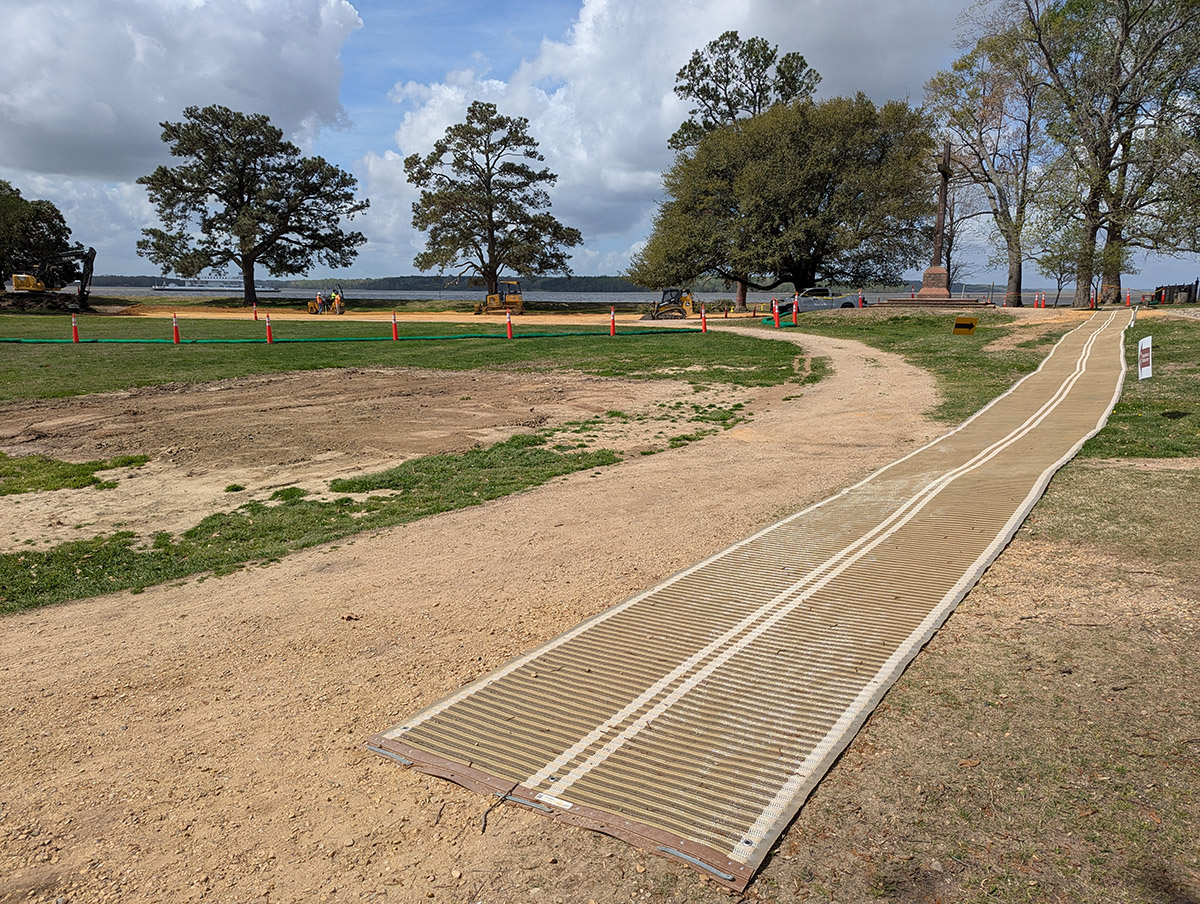
The pathway construction is currently focused on the area between the Archaearium museum and the Dale House. Members of the archaeology team are monitoring the construction to look for any possible issues that may arise. When a potential issue comes up, the archaeologists investigate while the construction crew moves a few feet down the path and continues their work.
Another construction project happening this spring is the improvement of the steps on the southside of the Yeardley House, leading to the Ellen Kelso Memorial Garden. The steps will be more gradual, lowering the grade, and improved railings will be installed. Because any construction at Jamestown has the potential to adversely affect archaeological resources, Archaeological Field Technicians Josh Barber and Eleanor Robb are conducting excavations on both sides of the current stairs where the ground will be disturbed.
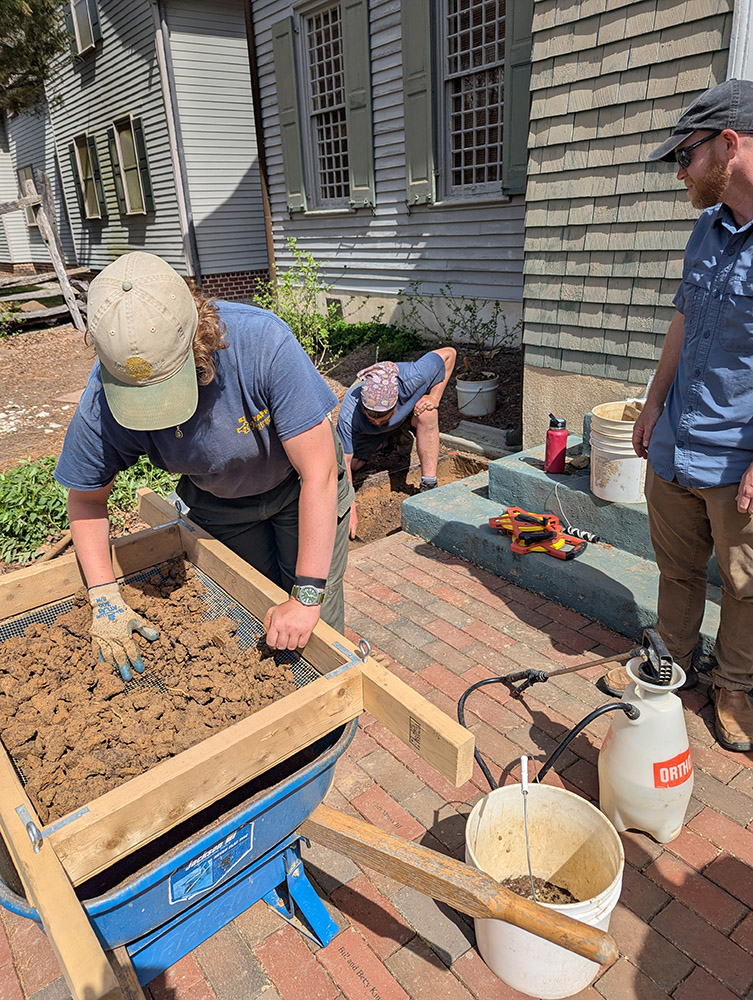
The area here, like much of north Smithfield, has a very shallow depth above the subsoil. Other areas of the island have a thick plowzone but that is not the case here. One of the current theories is that the soil here was removed as part of a landscaping effort, perhaps by the APVA around the turn of the 20th century. Josh and Eleanor are also being cautious because the garden lies over part of the Statehouse burial ground. In the 1960s, human remains were accidentally found here while planting bushes. The unusually shallow soil layers indicate that burials may be found at relatively shallow depths. The archaeologists are eschewing their shovels and sticking with trowels for these excavations.
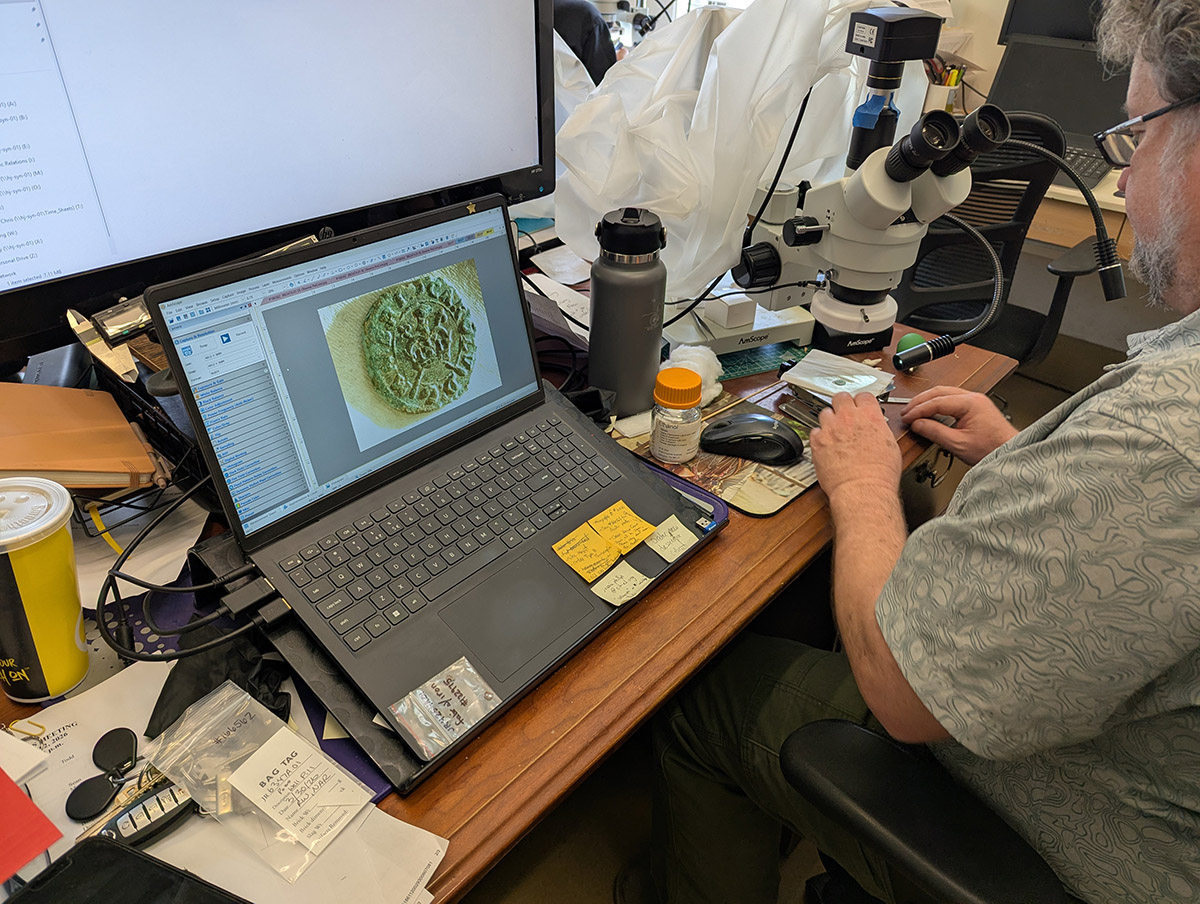
Just in from the field, the Charles I farthing found in the top of the well fill by Staff Archaeologist Natalie Reid is in the lab, being conserved by Senior Conservator Dr. Chris Wilkins. Peering through a stereo microscope, Chris carefully removed the soil obscuring its features. The farthing is small, a bit smaller than a U.S. dime, and its green color indicates it is made of a copper alloy.
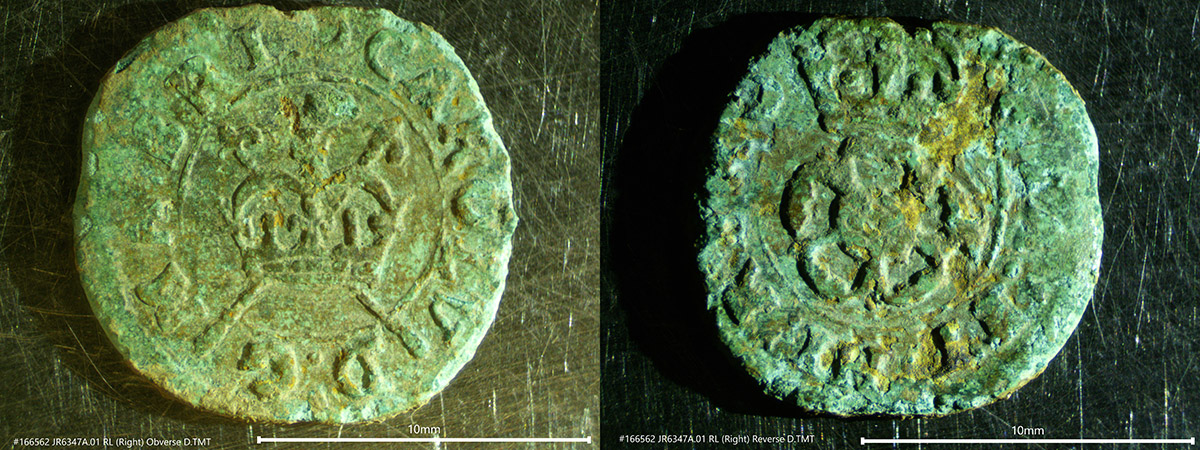
The rose on the reverse indicates that it was minted 1636-1643. The legend on the obverse (the side with the crown with crossed sceptres) is “CAROLV DG MA BRI” (Charles by the Grace of God, King of Great Britain) and the legend on the reverse is “FRA ET HI REX” (France and Ireland). The whole legend together is an abridged version of “Carolus Dei Gratia Magnae Britanniae Franciae Et Hiberniae Rex.” Right before the “C” on the obverse and after “X” on the reverse is the mintmark, a crescent, which is a very common mark on this coin.
Including this one, Jamestown archaeologists have found seven Charles I rose farthings, and at least three of them have crescent mint marks. The only other one from a sealed strata is one from the midden, a trash deposit feature near James Fort’s eastern bulwark.
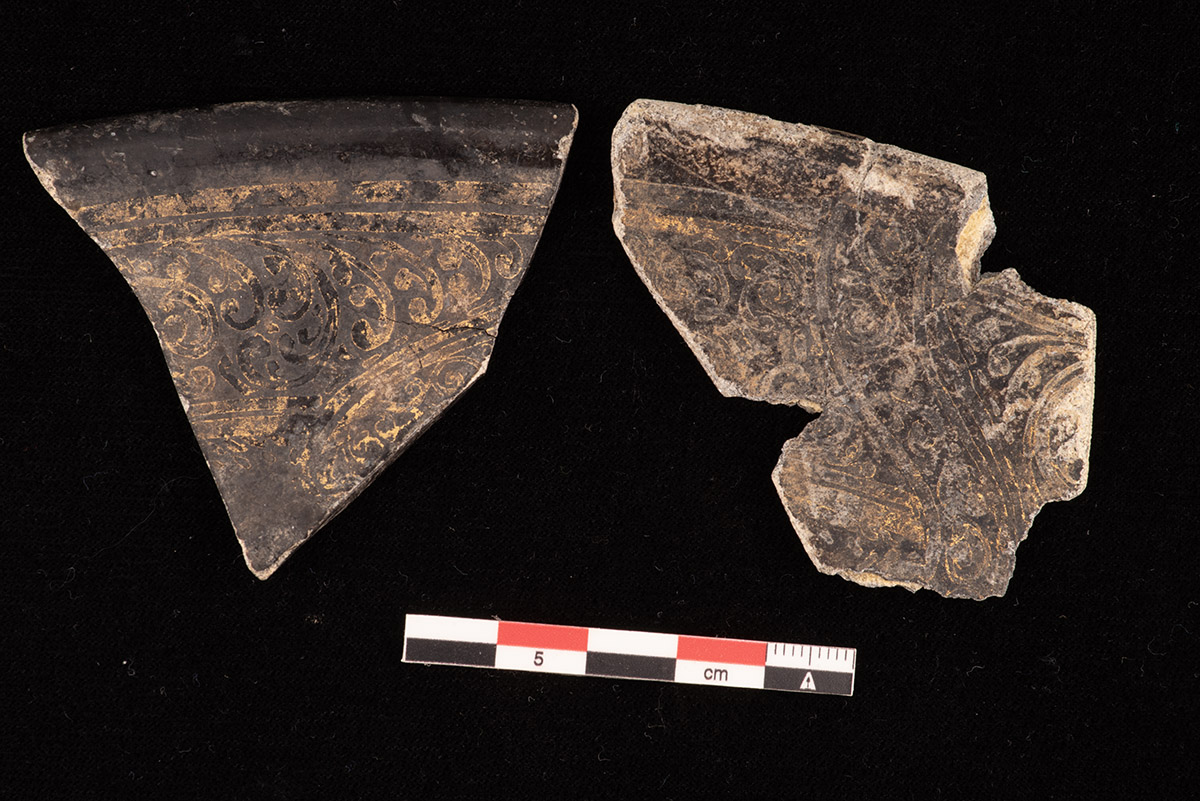
In the lab, Assistant Conservator Jo Hoppe is doing her part to help produce the glass reference collection. As Senior Curator Leah Stricker peruses Jamestown’s glass objects for inclusion in the reference collection, Jo treats the artifacts that require conservation. One of the objects Jo is treating is a partial glass dish, decorated with gold leaf. Three pieces of the dish have been recovered, all of them in “The Factory“, a building just outside and connected to the palisade extension that transformed the triangular fort into a five-sided one. The glass is opaque now, likely a result of chemical reactions with the soil, but it once was clear and tinted dark green.
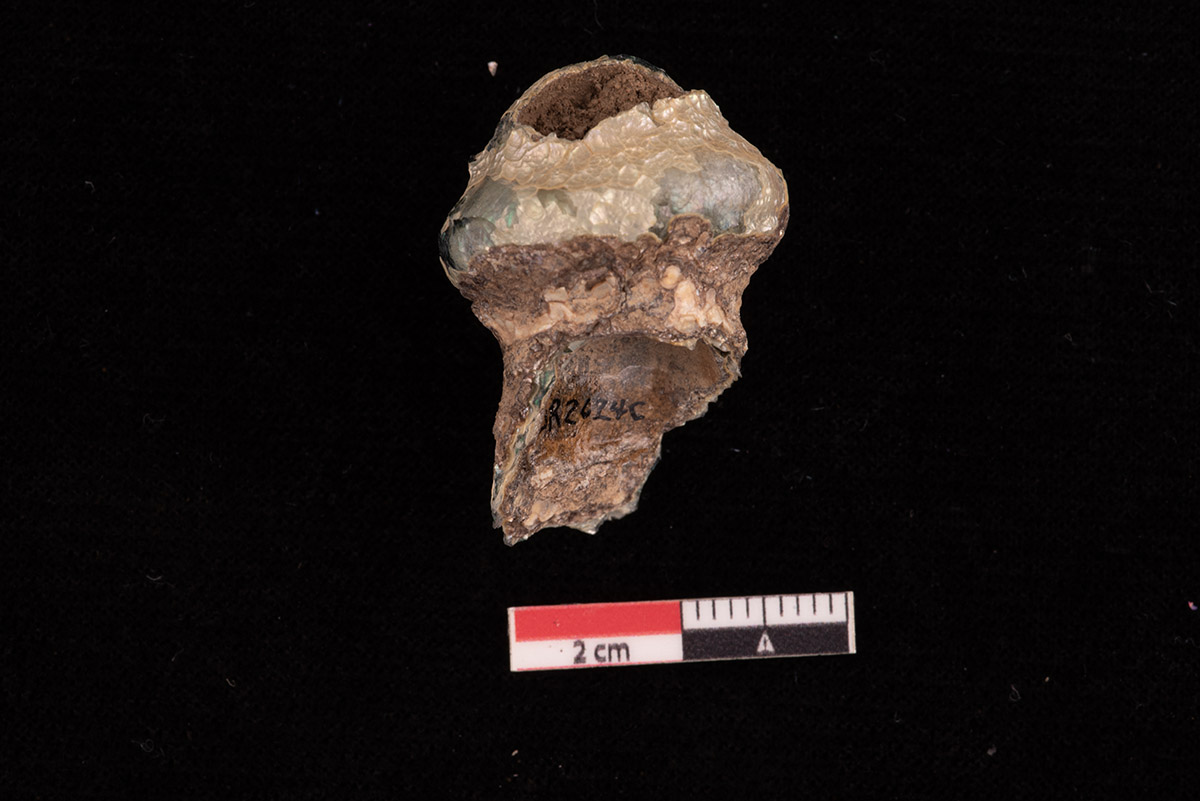
Jo is also conserving a glass knob from the top of an alembic. Alembics were used for distillation, for everything from medicine production to alchemy. The knob shows symptoms of having spent nearly four centuries underground, both in its incompleteness and the ravages of glass degradation seen in cracks, flaking, and discoloration. Unfortunately, this object was found in the plowzone, a context fraught with disturbances from centuries of farming. Because plows could move artifacts several feet from their original deposit location, and may have been moved by plows several times over the years, artifacts found in the plowzone cannot be reliably tied to a historic feature unless there are crossmends.
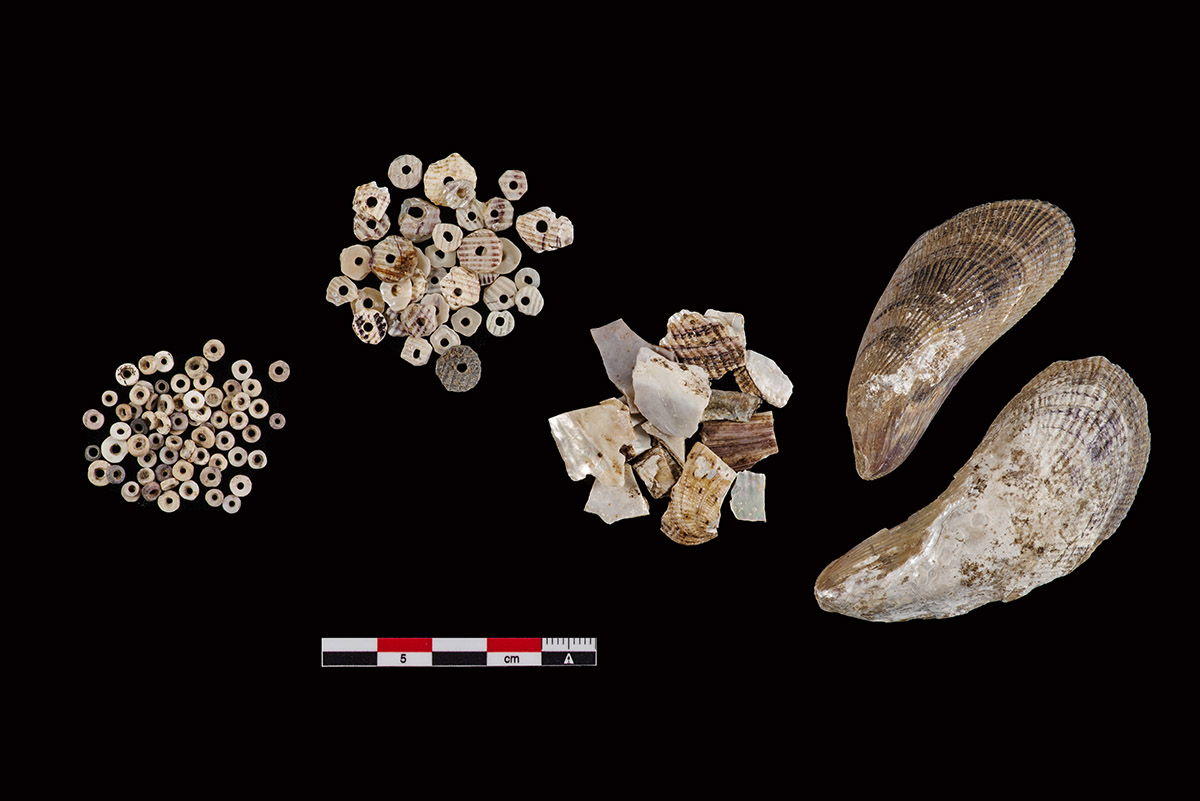
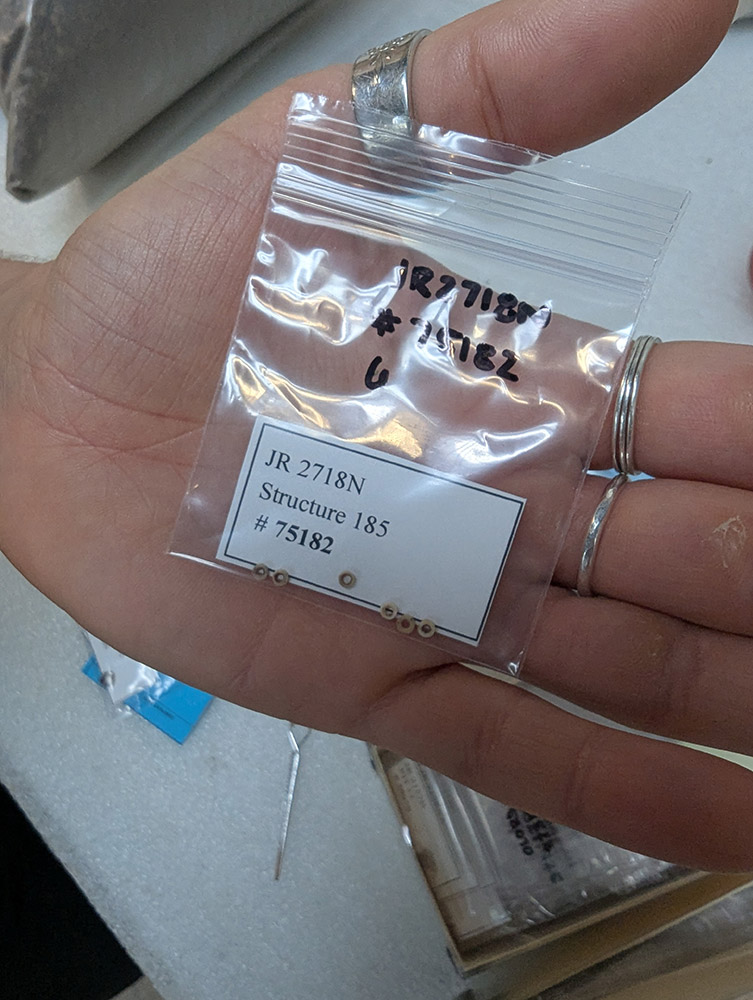
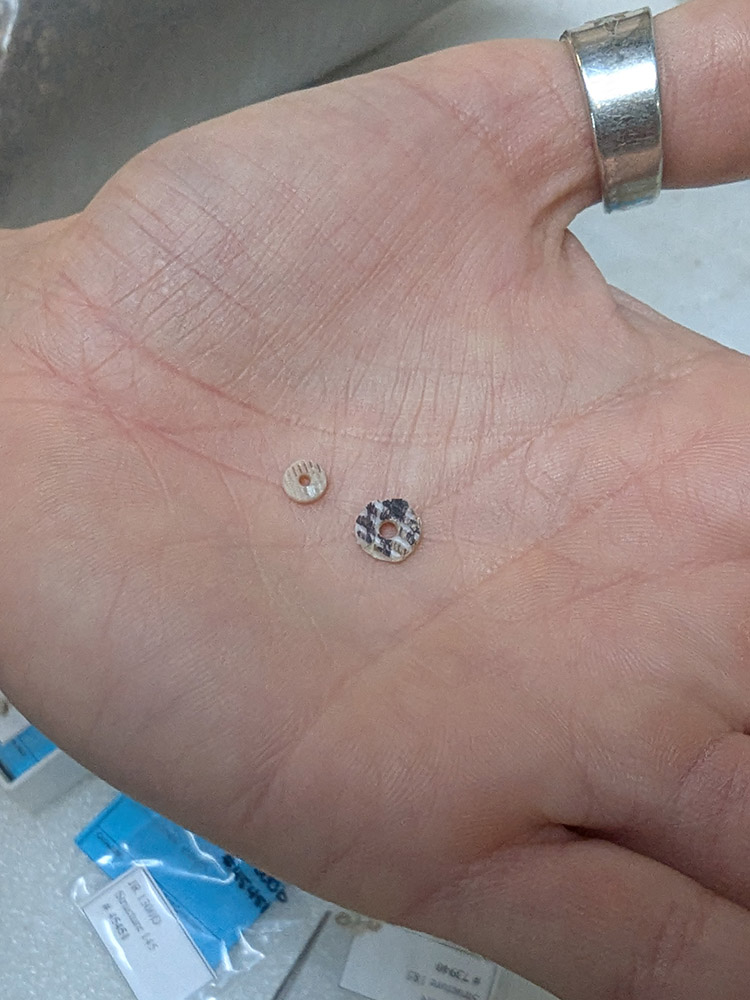
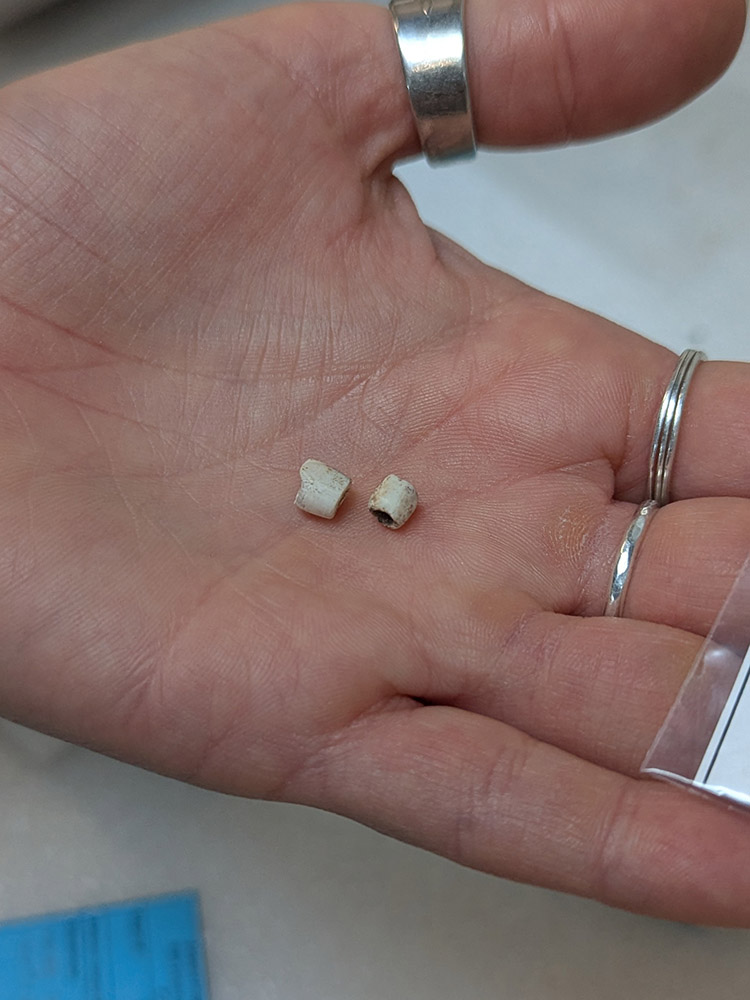
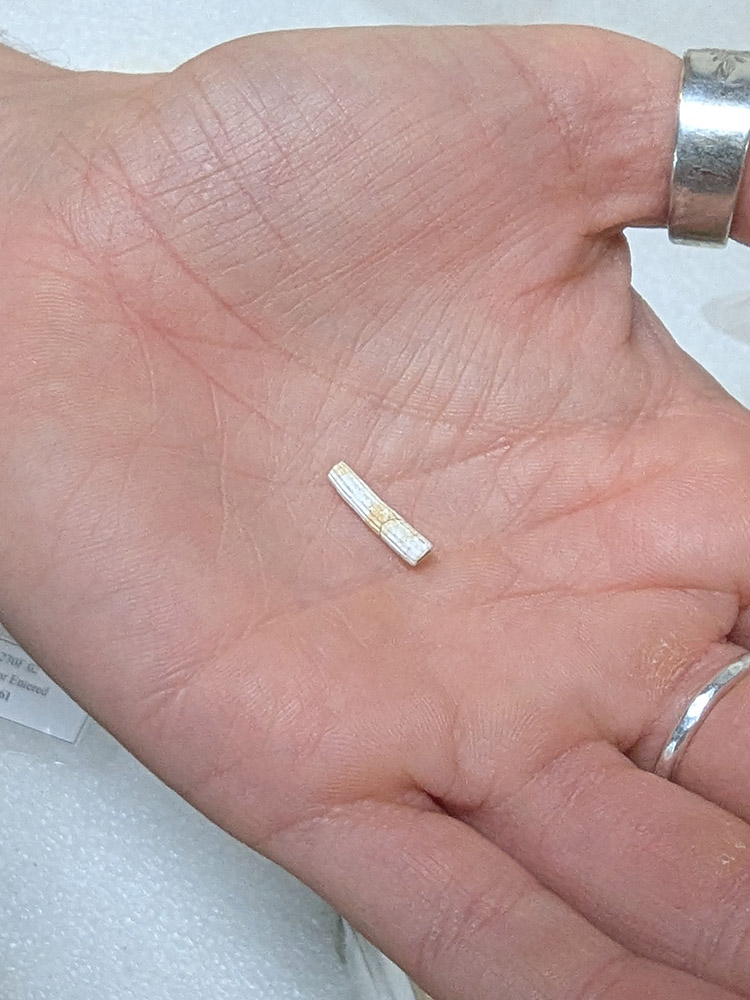
Associate Curator Emma Derry has completed work on the shell bead reference collection. There are over 3,700 shell beads in the Jamestown collection. Most (3,319) are made from ribbed mussel shells. Other shell beads in the collection were made from clam, whelk, and dentalium. The vast majority of the shell beads were found in the fort’s first well (the “John Smith Well”). Of the ribbed mussel and clam shell beads, we have examples of several sizes. Though all were worked to be discs, there is a large variation in diameter, from about 2.5mm to about 9mm, with the tiny ones requiring greater effort to produce. The whelk beads were short tubes instead of discs, and the dentalium beads were largely left unaltered — long slim tubes. We have only 18 examples of tubular beads (whelk and dentalium).
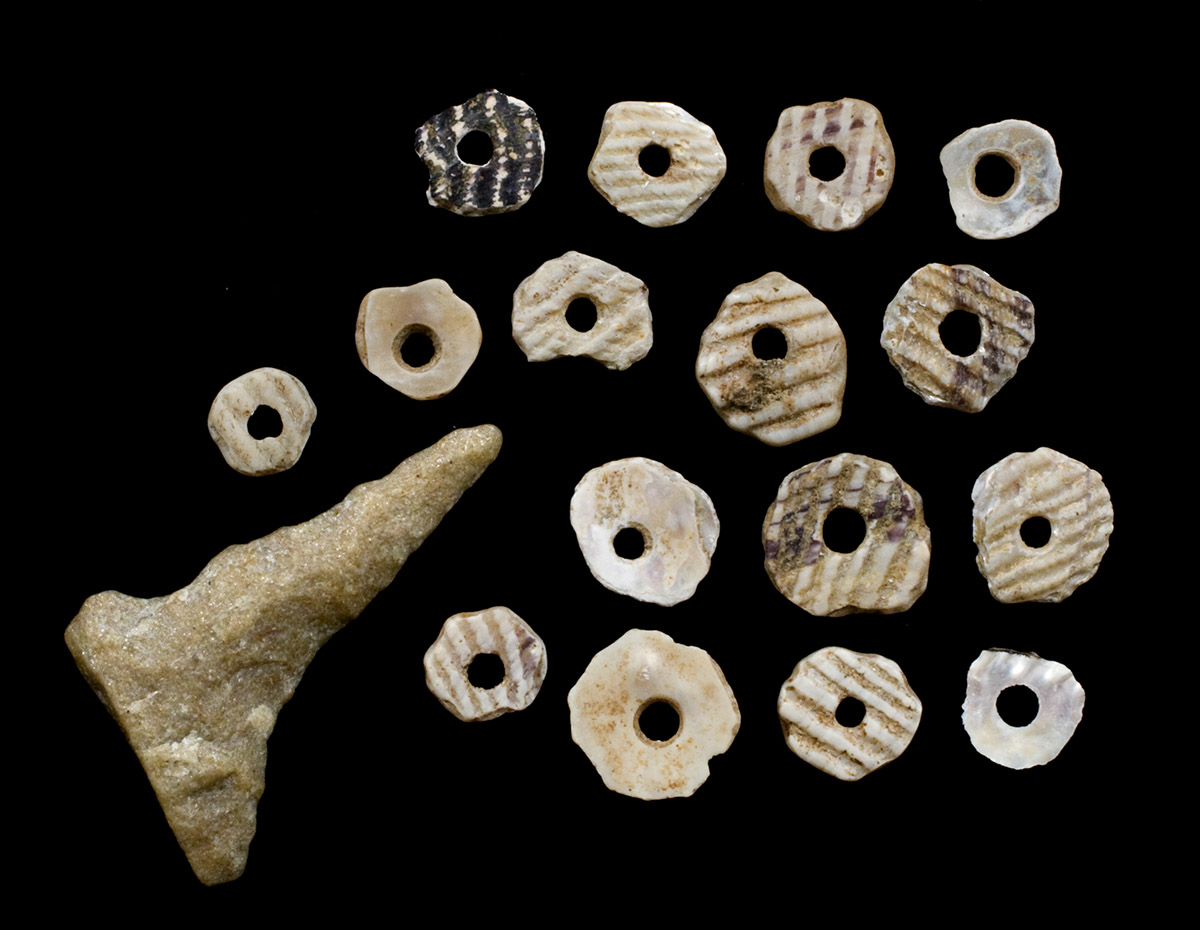
We believe Virginia Indian women living inside James Fort were creating shell beads there. Archaeologists have found beads in all stages of the production process as well as the tools they used. The “Mussel Shell Beads” webpage contains more information on these beads as well as a video of them being found while water screening soil excavated from the fort’s first well. These beads are featured prominently in the “World of Pocahontas” exhibit in the Archaearium museum, with over 2,200 on display there.
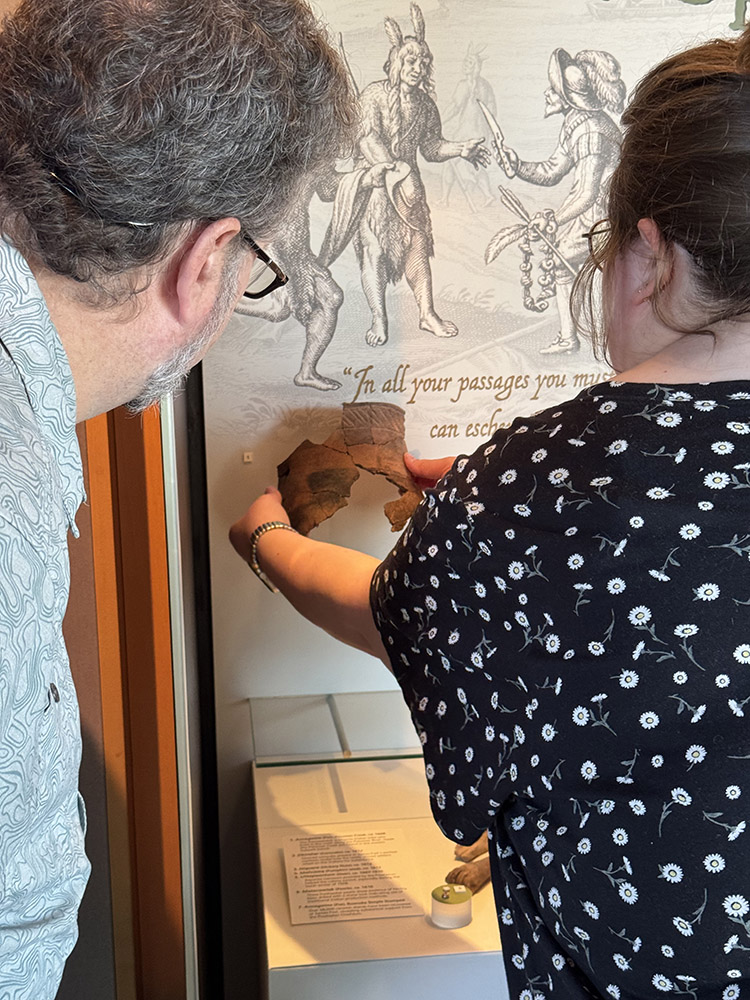
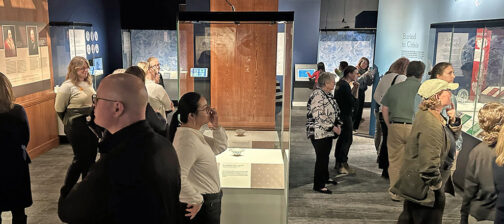
After months of work, Curatorial Intern Molly Morgan has successfully completed the conservation of an important large Potomac Creek pot in Rediscovery’s archaeological collection. The vessel, enlarged with sherds found and mended by Molly is now back in the Archaearium museum. Before her mending process began, the vessel was removed from display in the Archaearium and because of her mends, its mount needed to be amended with more supporting arms to secure the expanded pot, a task Assistant Curator Lauren Stephens undertook.
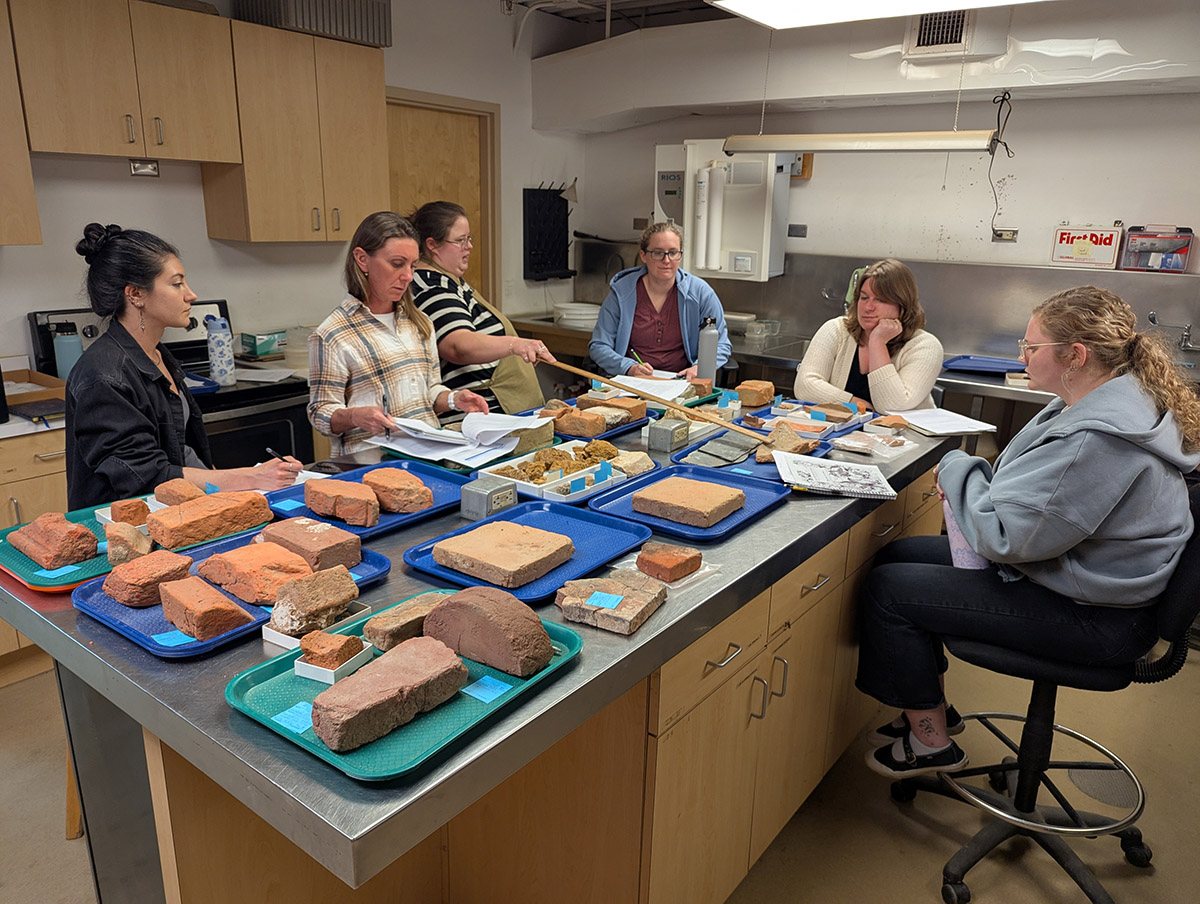
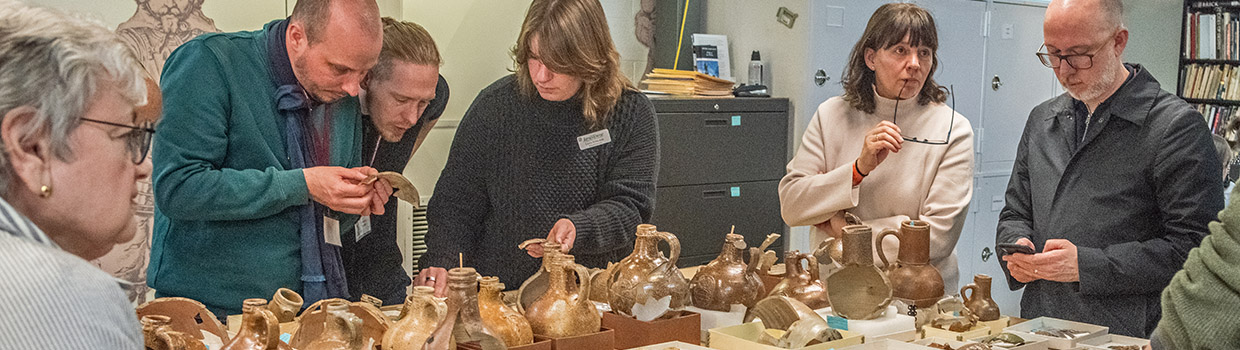
As more and more artifact types are added to the reference collection, one or two curators take the lead in assembling a collection of a particular artifact type, such as glass beads or Surrey-Hampshire Boarder ware. The goal is to disseminate their knowledge to other staff members and to ultimately make the information available to researchers as well as the general public. To pass along their knowledge, the curators are having monthly meetings in the lab, artifacts on the table around which they all sit. For example, this month, Assistant Curator Lauren Stephens shared her knowledge of the architectural materials reference collection with her colleagues. Lauren was the primary researcher for the collection, which includes bricks, mortar, roof tiles, and the like. Her research will also be available on our website and perhaps in a publication yet to be announced. You can learn about her efforts by reading November 2025’s dig update.
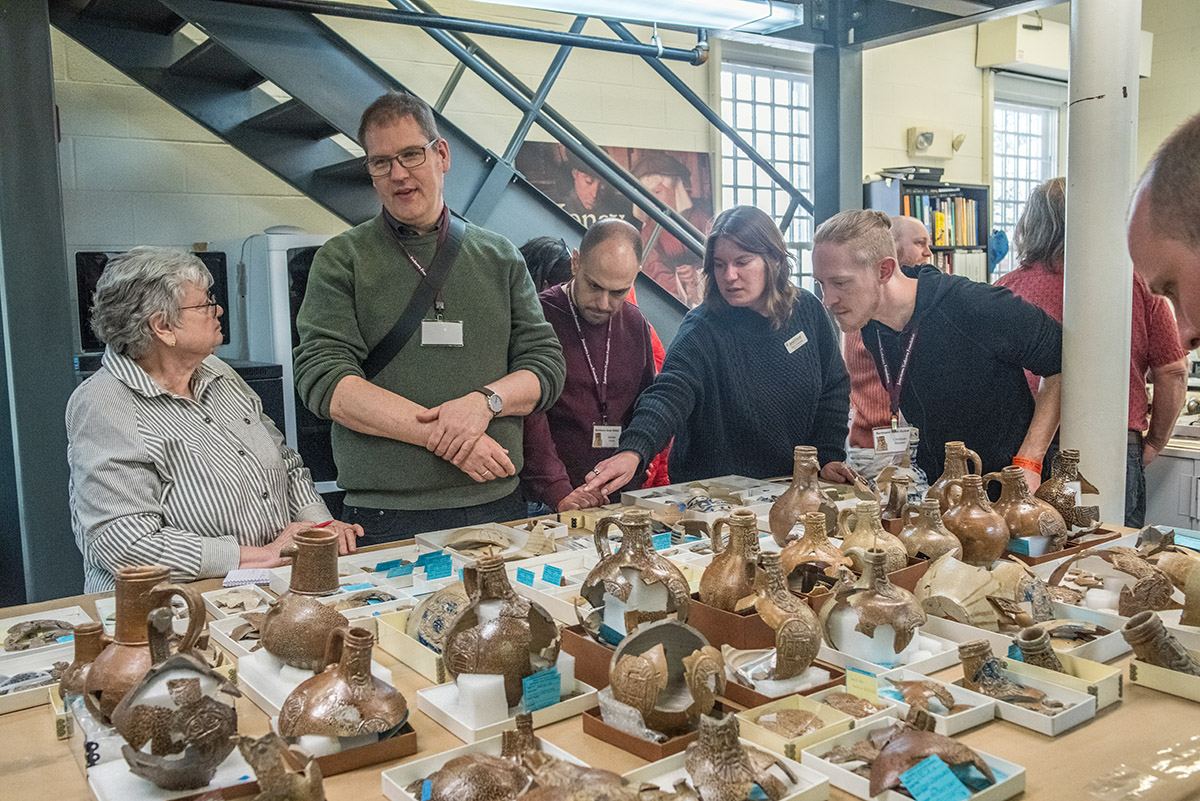
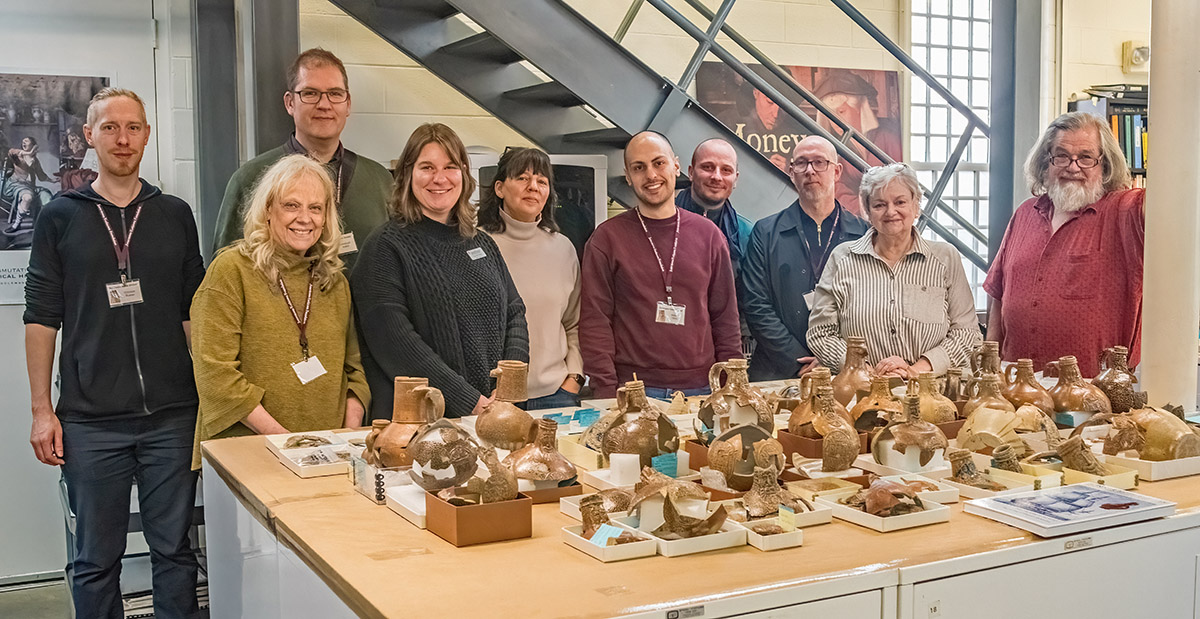
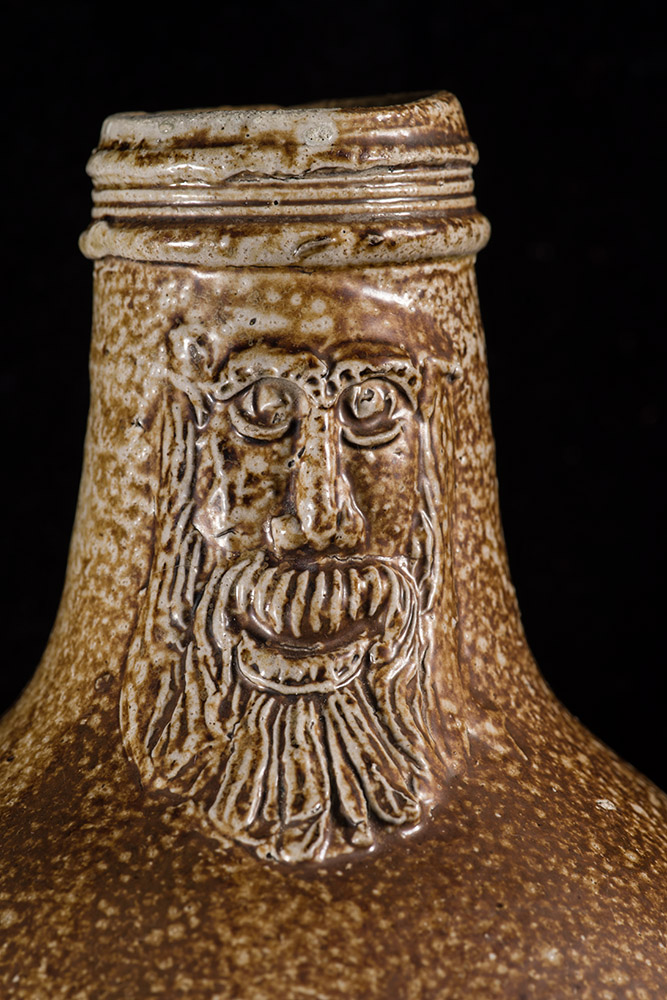
This month, the international group “Bartmann Goes Global” visited Jamestown. The group of researchers from Europe and the United States is interested in all things related to Bartmann jugs, a German stoneware vessel type that features prominently in the Jamestown collection. Bartmann Goes Global is interested in determining if certain jugs can be traced to specific potteries using chemical analysis or by tracking design patterns. Perhaps chemical analysis of the jug’s fabric or glaze could narrow down its location of origin. Or maybe design details such as the face design (the “mask”) or medallion type could tie a vessel to a specific pottery. They are also tracing the trade routes that brought these northern European vessels across the world and researching the cultural contexts of the jugs for the different peoples who used them. These are only a few of the many goals of the project.
Dozens of Bartmann jugs have been excavated at Jamestown, with new sherds of the jugs being found regularly. The group investigated the Jamestown collection and took several samples for chemical analysis in the hope of furthering their origin location research. Bly Straube, former Senior Curator at Jamestown Rediscovery and current Senior Curator at Jamestown-Yorktown Foundation is a member of Bartmann Goes Global and joined the group on their visit.
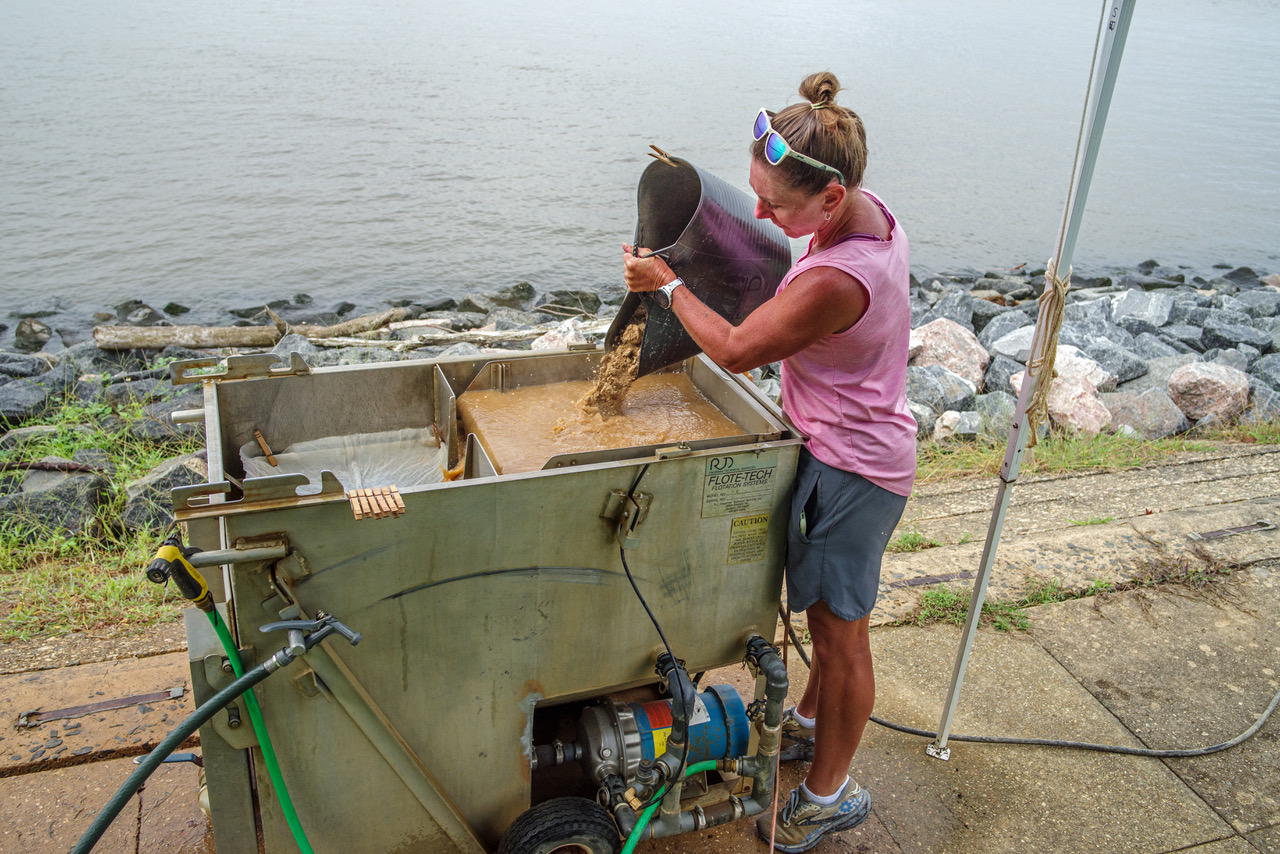
Curatorial Assistant Lindsay Bliss has completed maintenance on Jamestown’s flotation tank and will soon be back on the Seawall, floating soil samples from several different contexts. The flotation machine separates artifacts of different densities using water. Dense objects sink while light objects float to the top. The resultant groupings of objects are called the heavy fraction and the light fraction. This process makes it much easier to find botanical materials such as leaves and seeds, things that are typically found in the light fraction and that can tell us what the colonists were eating and what their environment was like. Otherwise, a curator would need to carefully pick through thousands of small objects under a microscope to separate these things from the surrounding soil and rocks. Look for Lindsay on the Seawall near the Dale House through September and feel free to ask her what she’s finding!
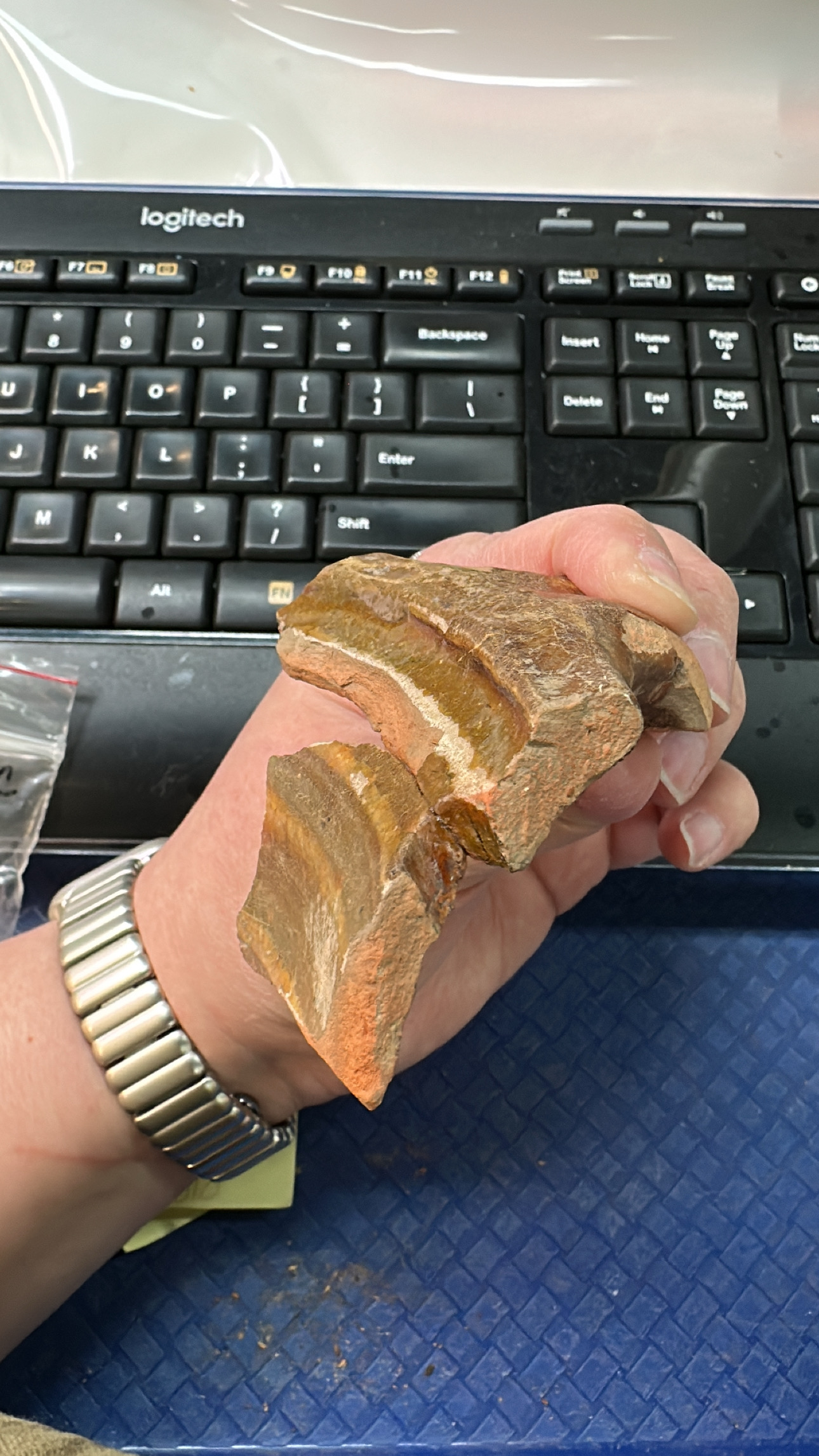
The curatorial team has found new mends for a ceramic vessel likely made in the village of Donyatt, West Somerset, England. The object is probably a chafing dish, a vessel used to keep food warm. Chafing dishes had two parts: the base was hollow and filled with charcoal or another combustible material that was set alight. The top part, in this case a hemispherical bowl, held food. Holes present in the lower part allowed oxygen to feed the fire. Assistant Curator Lauren Stephens has taken the lead in mending the vessel. She found two sherds that mend, and the resultant larger piece appears to contain a purpose-built hole, something that up until now was missing from the vessel. There are no burn marks on the object, indicating that it probably wasn’t used. Perhaps it broke before it could be.
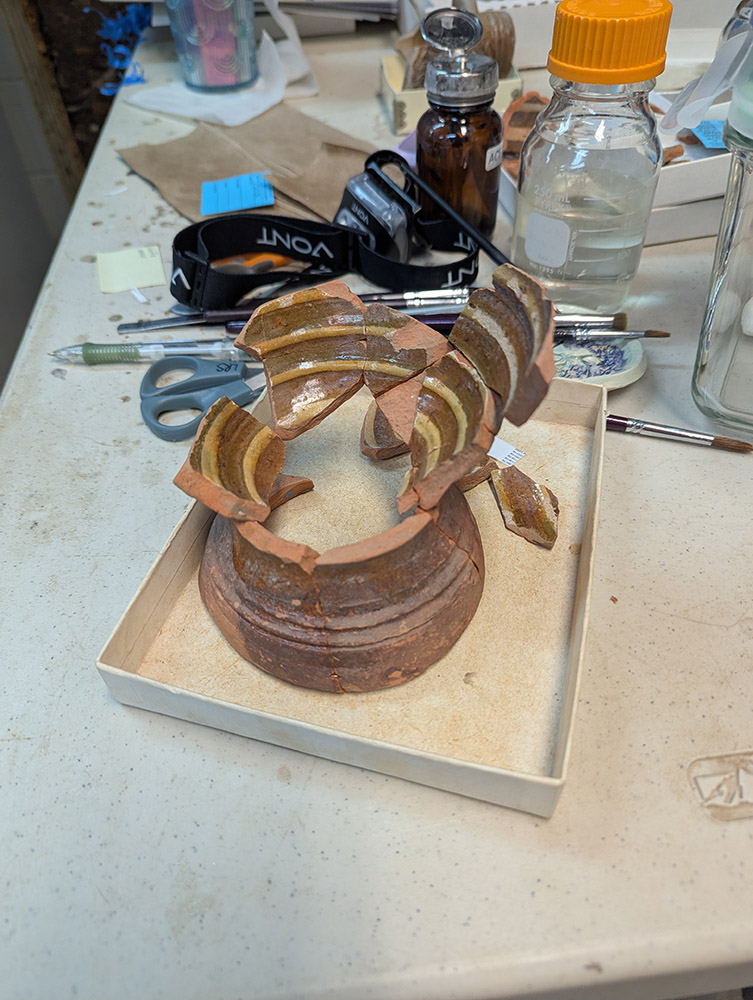
After examining the remaining sherds, Lauren believes we have at least two of these objects in the collection. Some of the sherds simply do not fit in the existing vessel. There are also differences in the width of the slip (a water/clay paste used for joining pieces or used for decoration) on some of the sherds when compared to the partially complete vessel. The slip in this case is the yellow spiral on the vessel’s interior. Hopefully additional pieces will be discovered in the archive or by archaeologists in the field to more fully flesh out these vessels.
dig deeper
related images
-
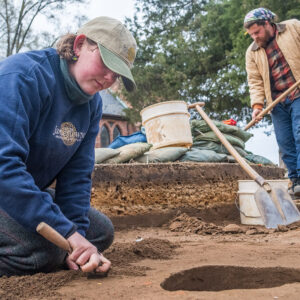
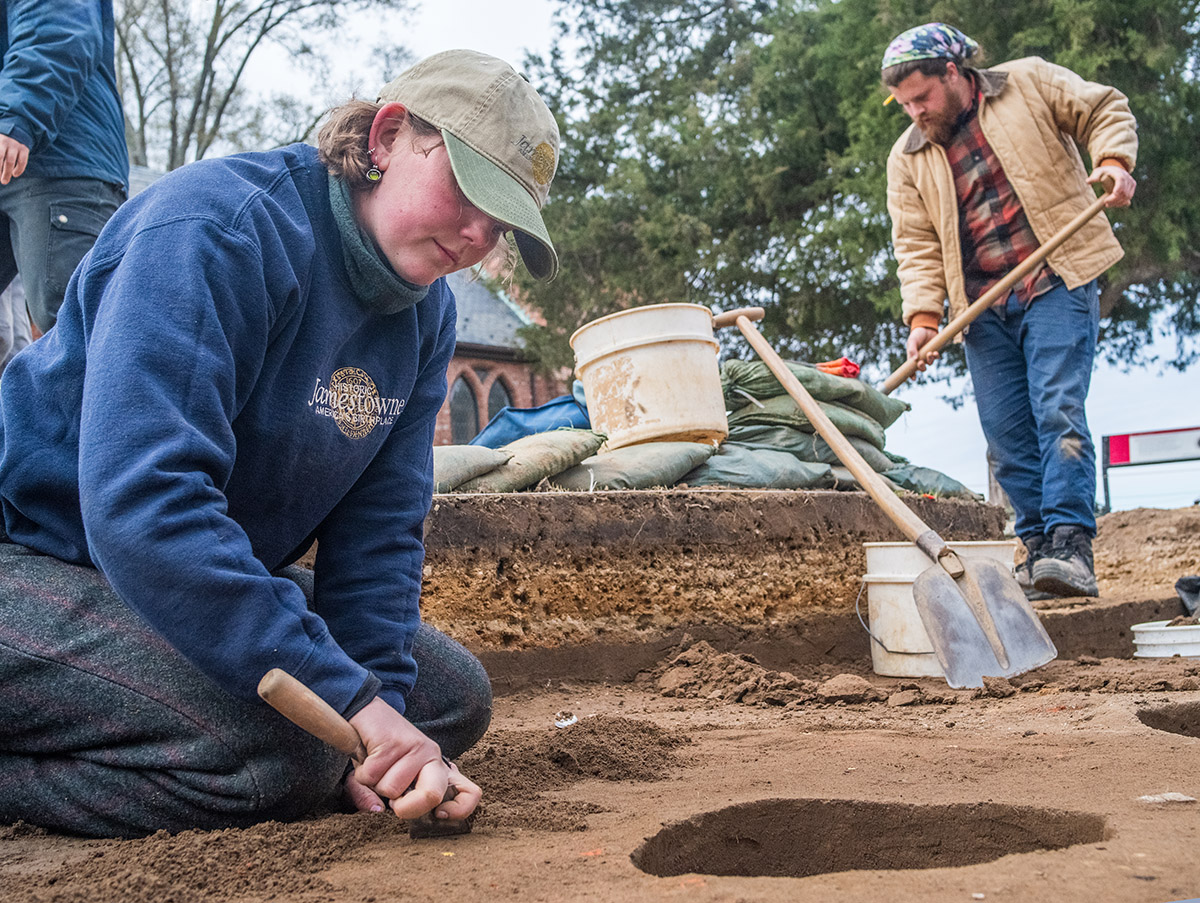
- Archaeological Field Technicians Eleanor Robb and Josh Barber at work in the North Church excavations.
-
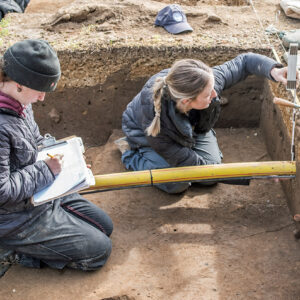
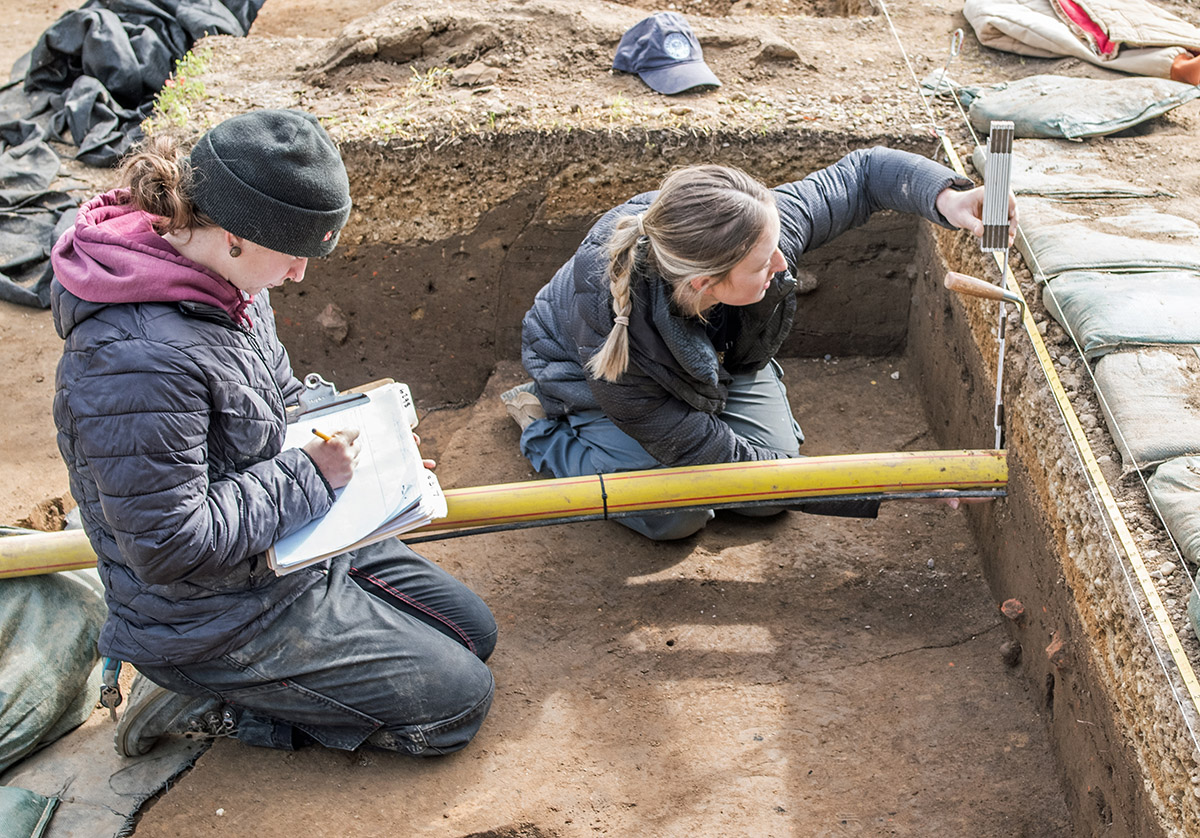
- Staff Archaeologist Ren Willis and Archaeological Field Technician Katie Griffith record measurements of different soil layers in the North Church excavations. The yellow conduit houses telecommunications cable.
-
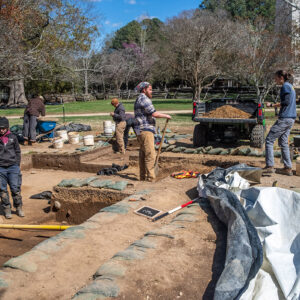
- The North Church excavations
-
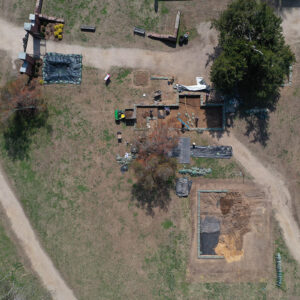
- A drone shot of the North Church excavations
-
- Director of Archaeology Sean Romo and Archaeological Field Technician Katie Griffith conduct a GPR survey of one of the burials in the North Church excavations.
-
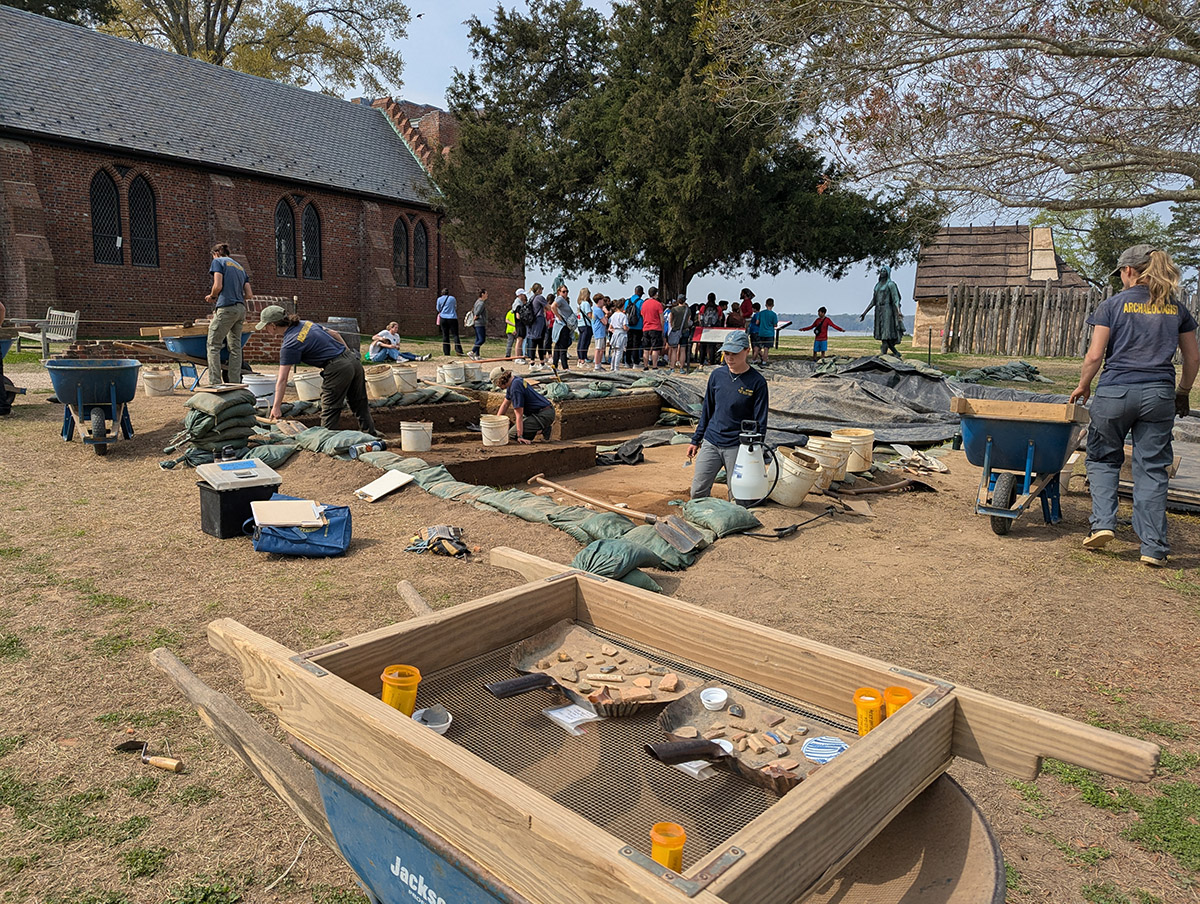
- The North Church excavations
-
- The architectural materials in the clay cap at the top of the well
-
- The 1608 palisade extension, with scored postholes seen in the foreground, is cut by a large rectangular feature. Because the feature cuts the palisade, it’s newer than the palisade.
-
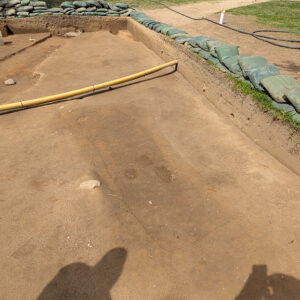
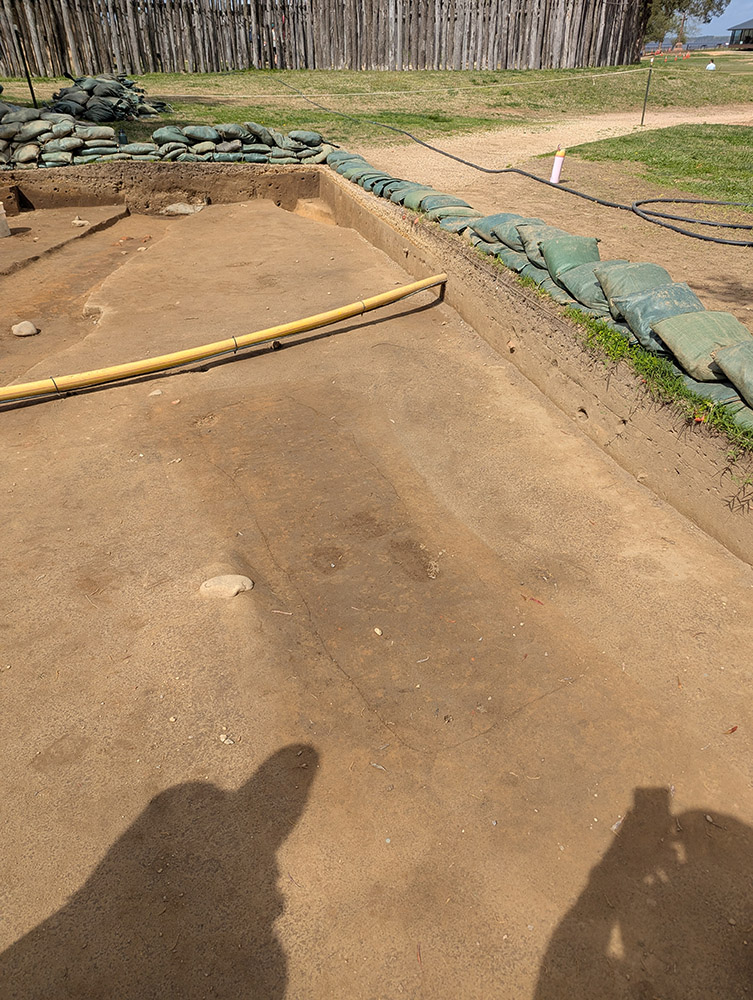
- A burial, scored by an archaeologist to make it easier to see, discovered in the North Church excavations
-
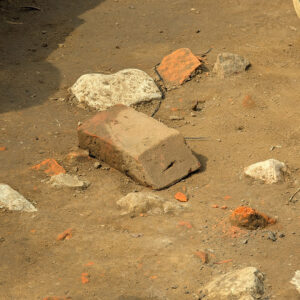
- A water table brick found in the clay cap of the well
-
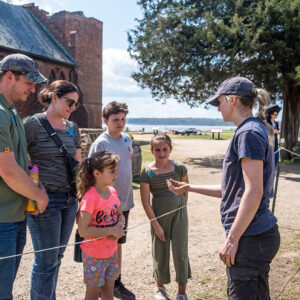
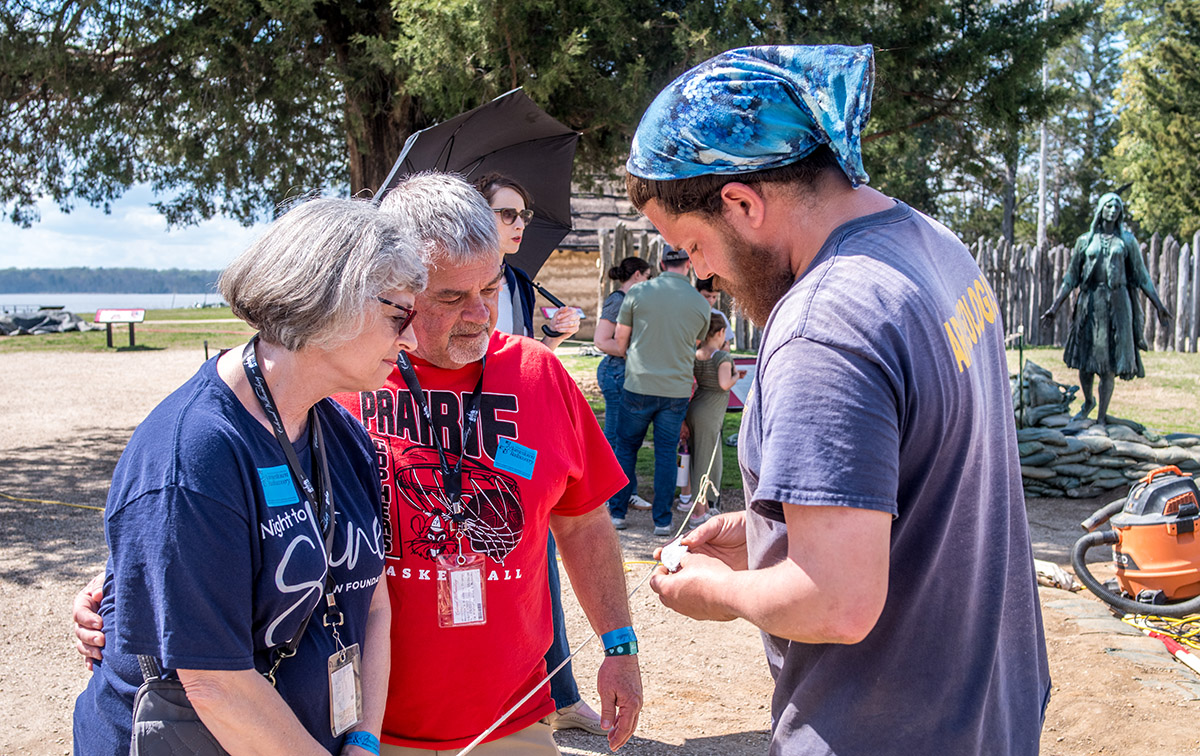
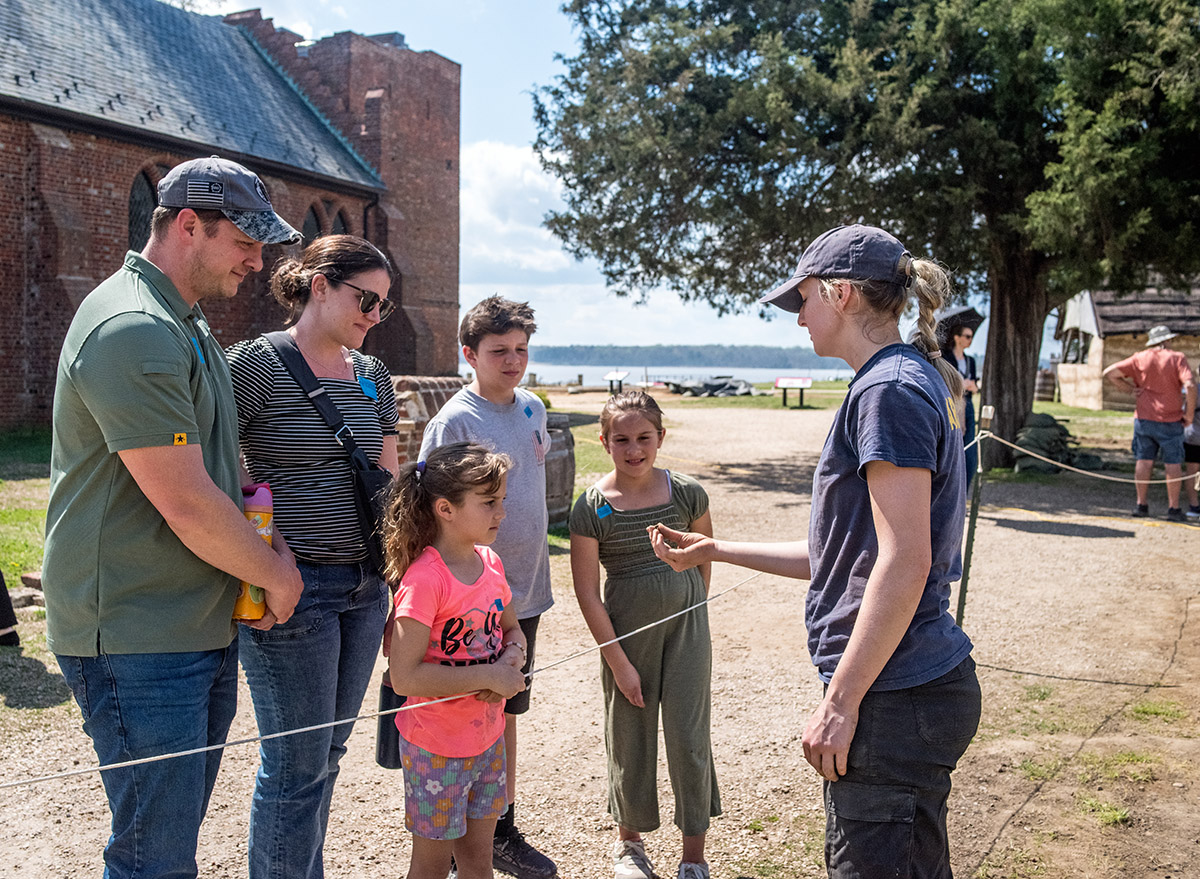
- Archaeological Field Technician Katie Griffith shares a small find with visitors.
-
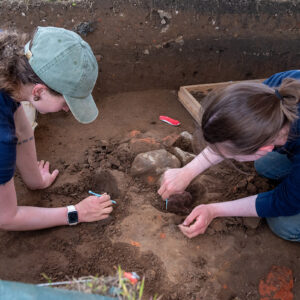
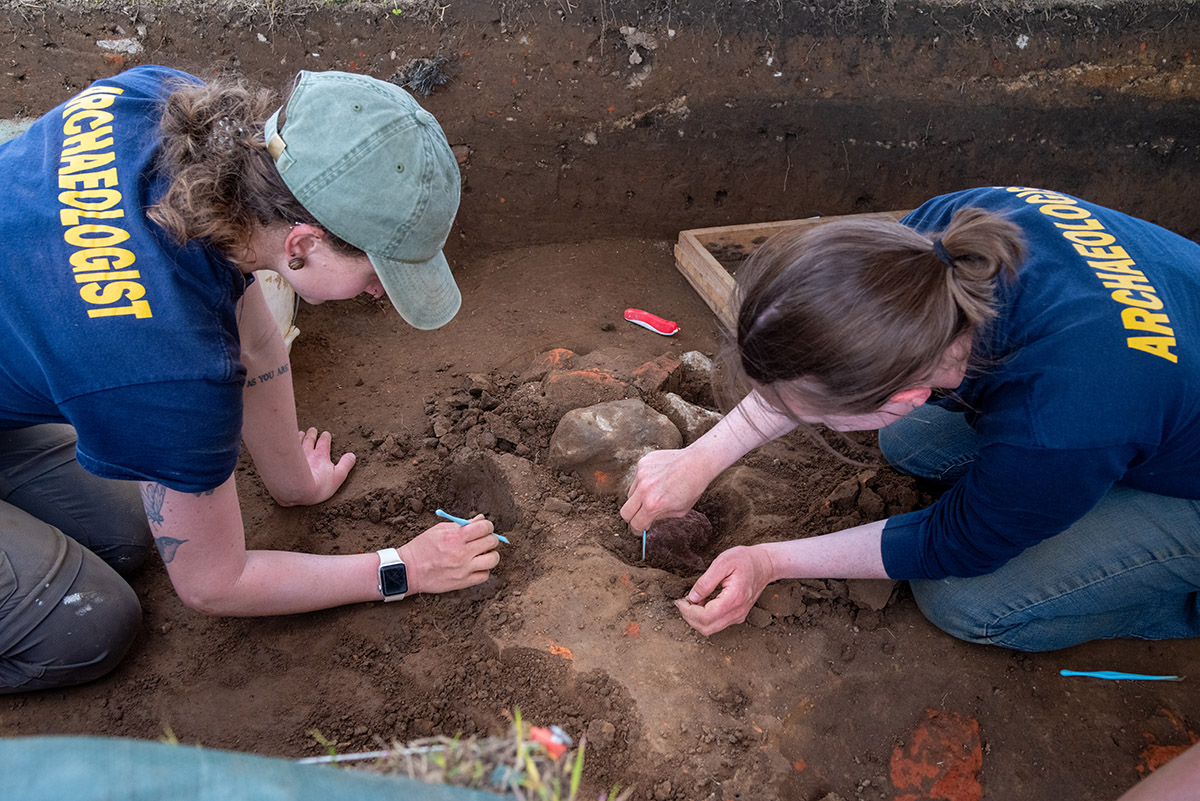
- Staff Archaeologists Ren Willis and Natalie Reid excavate artifacts from the top of the well.
-
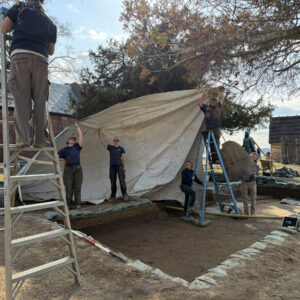
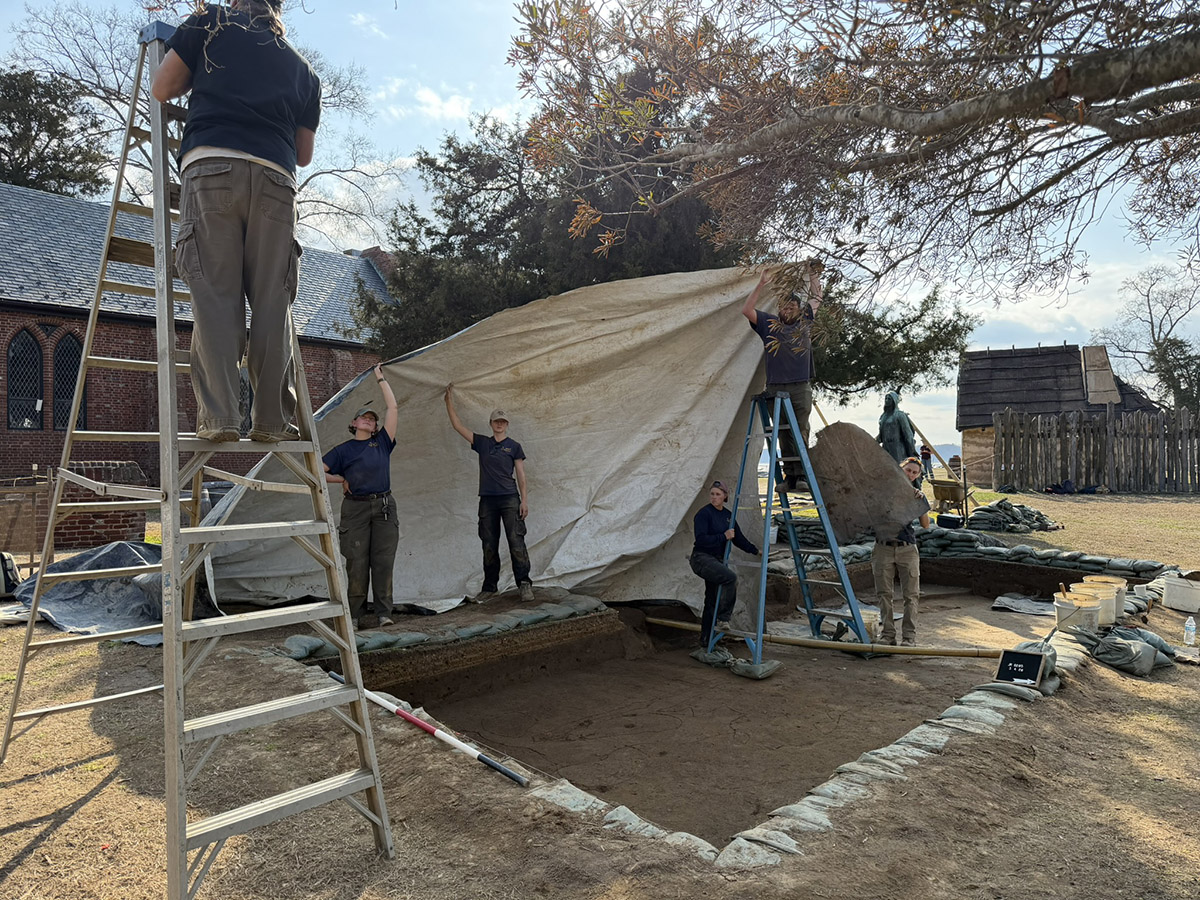
- In order to get a record shot with even lighting, the team blocks the sun while Senior Staff Archaeologist Dr. Chuck Durfor climbs a ladder to take the photo.
-
- A Dutch pipe stem found in the North Church excavations
-
- Two Virginia Indian projectile points found in the North Church excavations
-
- The projectile points and a cobble in situ
-
- A chunk of mortar found in the clay cap of the well
-
- Archaeological Field Technician Josh Barber searches for more pieces of the slate.
-
- The slate piece found in the North Church excavations
-
- Archaeological Field Technician Josh Barber examines the slate piece he found in the North Church excavations.
-
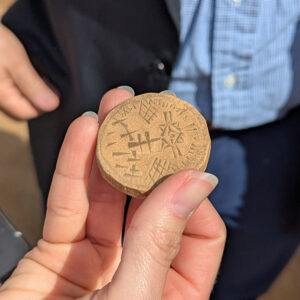
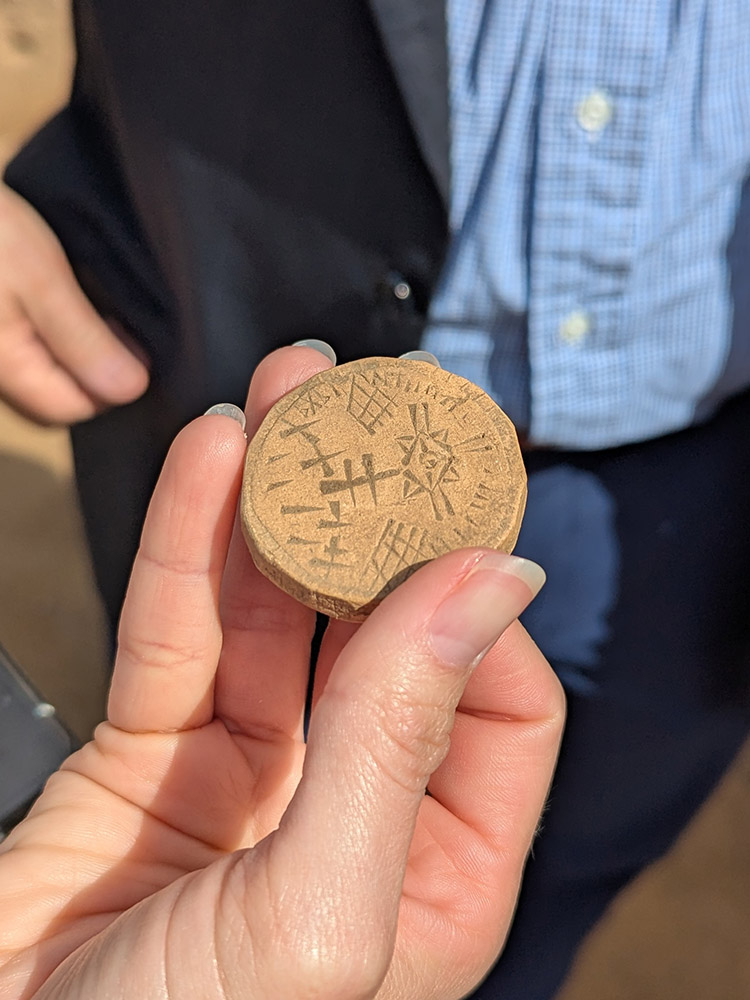
- An interesting clay disc found in landscaping layers in the north Church excavations. It likely is modern, probably dating to the twentieth century.
-
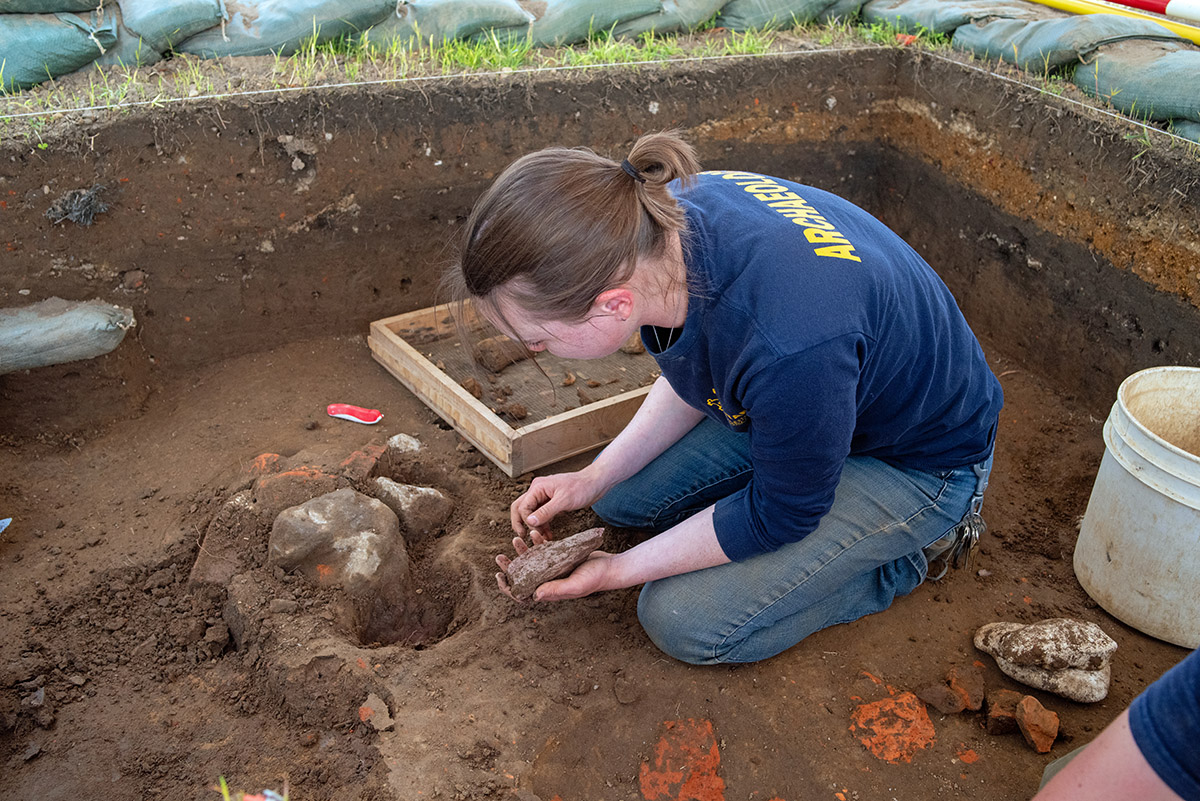
- Staff Archaeologist Natalie Reid excavates cobbles from the top of the well
-
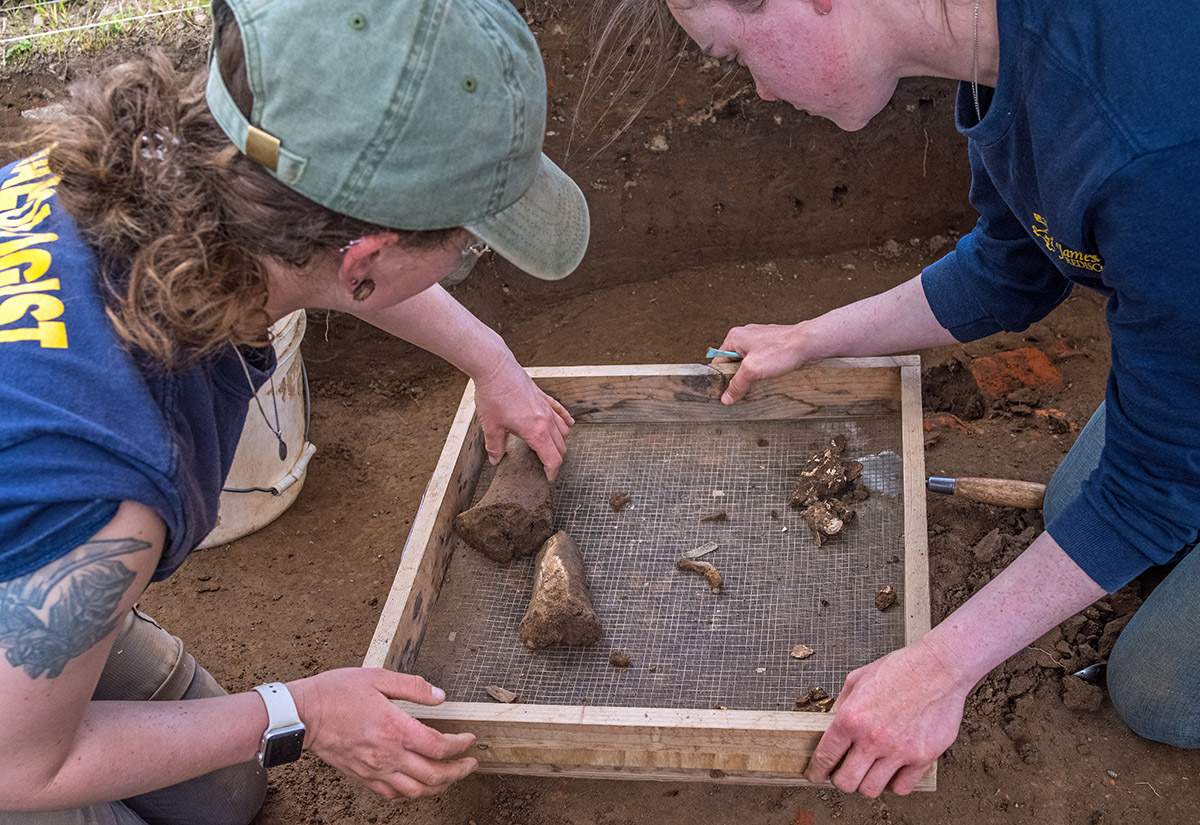
- Staff Archaeologist Ren Willis places a large mammal bone she excavated into a tray
-
- Cobbles, coral, limestone, and animal bones fill a screen of artifacts found in the North Church excavations.
-
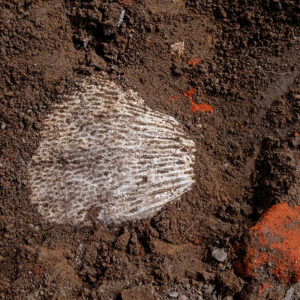
- A piece of coral found in the top of the well
-
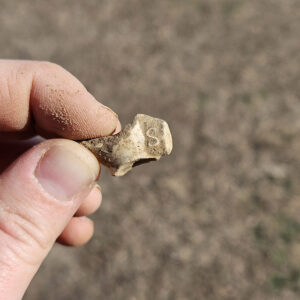
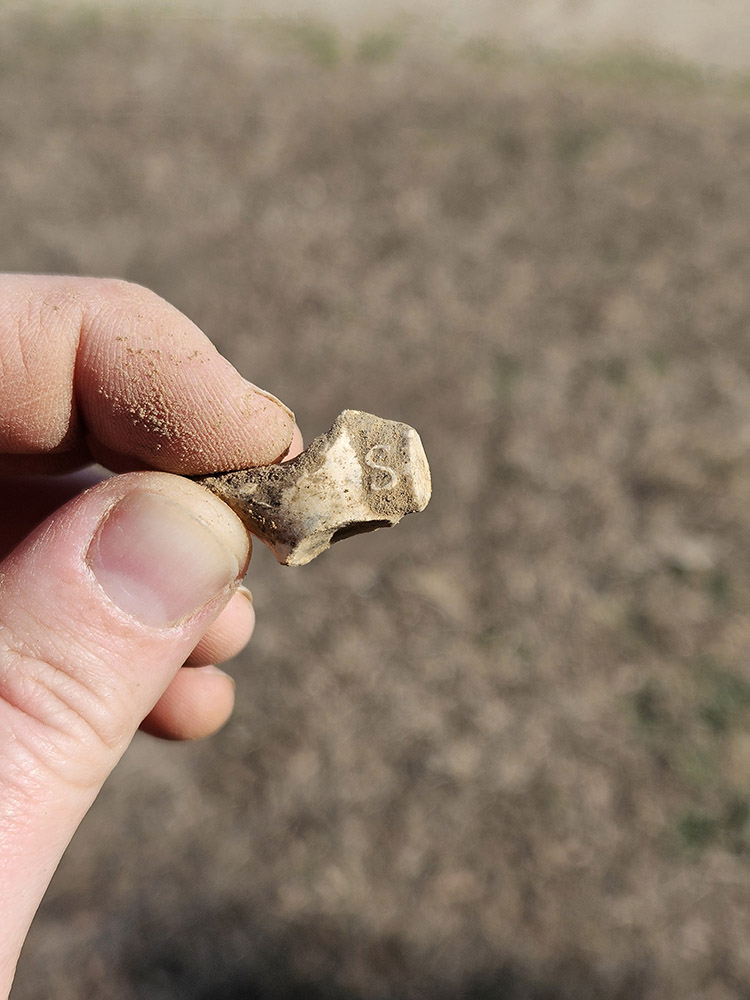
- A partial pipe bowl stamped with an “S” found in the North Church excavations
-
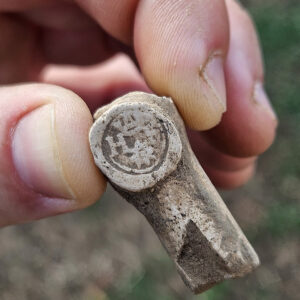
- A partial pipe with a stamped heel found in the North Church excavations
-
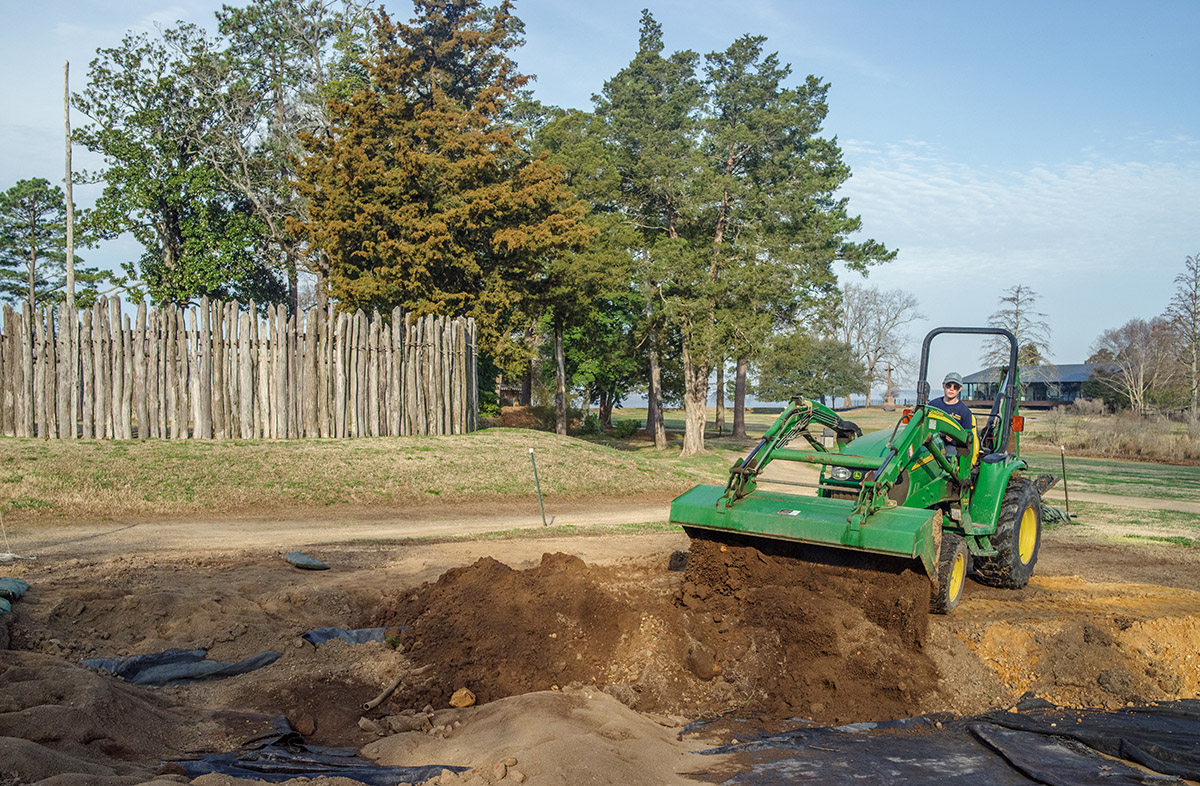
- Staff Archaeologist Natalie Reid uses a front loader to backfill the cellar excavations.
-
- As construction workers construct the new pathway in the distance, a temporary one allows visitors access to the Archaearium museum.
-
- Tiny clam shell beads found in the fort’s first well
-
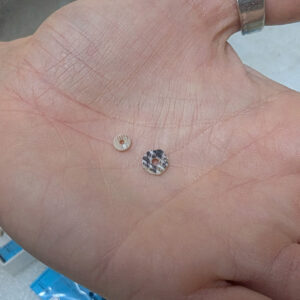
- Two mussel shell beads
-
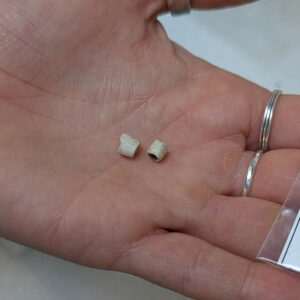
- Two whelk shell beads
-
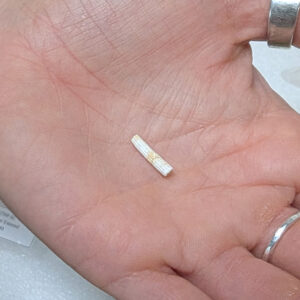
- A dentalium shell bead
-
- The Potomac Creek pot is back on display in the Archaearium after being mended with new sherds.
-
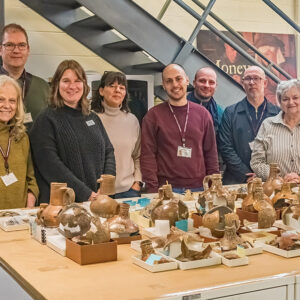
- The “Bartmann Goes Global” group and staff take a photo with Jamestown’s Bartmann jug collection.