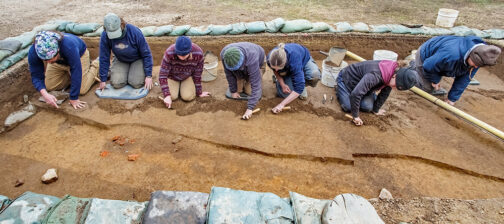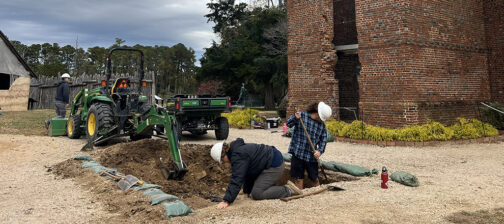
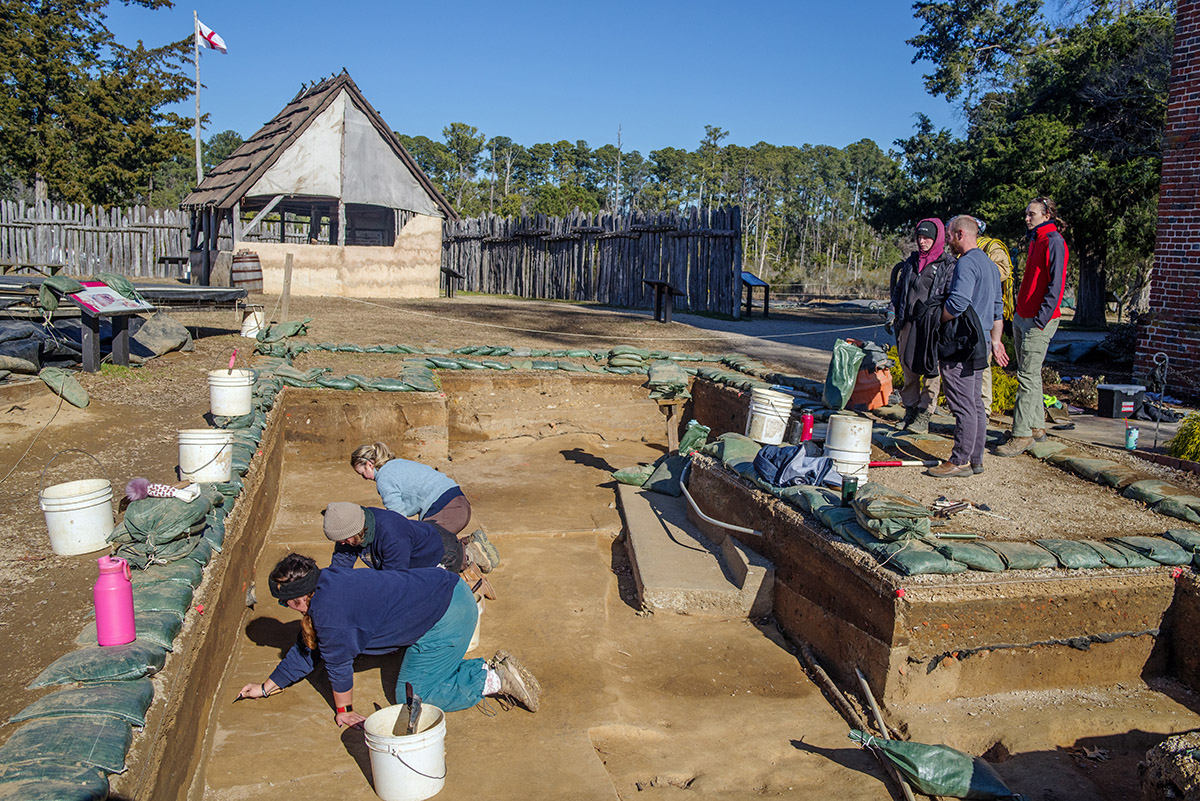
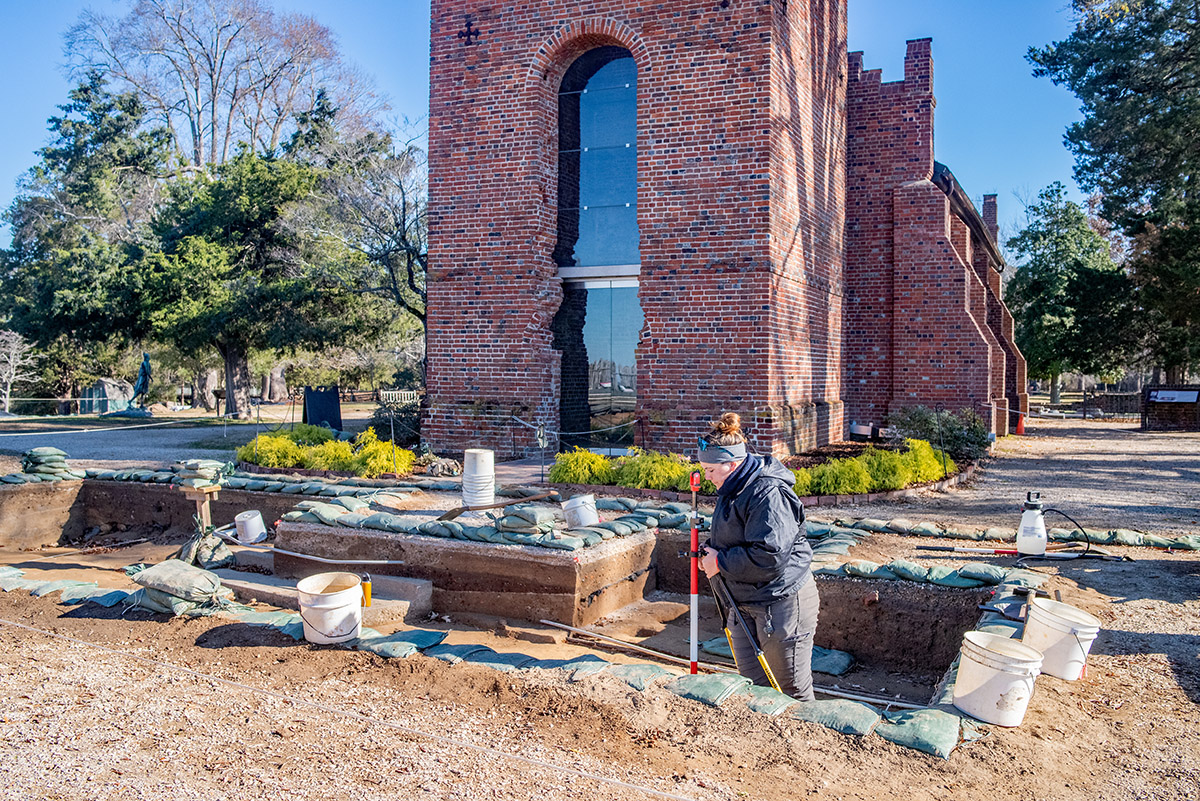
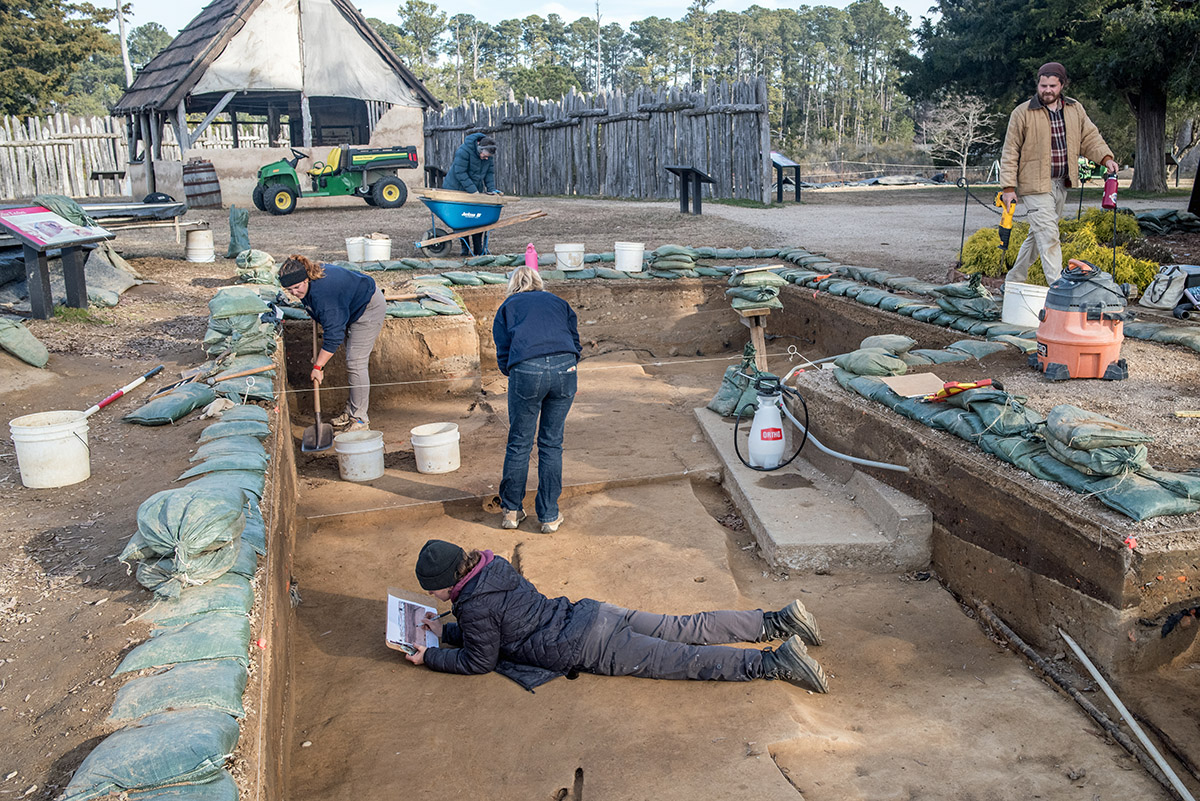
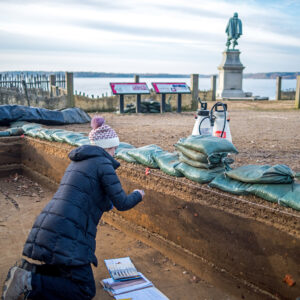
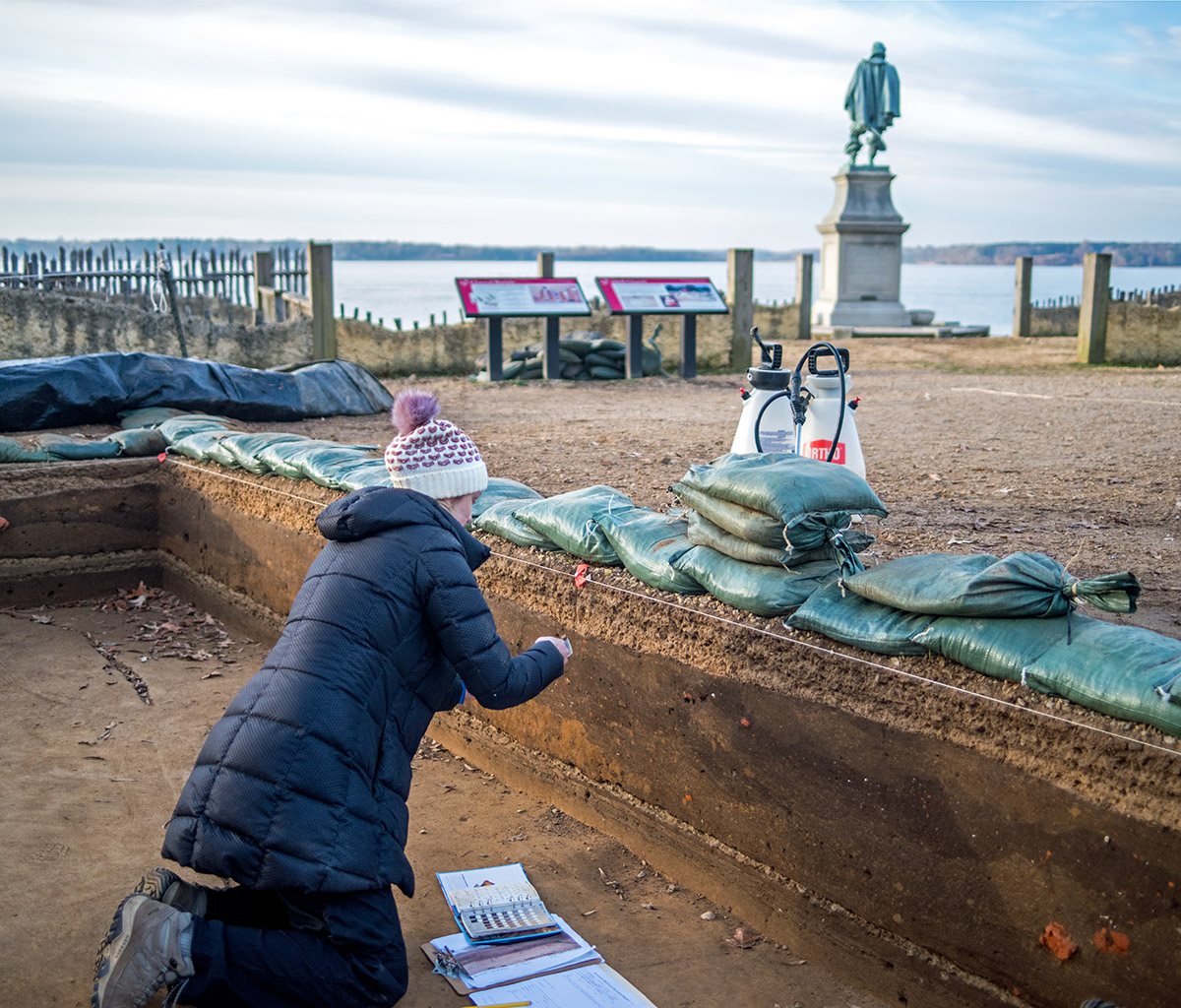
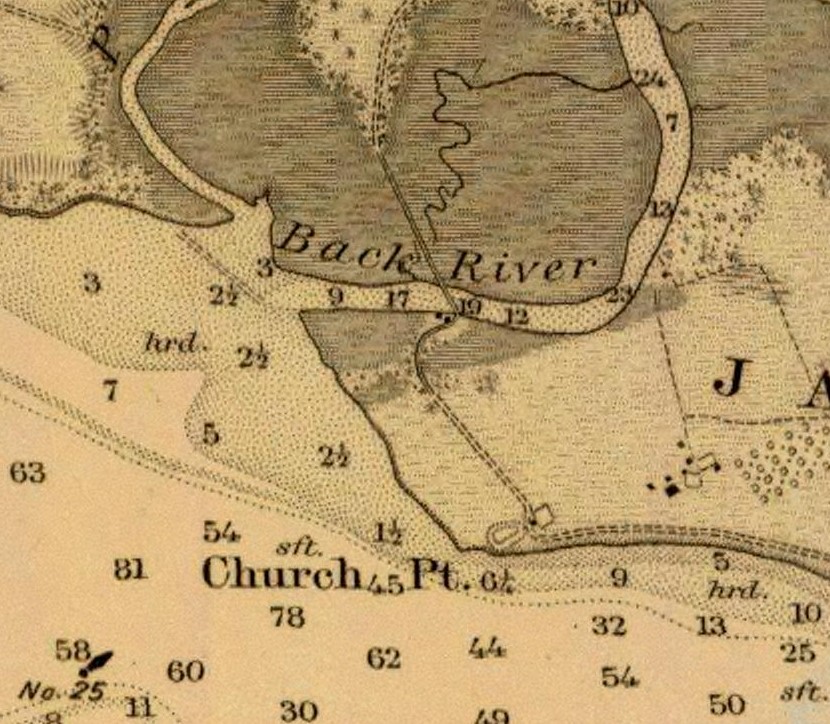
Just west of the 1680s Church Tower, the only surviving above-ground 17th-century structure at Jamestown, the archaeology team continues their excavations of the areas that will be affected by upcoming site improvements. A new, improved drainage system for the Church Tower and Memorial Church is scheduled to be installed in 2026 as is a new path for the Preservation Virginia portion of the site. The archaeologists, led in these excavations by Staff Archaeologist Ren Willis, are eager to prevent damage to any archaeological resources in the proposed path of these site improvements. To this end, they are conducting excavations to designate safe areas for any infrastructure that will disturb the soil. The team is finding evidence of a dirt road that ran right in front of the Church Tower, in the form of soil stains and even wagon wheel ruts. The road shows up on maps from the late nineteenth century and lasted until 2004 when extra soil was added to build up the landscape.
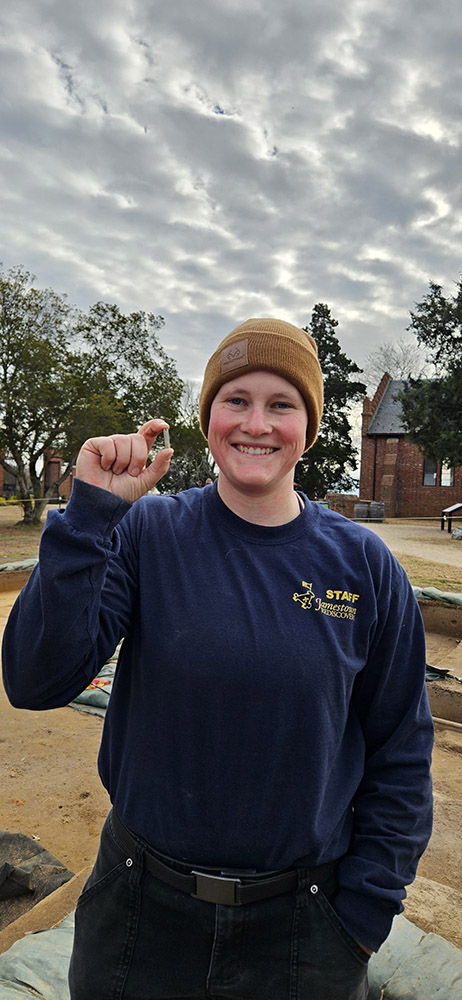
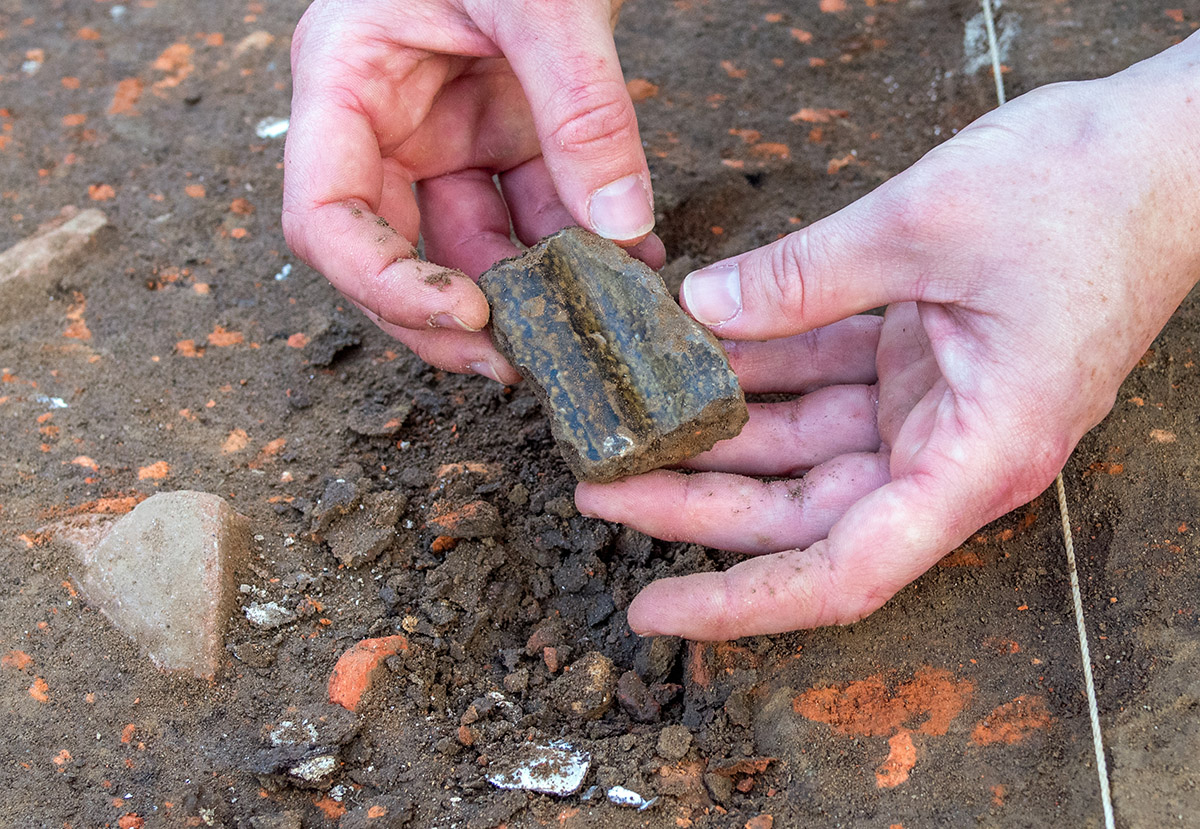
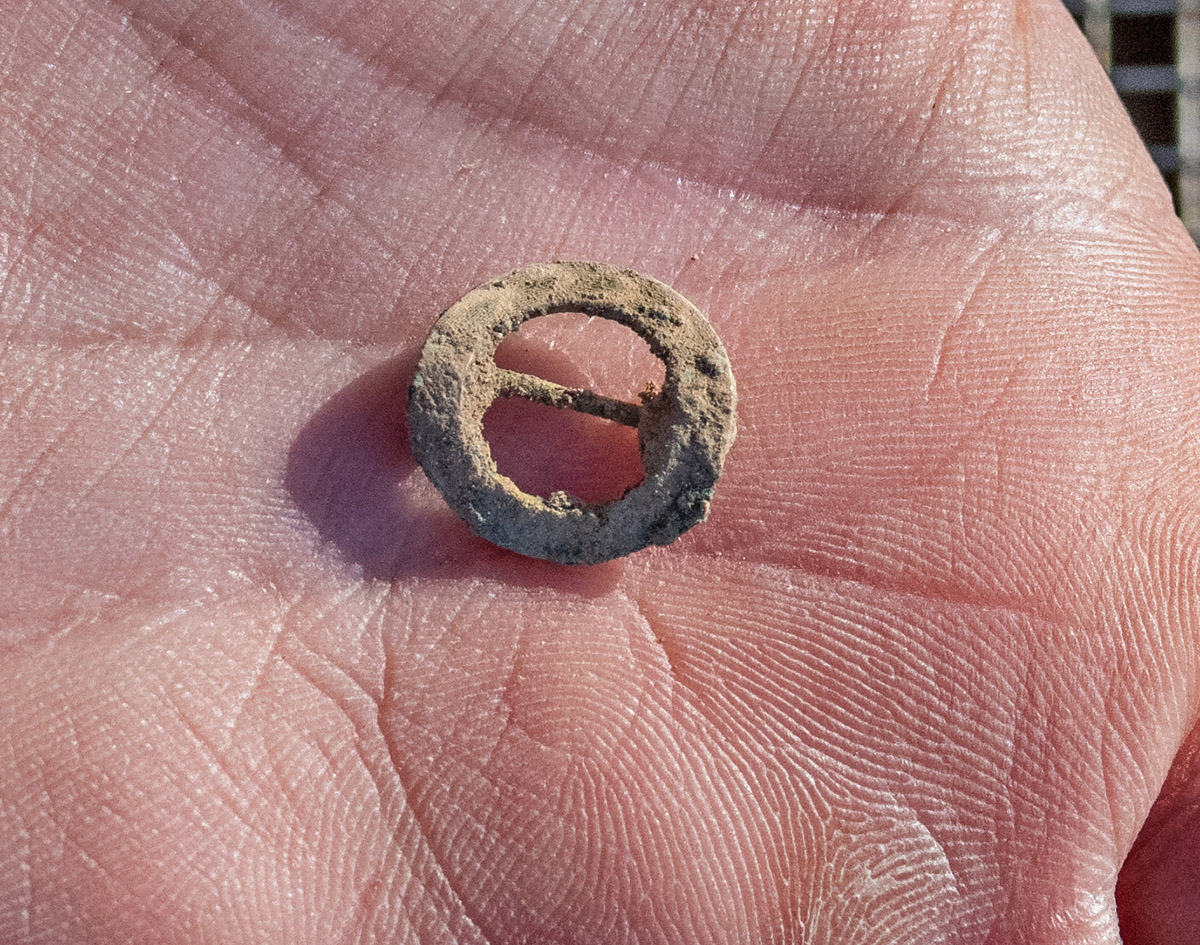
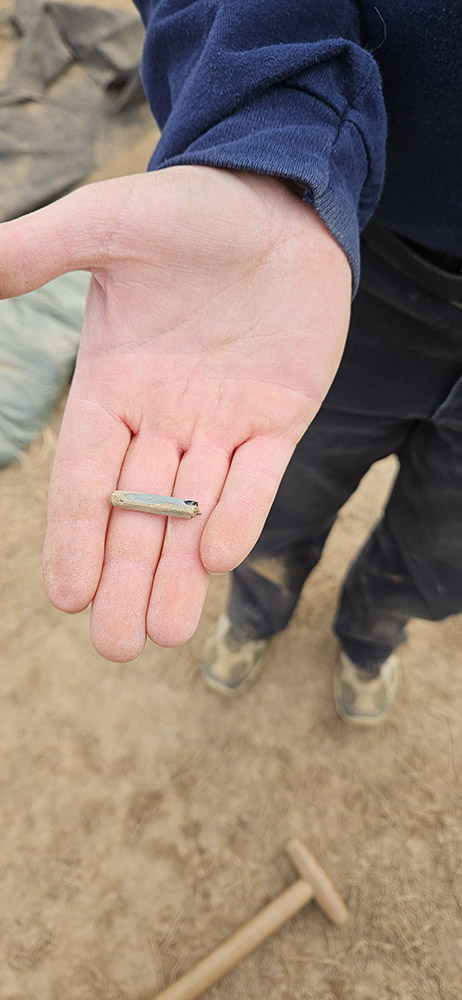
Several unknown features have turned up, including a posthole that belongs to the structure known as “the Quarter”, an early fort-period building running parallel to the eastern palisade wall. Twentieth-century concrete and granite steps leading from the road to the Tower were daylighted by the team; these will be left in place unless features are found that appear to be cut by them. Artifacts have been few and far between. A sherd of North Devon gravel-tempered ware and an early twentieth-century pin or brooch were found here this month.
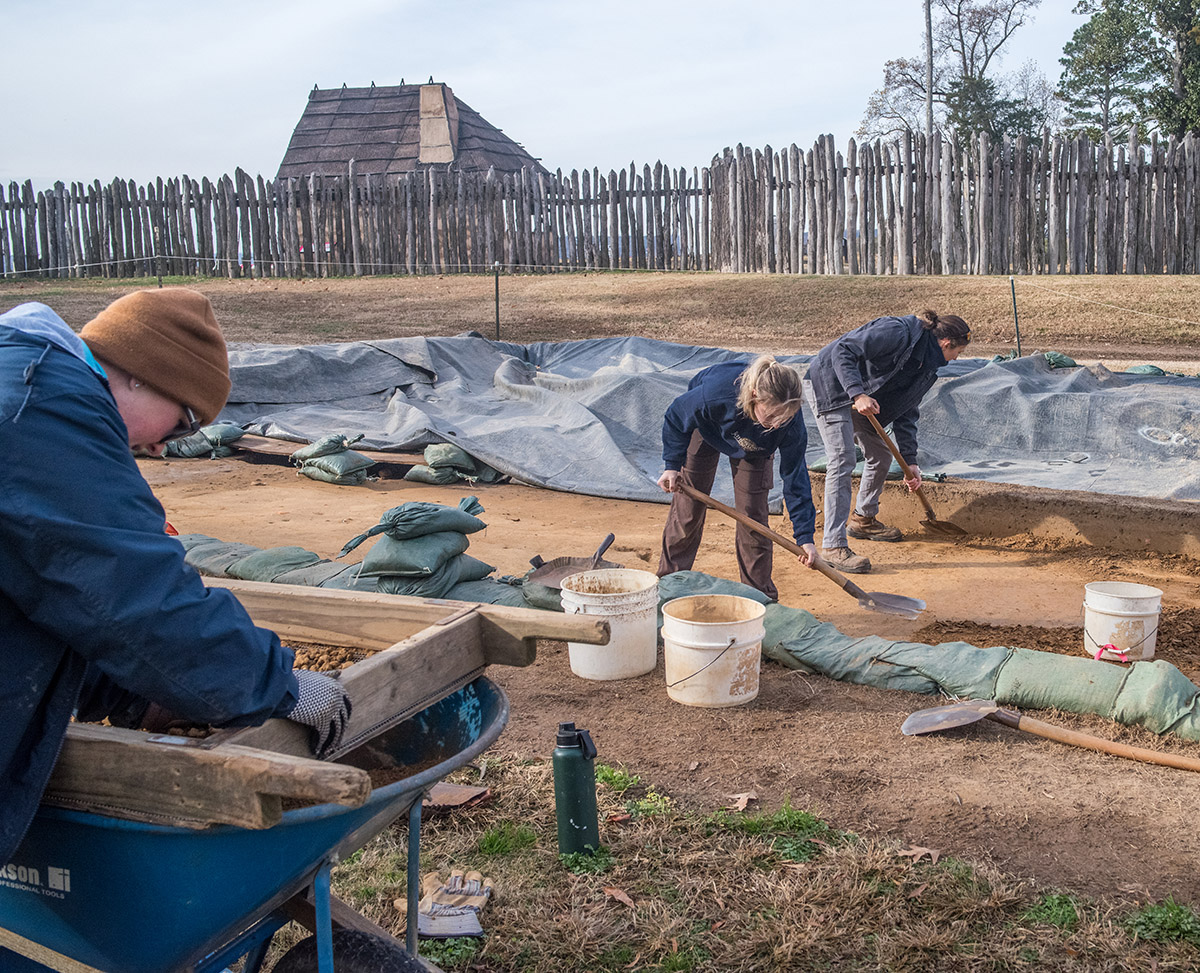
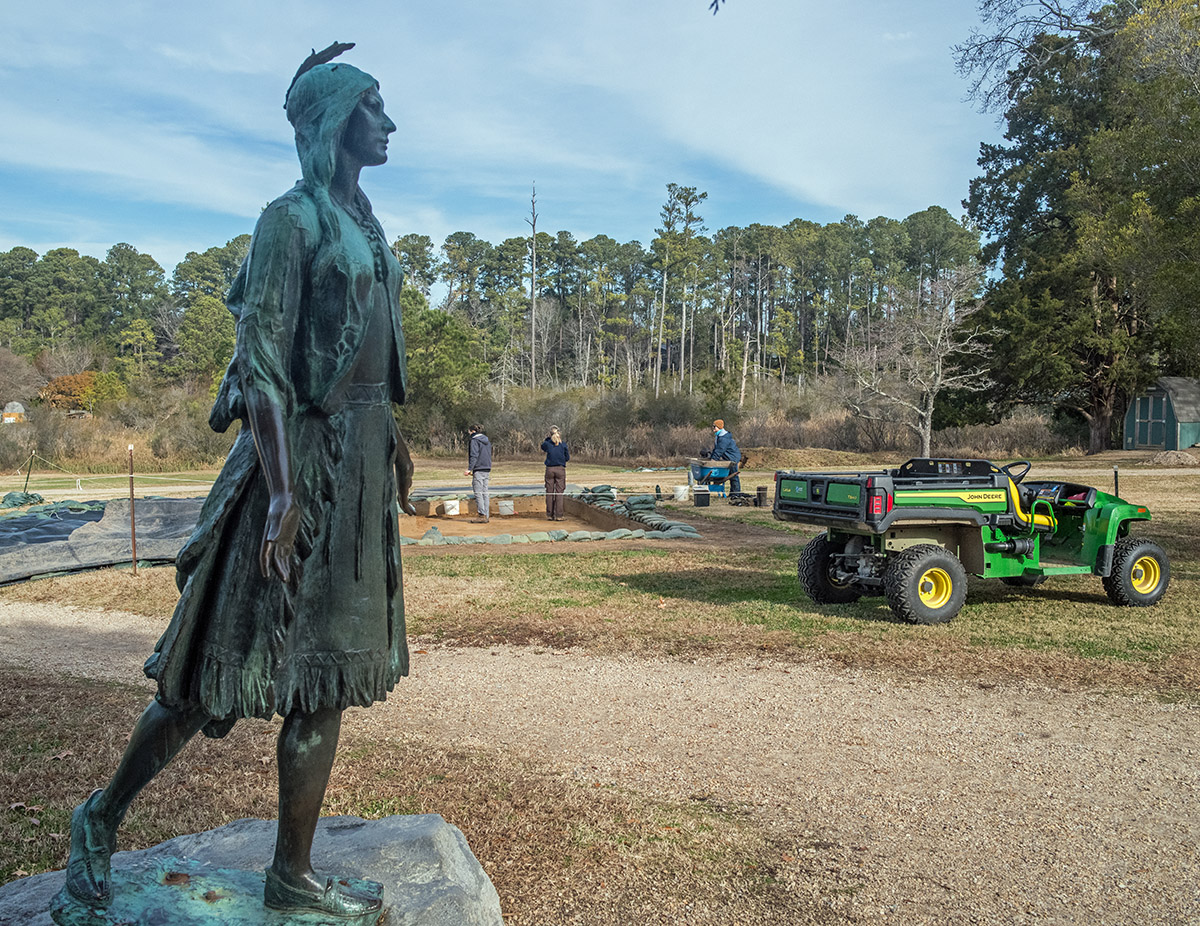
Another feature being affected by the upcoming capital improvements is a cellar a few yards to the north of the Church Tower. Thought to date to the late 17th century, the cellar (and the house above it) may have belonged to John Howard, a tailor who purchased this land in the 1690s. Because heavy vehicles involved in the upcoming construction projects will use a dirt road adjacent to the cellar to access the construction sites, the team will be backfilling the excavations here to protect them until the projects are complete. The archaeologists are preparing for the backfilling by finishing the excavations as they stand, without going deeper into the cellar.
Several postholes have been found in these excavations, probably related to the house above the cellar. A very small burial, just over four feet long, was found during the dig here, the latest of several found in this area, seemingly haphazardly oriented, whereas typically burials are situated with respect to some nearby feature or pointed towards the east, towards Jerusalem. It is believed these burials predate the cellar.
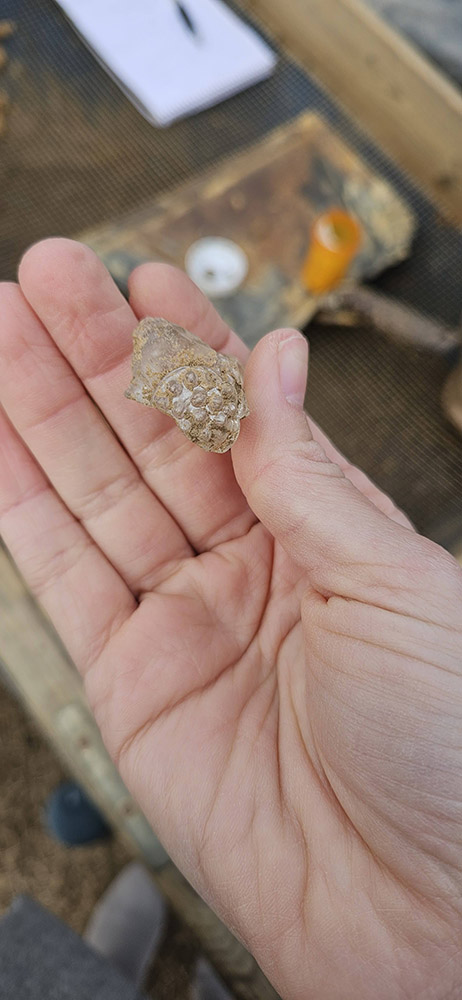
A large circular feature centered atop the cellar may be the result of the cellar being left open after the house above was torn down, perhaps to rob the bricks for another project. This sign of erosion suggests the area was either open temporarily during deconstruction or just incompletely filled in. Future excavations may yield additional clues. The archaeologists haven’t found any stairs yet, but a cellar of this size (16’x24′) should have them, so hopefully they’ll turn up in a future dig. While the team will do limited testing in the same area during construction, the entirety of cellar will not be investigated until after the construction is complete, likely in 2027. The archaeologists are eager to continue the dig here but the necessity of protecting the site and keeping the archaeologists safe during construction takes precedence. Among the artifacts found here this month are a colorless raspberry prunt for a drinking glass and a Nueva Cadiz bead.
This month several members of the Jamestown team traveled to the University of Connecticut to transport human remains from this year’s burial excavations for DNA extraction and processing. Director of Collections and Conservation Michael Lavin, Director of the Voorhees Archaearium Museum Jamie May, and Associate Curator Emma Derry met with Drs. Deborah Bolnick and Raquel Fleskes, and graduate researchers Lucy Owusu and Abigail Interrante. The group discussed the results of the processing of past years’ DNA analysis and plans for the project moving forward. A paper on the progress of this bioarchaeology project, titled “Ancient DNA from the First Colonists at Jamestown Reveals Distant Kinship Patterns and European Origins” will be presented by Drs. Fleskes, Bolnick, Mr. Lavin, and others at the 2026 Annual Meeting of the American Association of Biological Anthropologists in Denver.
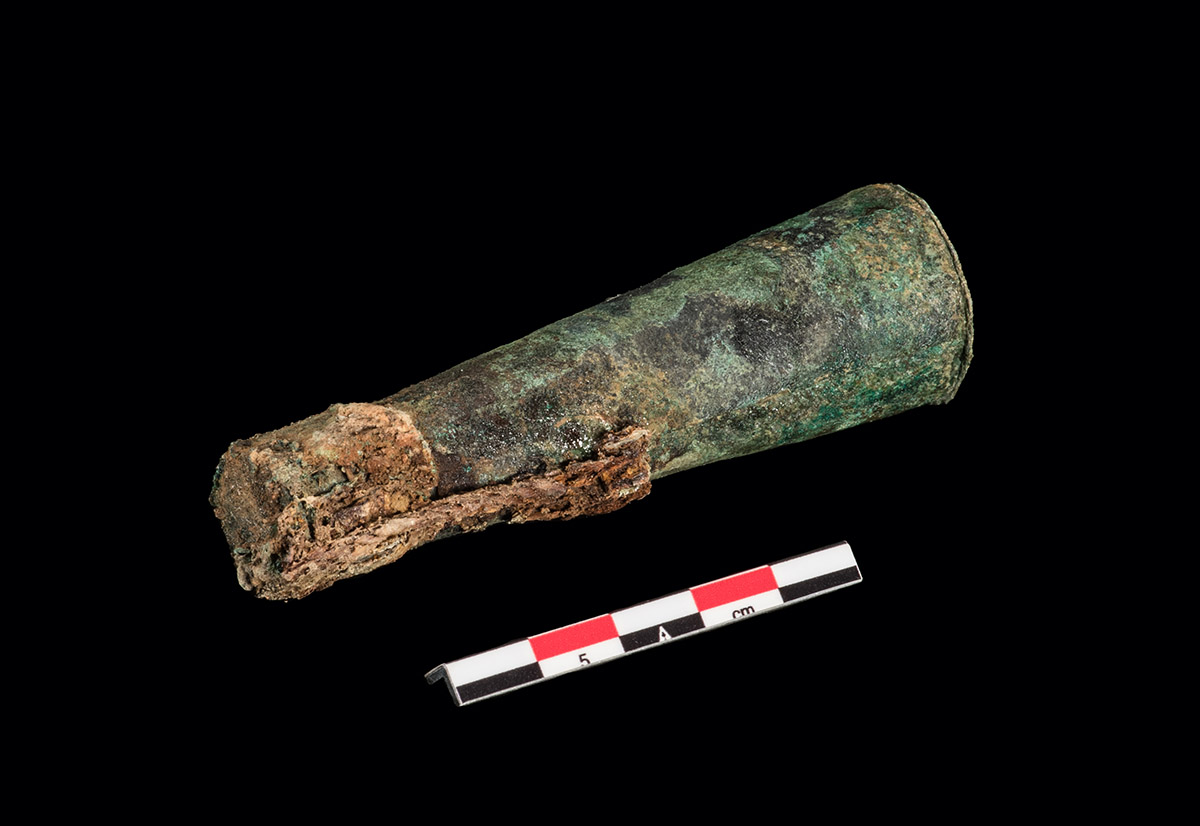
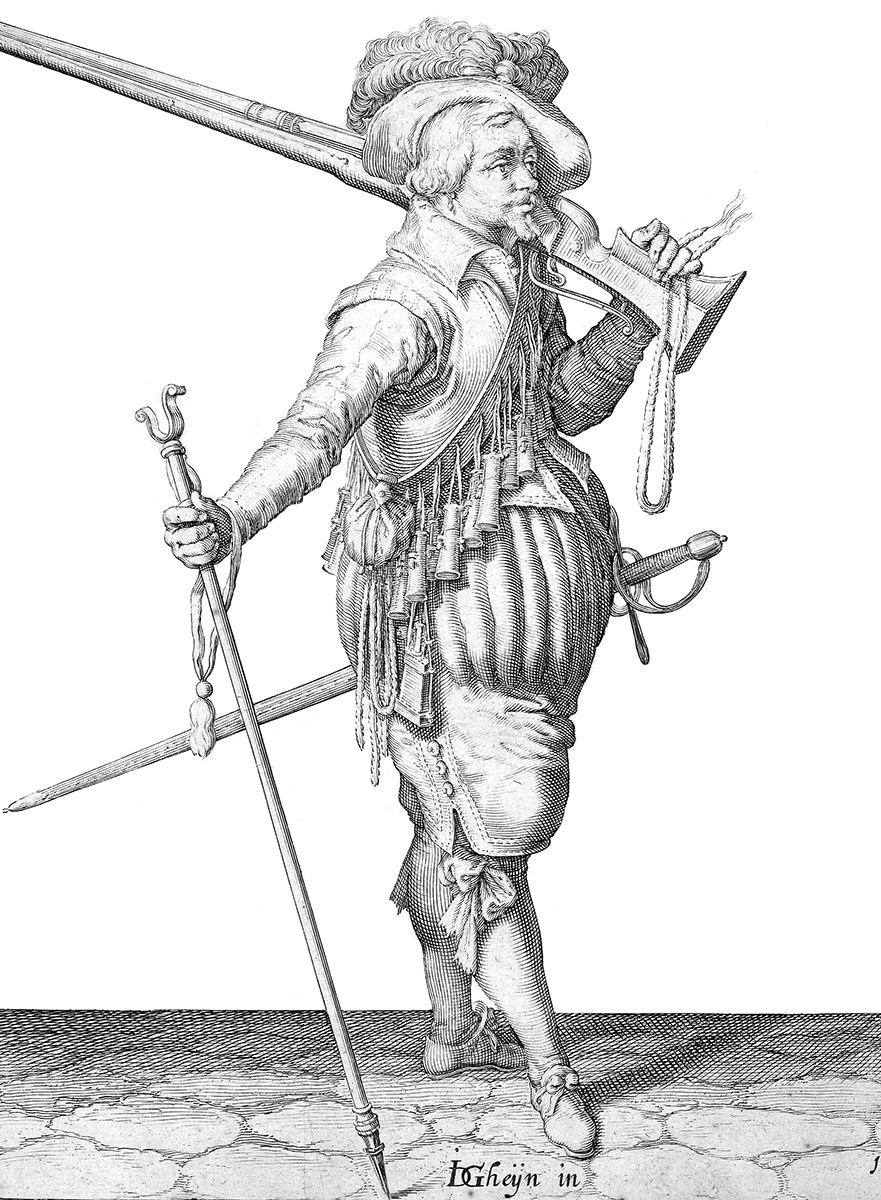
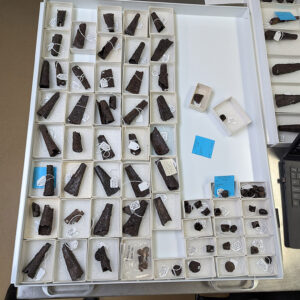
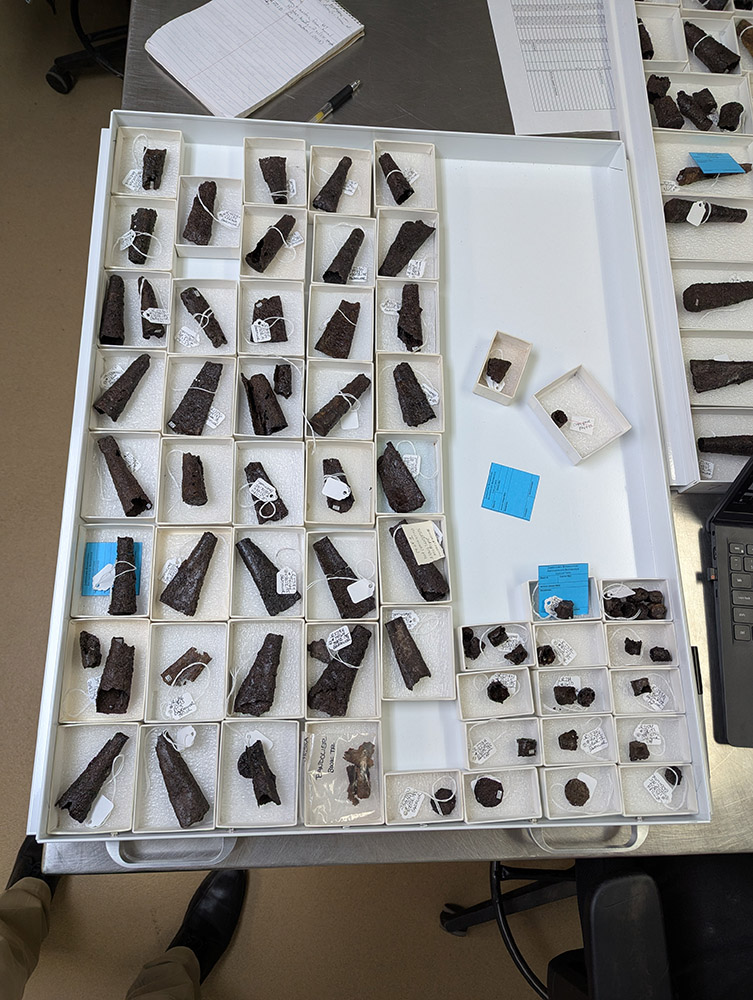
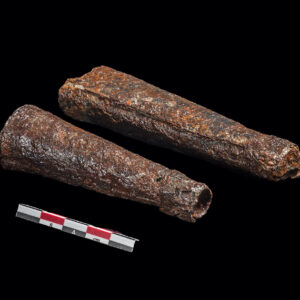
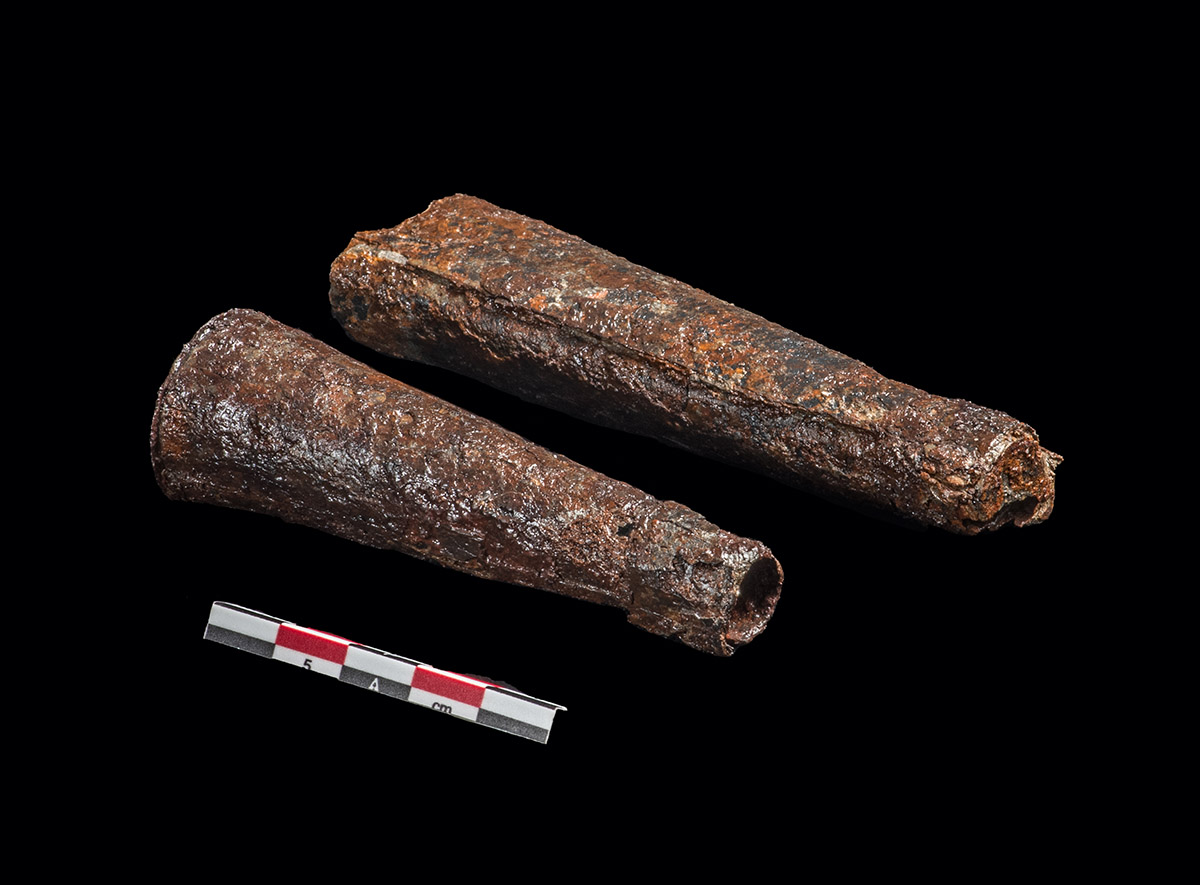
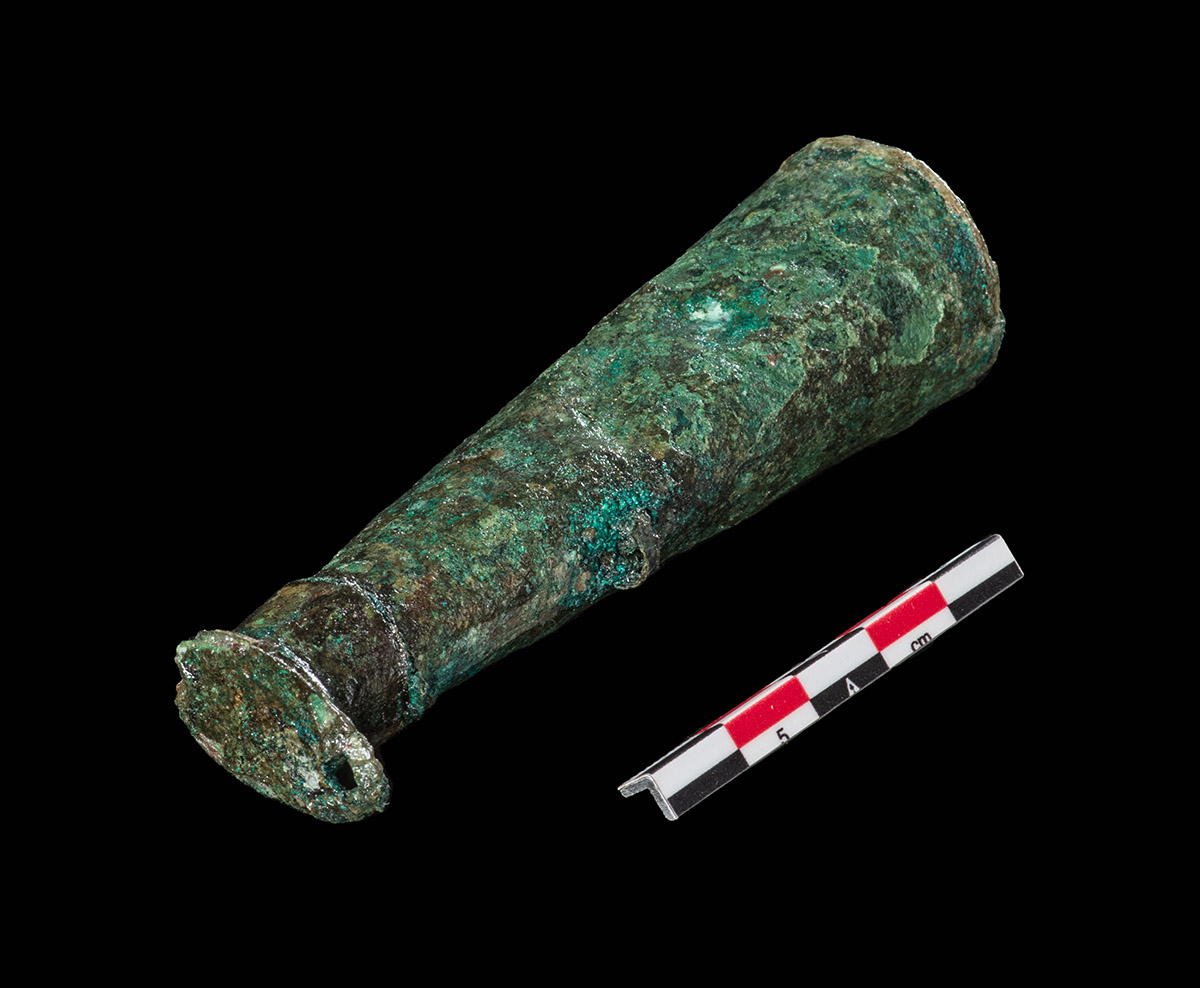
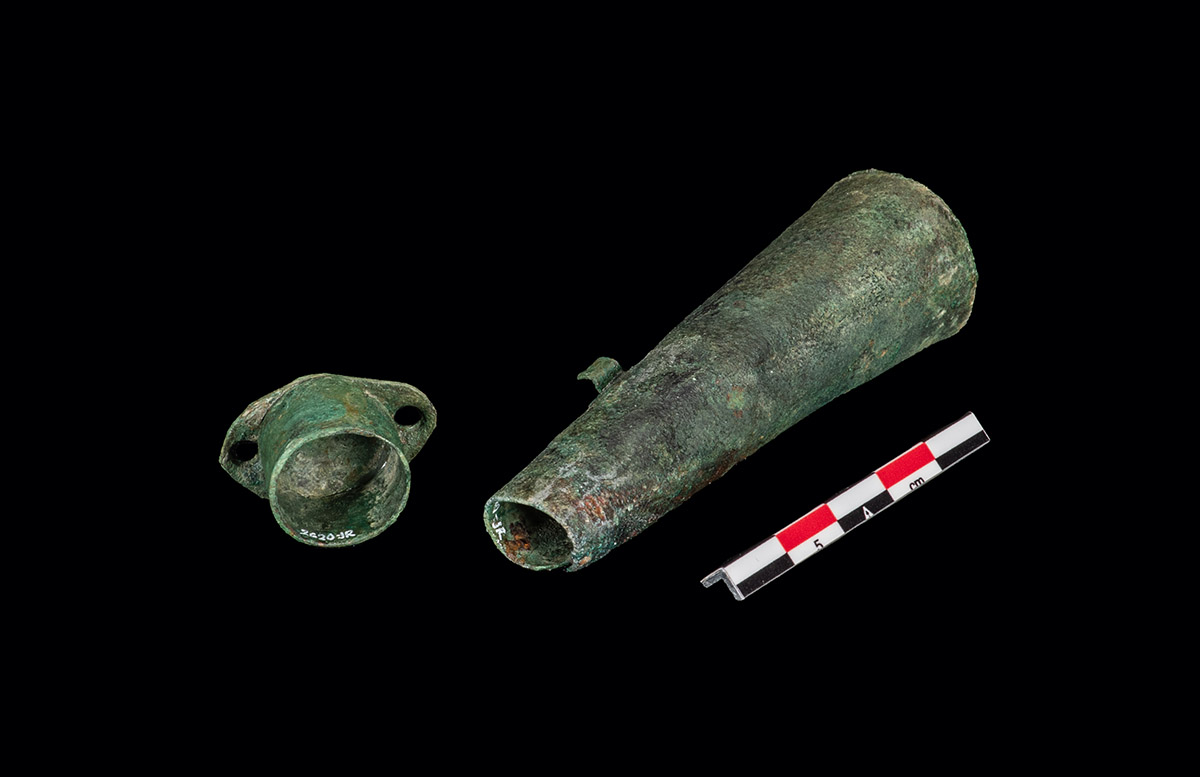
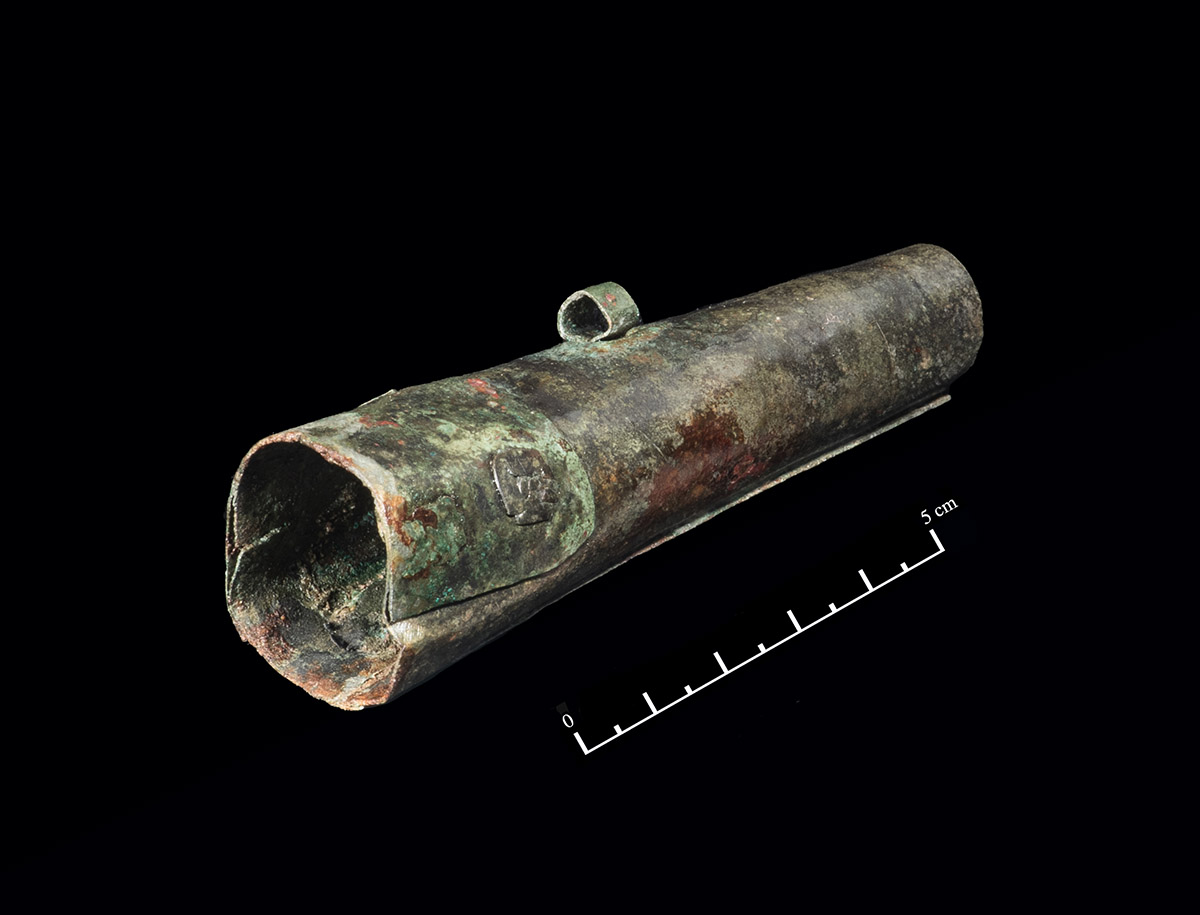
Associate Curator Janene Johnston is studying Jamestown’s bandoliers this month as the latest artifact type to be included in the reference collection. These bottles would have held one charge of gunpowder for ease of loading and preparing the musket. There are two general sizes of bottles in the collection, indicating different amounts of gunpowder. The larger ones were likely for the full-sized musket, while the smaller bottles could have been used with arquebuses or cavalier muskets. The cylindrical containers were attached via cords or strings to a strap worn diagonally from the gunman’s shoulder down to his opposite side near the waist. In the 17th century, the full set would often be referred to as a collar of charges. Our archaeologists have even excavated delft tiles with the illustrations of bandolier-clad musketeers. Coasters from Jamestown’s gift shop bear one of these illustrations.
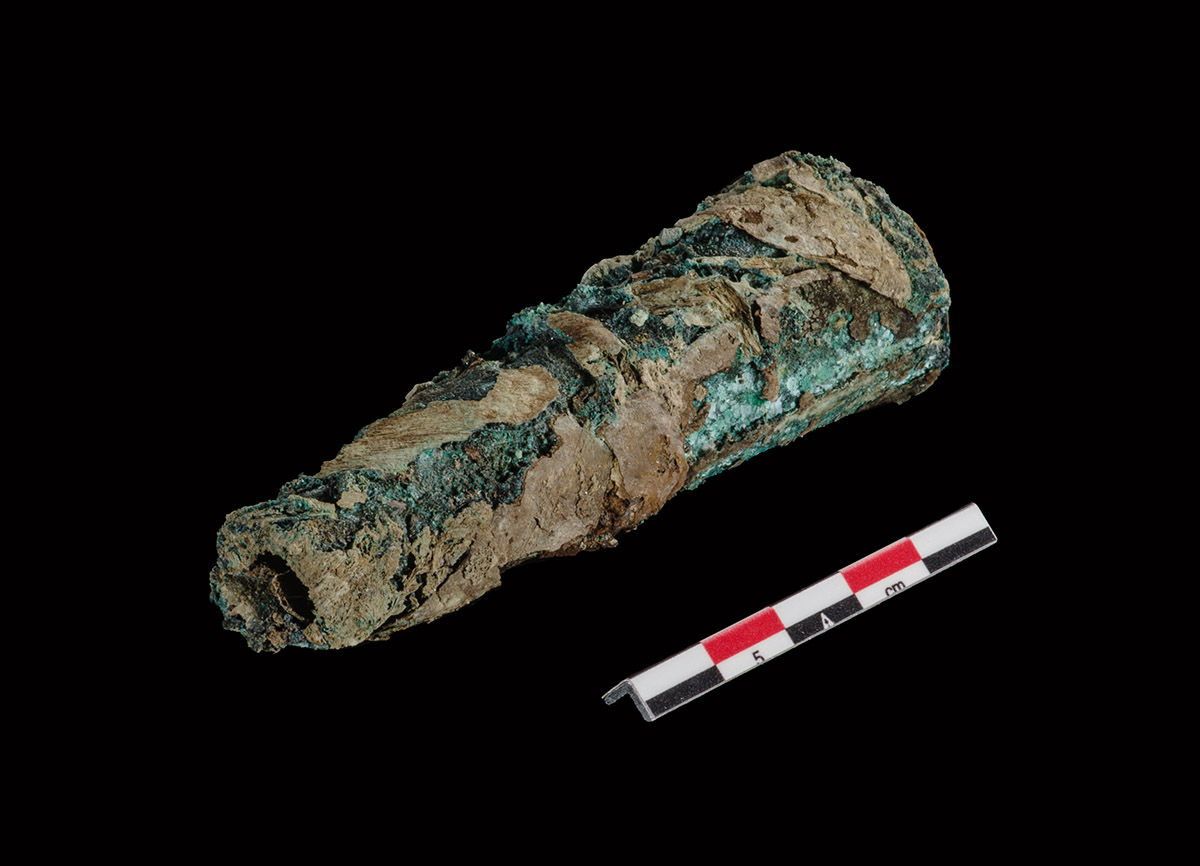
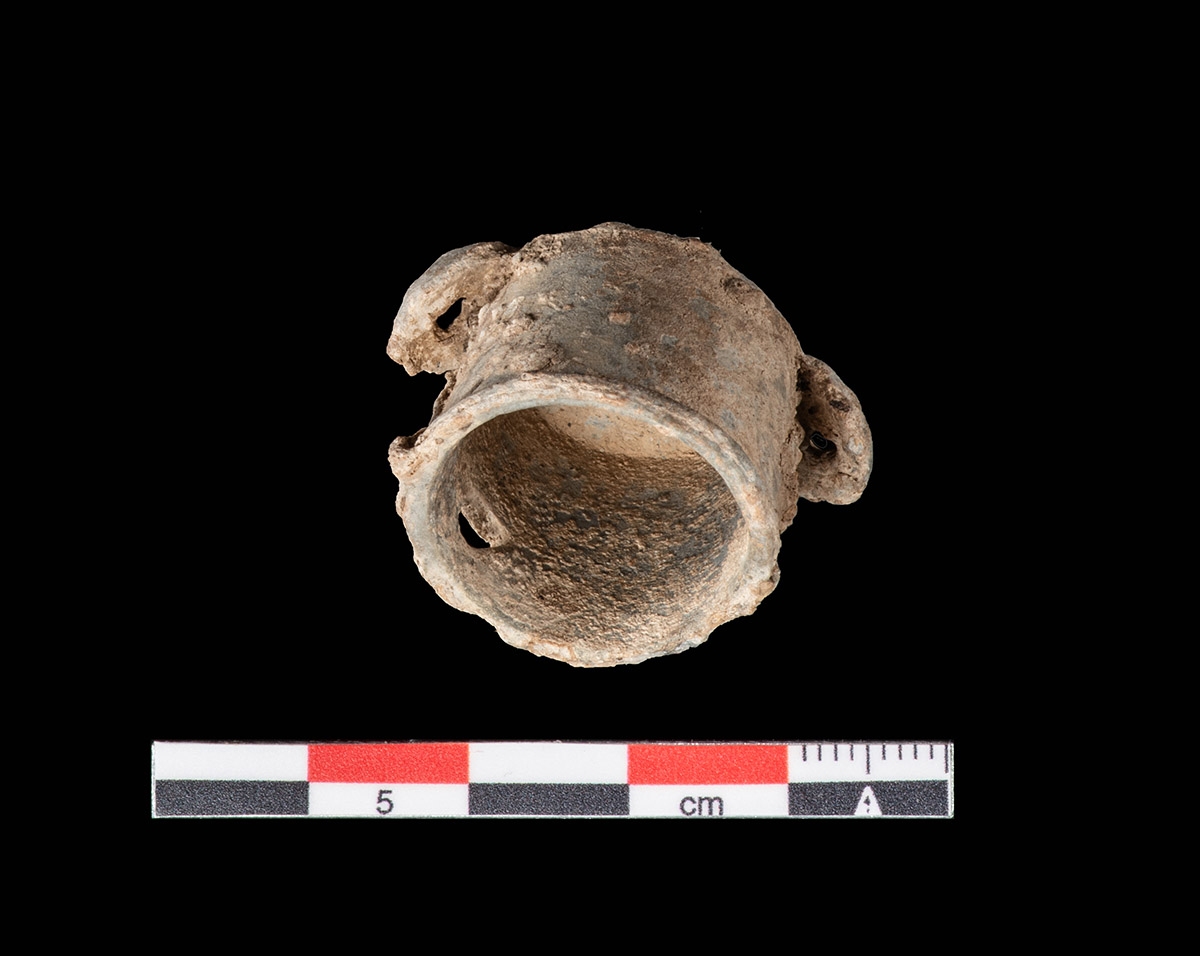
Over 2,200 bandolier bottles have been found by archaeologists at Jamestown, which speaks to the importance of firearms to the survival of the colony. The vast majority (about 95%) of the cylinders are made of a tinned iron, though there are about 75 copper alloy examples as well. While no wooden bandoliers have been recovered from Jamestown likely due to preservation issues, over 30 lead caps which would have been used on these bottles have been cataloged. Some of the most interesting ones include one that’s been repaired with a tinker’s dam, one still partially covered in leather, and one that still has part of its cord.
Our collections volunteers have been busy in the lab, washing and sorting artifacts from October’s excavations in the 1607 Burial Ground. During their work they found 14 glass beads and 2 silver spangles. They have also finished counting the faunal material from the John Smith Well, the fort’s first. Readers of these updates will know that curating these artifacts has been a focus of Assistant Curator Magen Hodapp over the last few months. Thanks to the team’s combined efforts, the count of faunal artifacts from the well is now over 670,000, a huge source of information about the diet of the colonists from the early fort years. As with other wells at Jamestown, the colonists used the John Smith Well as a trash pit once its water turned bad, making it a treasure trove for archaeologists.
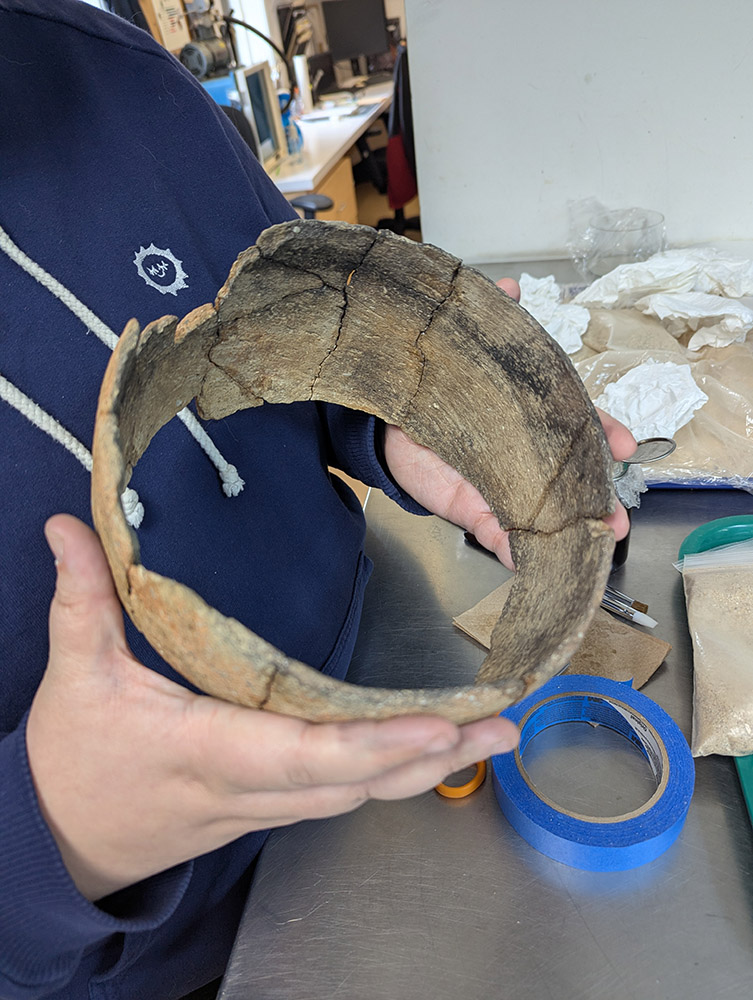
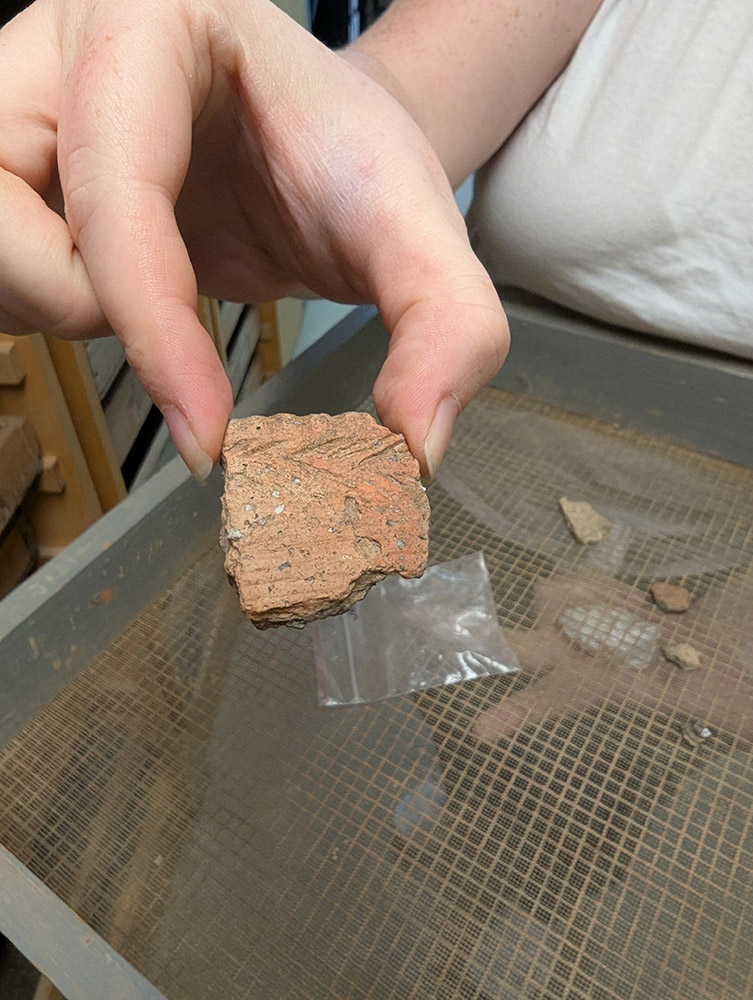
This month in the lab, Assistant Conservator Jo Hoppe and curatorial intern Molly Morgan both worked with Virginia Indian ceramics. Jo is working on conservation of a vessel from the Archaearium museum because some of its mends needed stabilization. The vessel is a shell tempered jar, and the exterior and interior have been scraped. Found in the Kitchen and Cellar just east of the fort’s first well, it stands about 6 and a half inches tall with a diameter of almost 8 inches. The paste is very friable, exposing the hand rolled coils just beneath the surface. The cause of the high friability may be too much temper, and it is also remarkably thin, being as thin as 2.5mm in areas and as thick as 7.5mm in others. Because it has a rounded bottom, Jo typically places it upside down during her work, supported by sand covered in plastic. She is re-mending the object using Paraloid-B72, a reversible adhesive. One table over, Molly is analyzing ceramics from Midden 1, a feature discovered just east of the fort close to the Seawall. One of the sherds Molly recently rediscovered through her work has a pattern unique to the collection, a series of chevrons running parallel to and just below the rim. This vessel is tempered by crushed stones.
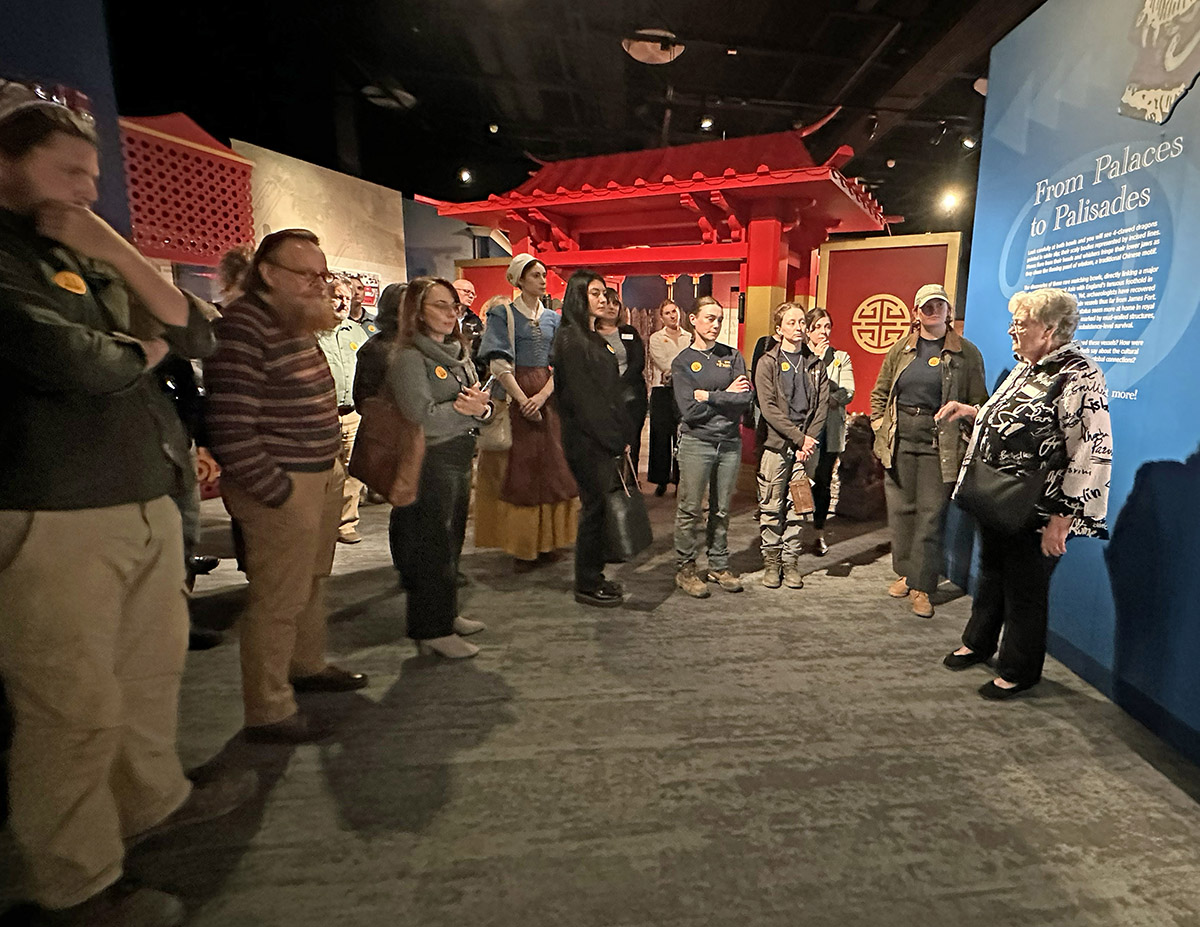
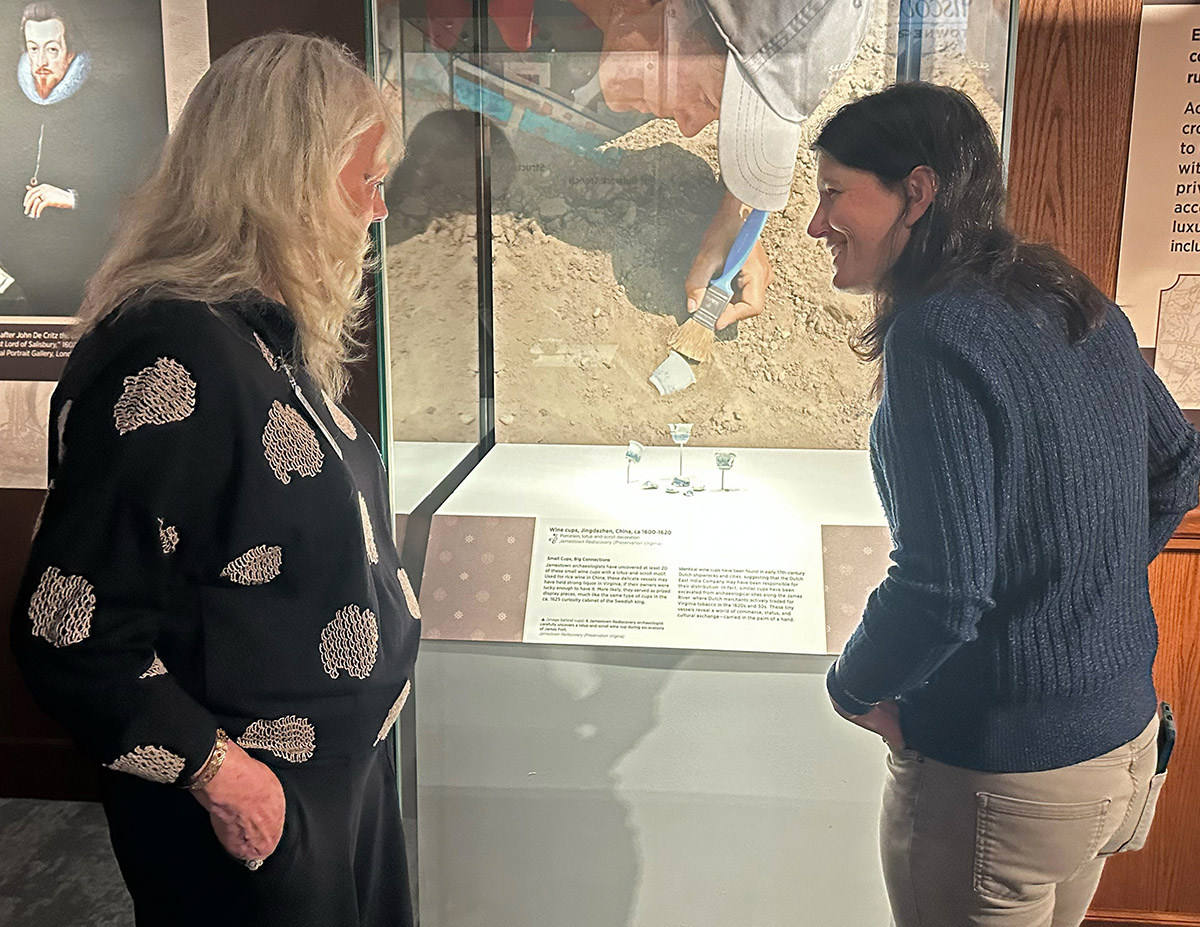
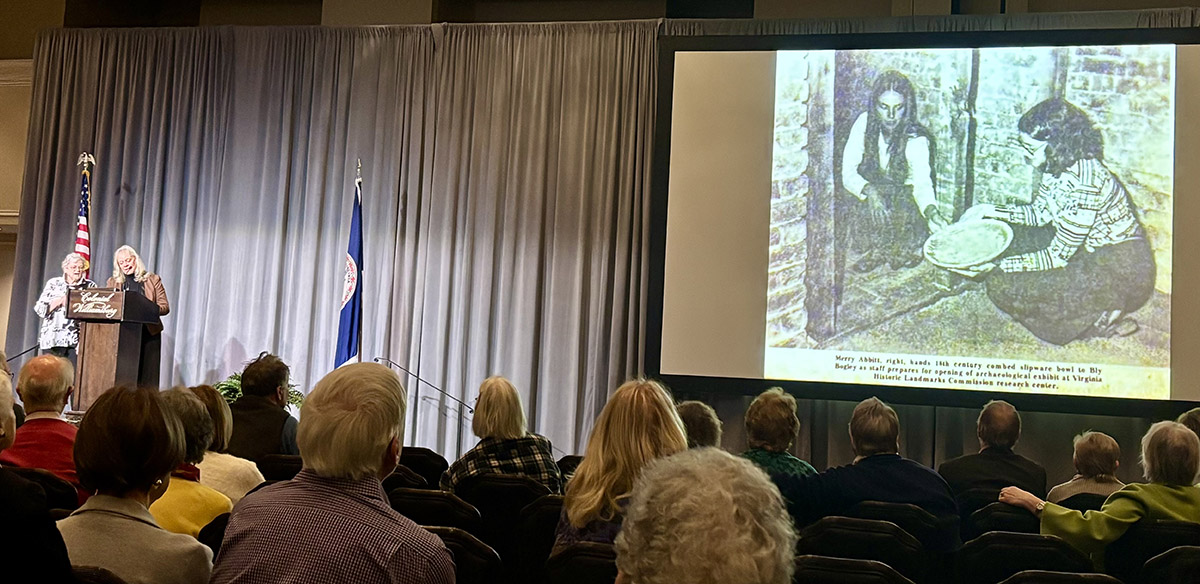
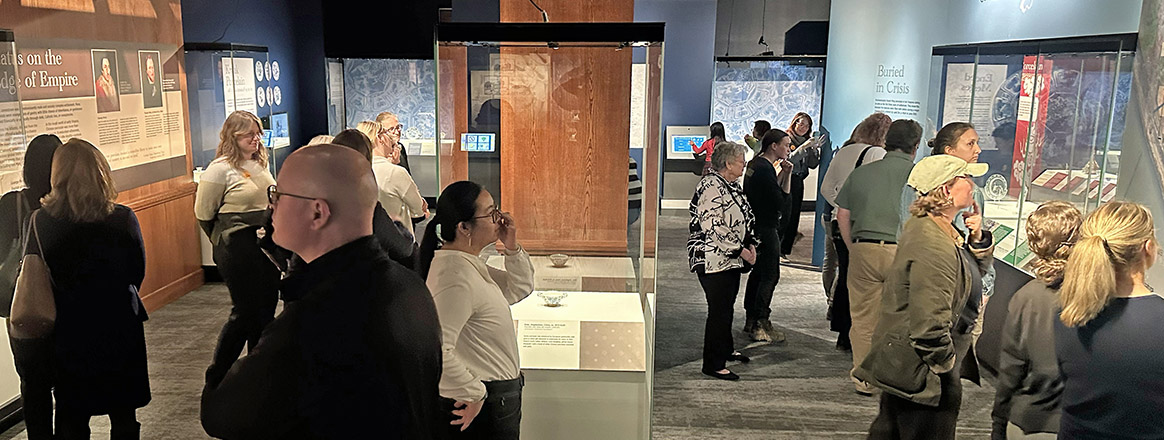
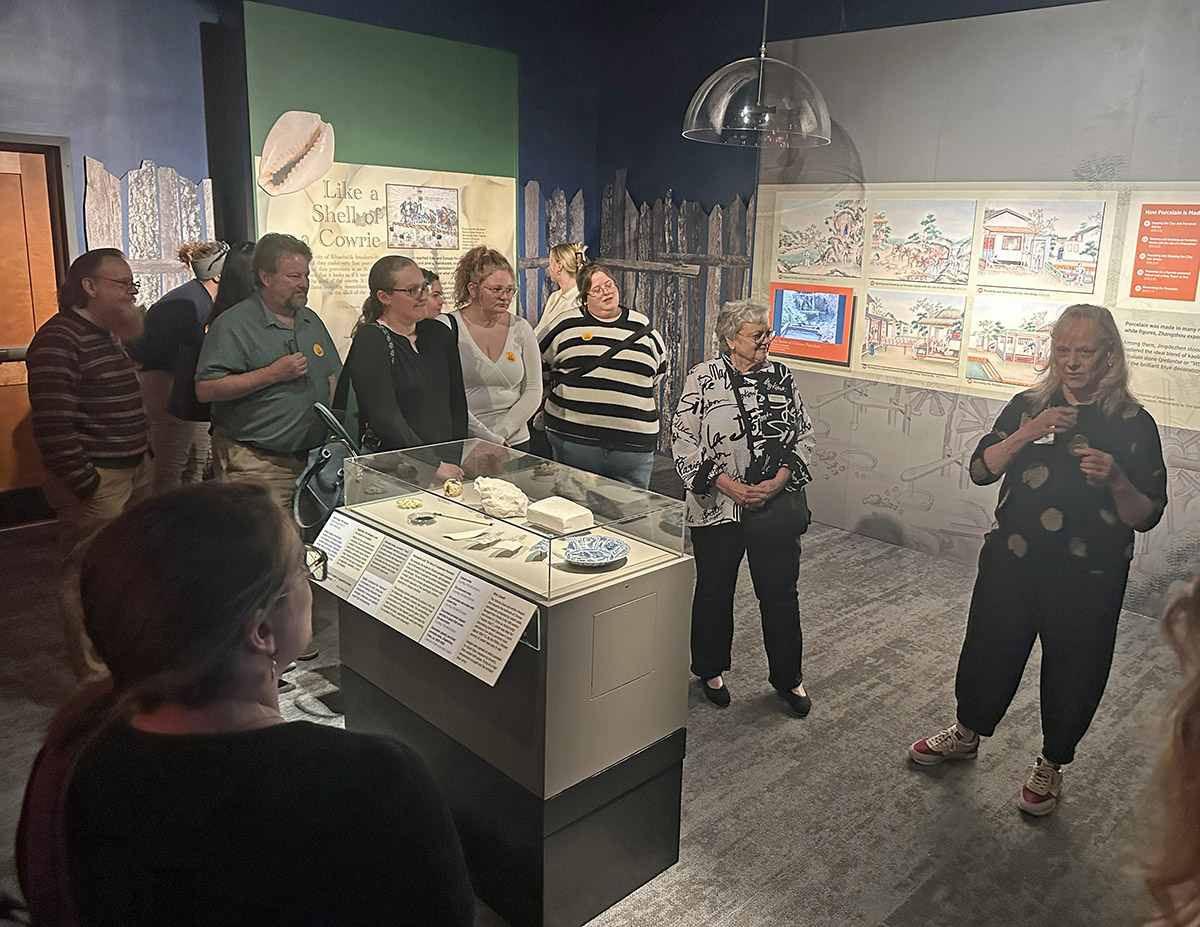
“Following the Dragon: Chinese Ming Porcelain in Early Jamestown”, an exhibit exploring Chinese porcelain discovered at Jamestown, has commenced at Jamestown Settlement. Open until July 12, the exhibit displays 31 Chinese porcelain vessels excavated at Jamestown alongside intact contemporary examples from museums and private collections. Jamestown Rediscovery’s Senior Curator Merry Outlaw and Jamestown-Yorktown Foundation’s Senior Curator Beverly “Bly” Straube were co-curators of the exhibit. The two friends have decades of experience working together, including time as colleagues at Jamestown Rediscovery. Many pieces from Merry’s personal collection are in the exhibit as are objects from across the globe, including one usually on display in Buckingham Palace. A film in the exhibit explains how the porcelain was made, the process having confounded European would-be imitators for centuries. How did these vessels end up at Jamestown, a frontier settlement half a world away from where they were created? Who would have used these expensive, delicate objects there? Ponder these and other questions as you explore “Following the Dragon: Chinese Ming Porcelain in Early Jamestown.” Jamestown’s museum store has many “Following the Dragon”-related items for sale, including the book Merry wrote to accompany the exhibit, complete with dozens of photographs of the objects on display.
related images
-
- Staff Archaeologist Ren Willis goes low to accurately mark details of the stratigraphy in the west wall of the excavations west of the Church Tower.
-
- In the excavations west of the Church Tower Archaeological Field Technician Katie Griffith takes a soil sample to classify using the Munsell Soil Color Chart.
-
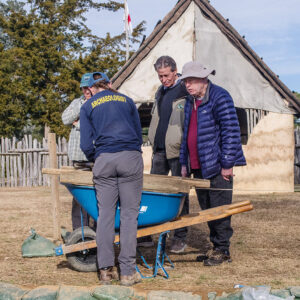
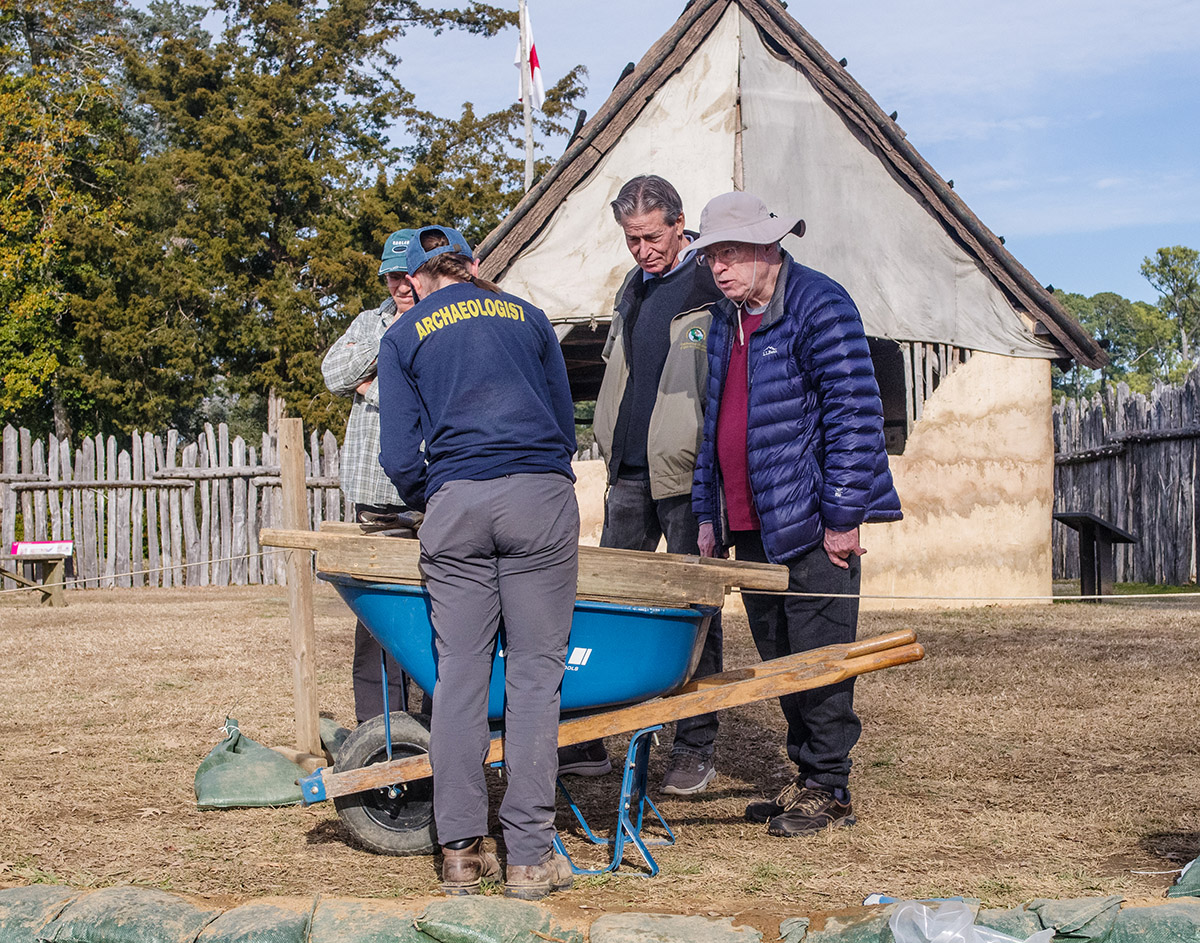
- Staff Archaeologist Natalie Reid shares her finds with visitors as she screens soil from the excavations west of the Church Tower.
-
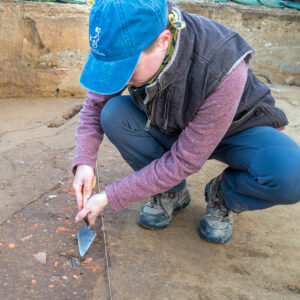
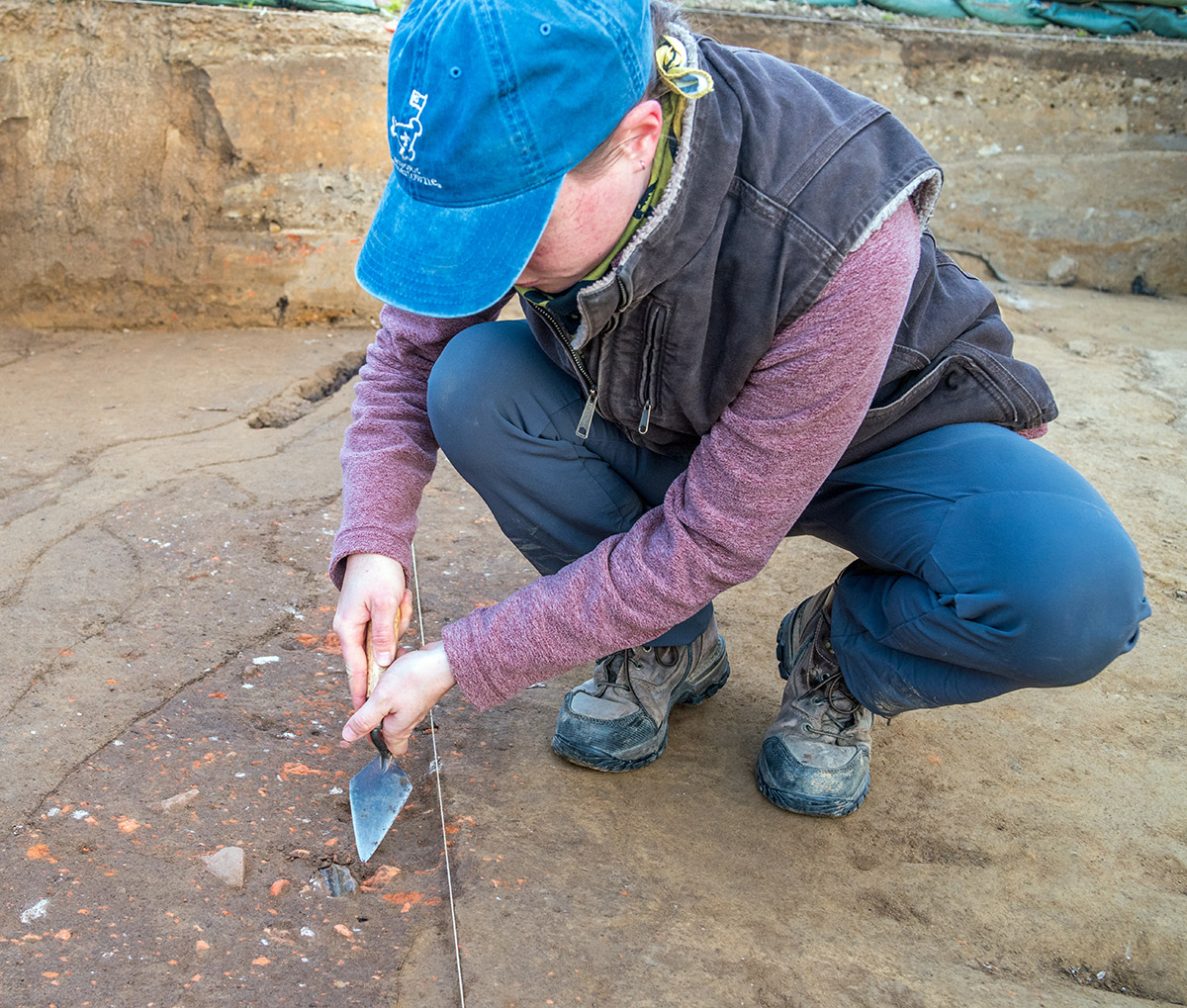
- Staff Archaeologist Natalie Reid prepares to excavate a sherd of North Devon gravel-tempered ware found in the excavations west of the Church Tower.
-
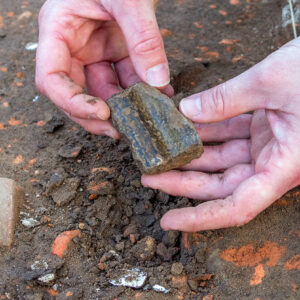
- A sherd of North Devon gravel-tempered ware found in the excavations just outside the Church Tower entrance
-
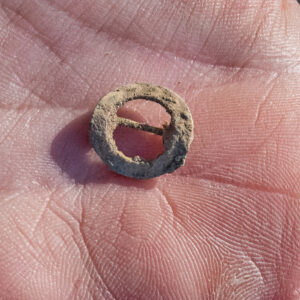
- An early twentieth-century copper-alloy pin or brooch found in the excavations just outside the Church Tower
-
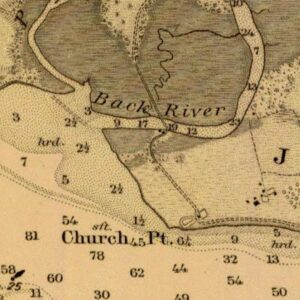
- An 1882 map showing a road passing just west of the Church Tower (represented by a square just northeast of the “Church Pt.” label). https://www.historicalcharts.noaa.gov/image.php?filename=CP1683C
-
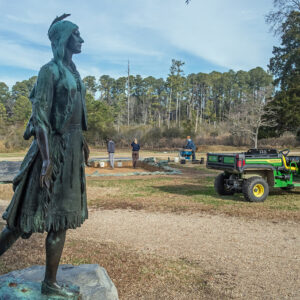
- Archaeologists at work in the cellar north of the Pocahontas statue
-
- The Nueva Cadiz bead found in the cellar
-
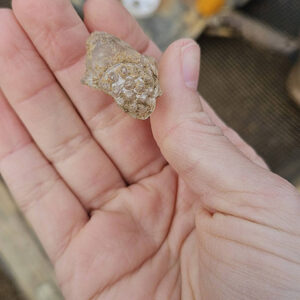
- A partial glass raspberry prunt found in the cellar excavations
-
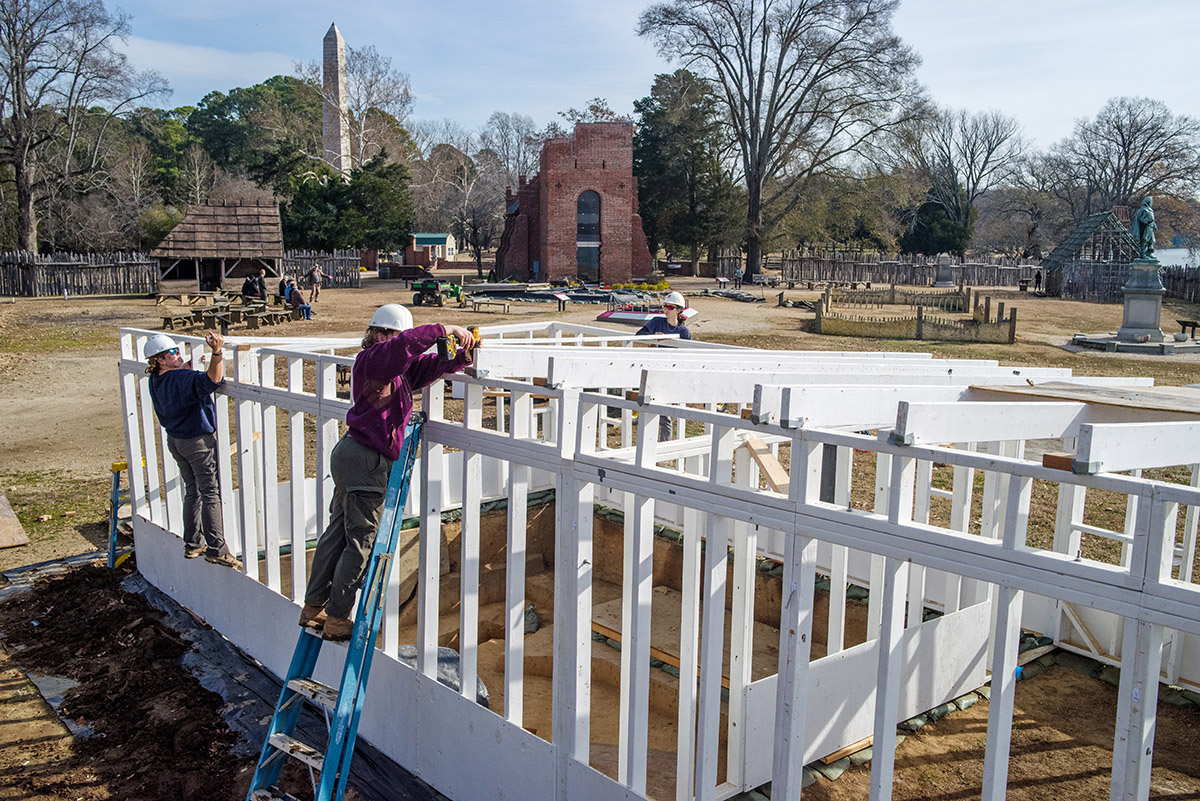
- Archaeological Field Technicians Hannah Barch and Eleanor Robb and Senior Staff Archaeologist Anna Shackelford disassemble the burial structure in the 1607 Burial Ground.
-
- Some of the iron bandolier bottles, caps, and bases in the Jamestown collection
-
- Two iron bandolier bottles
-
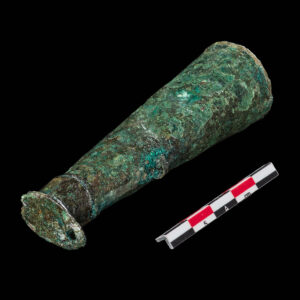
- A copper alloy bandolier bottle and cap
-
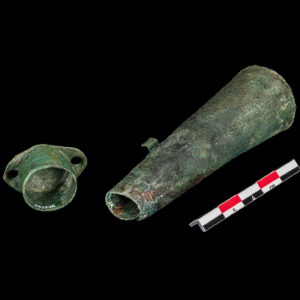
- A copper alloy bandolier bottle and cap
-
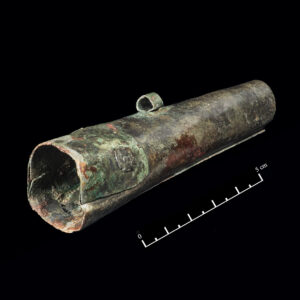
- A copper-alloy bandolier bottle with a repair
-
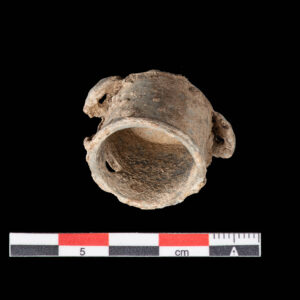
- A lead bandolier bottle cap
-
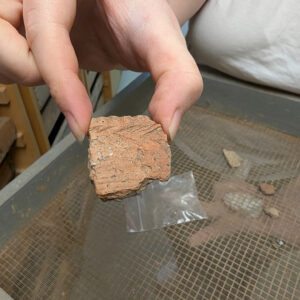
- A rim sherd of Native ceramic. This is the only piece in the Jamestown collection bearing this pattern.
-
- Beverly (Bly) Straube, Senior Curator at the Jamestown Yorktown Foundation, gives a tour of the “Following the Dragon” exhibit to Jamestown Rediscovery staff along with exhibit co-curator Jamestown Rediscovery Senior Curator Merry Outlaw.
-
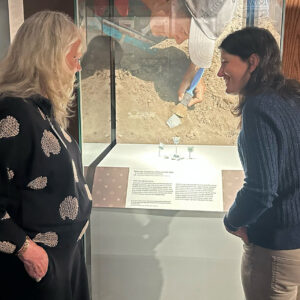
- Jamestown-Yorktown Foundation Senior Curator Beverly (Bly) Straube and Senior Staff Archaeologist Mary Anna Hartley discuss one of the cases in the “Following the Dragon” exhibit. The case’s background photo shows Mary Anna excavating one of the pieces of the wine cup on exhibit.