Sheep and Goat Bones

If you’re the type who likes to grab life by the horns, then you may have a lot in common with Jamestown’s sheep and goats! Part of the family Caprinae, sheep (Ovis aries) and goats (Capra hiscus) have very similar skeletal structures. As a result, zooarchaeologists cannot always definitively identify Caprinae bones to either sheep or goat. Cranial bones, teeth, and hoof/ankle bones are particularly similar between sheep and goats, and therefore difficult for zooarchaeologists to identify as one or the other.

Though sheep and goats are alike skeletally, they have some behavioral similarities and differences. Both are highly social herd animals, and both have been domesticated for thousands of years. Goats were one of the first animals domesticated by humans, thought to have occurred about 10,000 years ago in Iran. Both animals are fairly intelligent and curious, with goats especially known to attempt to eat almost anything. This is because goats are browsers, meaning they primarily eat leaves, shrubs, and higher-growing shoots, whereas sheep are grazers, preferring to eat low-growing grasses.

Along with cows, pigs, and chickens, sheep and goats were popular livestock in England, providing wool, milk, and meat. These animals are hardy and herbivorous, making them well suited for Virginia’s climate. John Smith’s writings suggest they were some of the very first livestock brought to the Jamestown colony. He states, “The commodities in Virginia or that may be had by industrie … [Under] that latitude or [climate], here will [live] any beasts, as horses, goats, sheep, asses, hens, etc. as appeared by them that were carried thether . . . ” The plentiful greenery provided, “ . . . an abundance of [fresh] fodder for any kind of livestock, especially pigs and goats, even if there were a million of them.”

As with the rest of the colony’s livestock, sheep and goat were consumed during the Starving Time and beyond, evidenced by butchery marks present on several Caprinae elements in the collection. John Smith in his General Historie wrote, “As for our hogs, hens, goats, sheep, horse, or what lived; our commanders and officers did daily consume them: some small proportions (sometimes) we tasted, till all was devoured.” Archaeological reports estimate that meat from sheep and goats likely made up a relatively small portion of the colonists’ diets in comparison to other livestock. However, sheep and goats would have also provided wool and cheese, making them useful beyond providing meat.

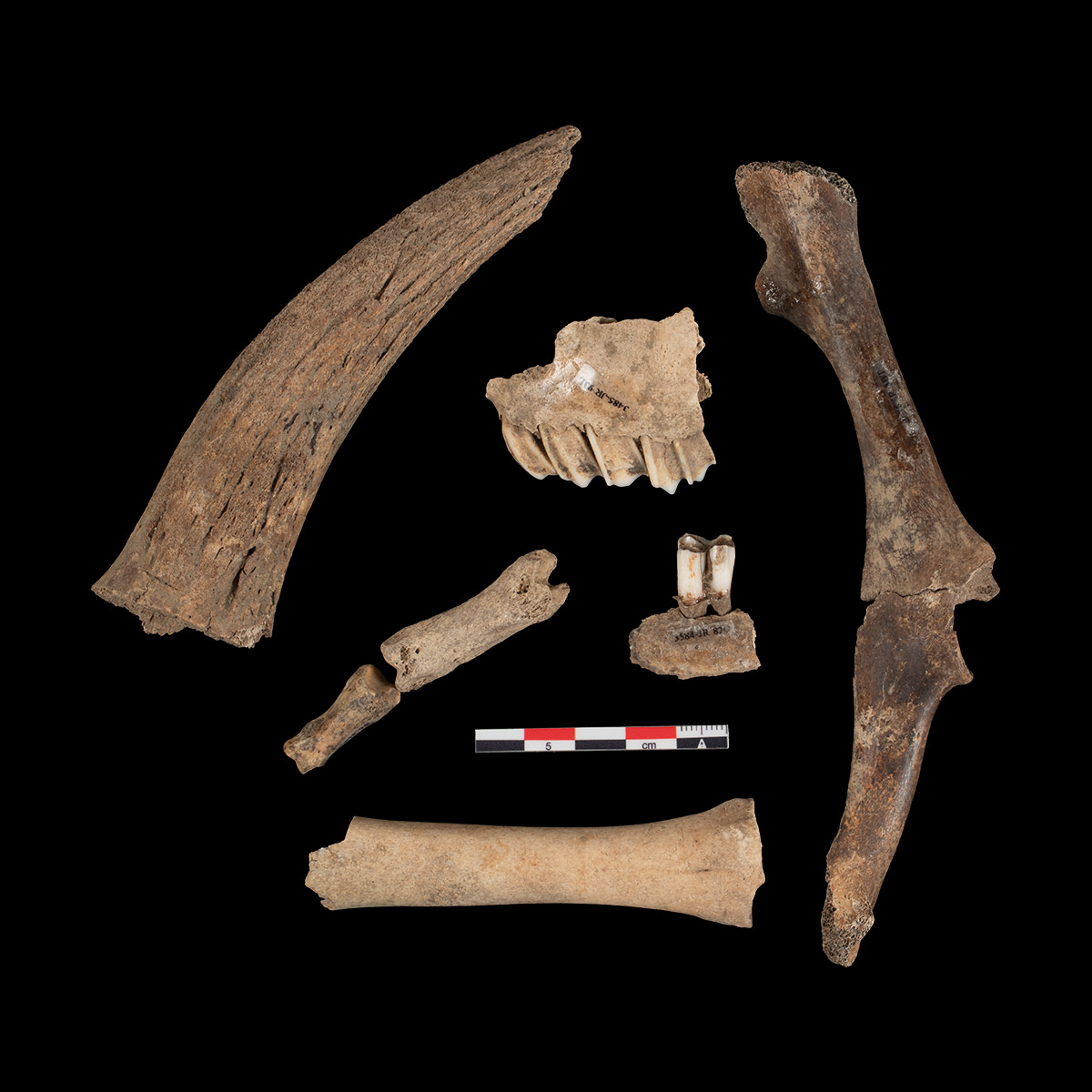
A major skeletal similarity of sheep and goats is their horns. Unlike antlers on deer, which are made entirely of bone and are shed and regrown each year, horns are permanent, bony projections that are coated with keratin — the same material that our nails and hair are made of. If a horn is permanently damaged, it cannot be regrown. Horns on sheep and goats vary greatly in size and shape, with some having twisted or incredibly large, curved horns. Some can even be polycerate, which is a genetic condition that causes them to grow more than two horns. Horns are one of the many elements identified to sheep and goat by Jamestown Rediscovery’s archaeologists, seen in the artifact photo.