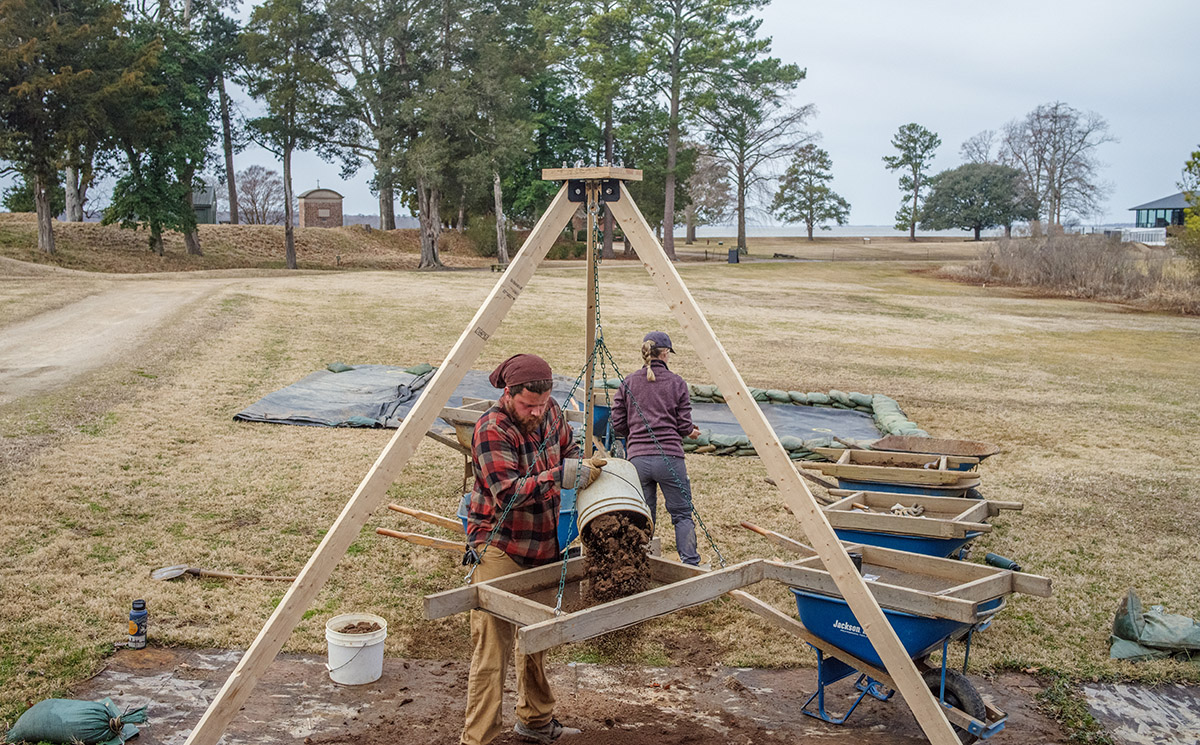


In September excavations were completed at the Seawall, in an area in and around James Fort’s eastern bulwark. This area was chosen for excavation because it is in the path of the construction of a permanent concrete and pebble aggregate walkway. Our archaeologists, led here by Staff Archaeologist Natalie Reid, needed to conduct excavations prior to the installation to properly investigate, record, and protect the archaeological features before the pathway goes in. The excavations are adjacent to another series of squares dug in 2020/21 during which a midden — first discovered in 1997 — was partially excavated. The archaeologists troweled away, following the midden down a sharp slope — the historic surface — to the James River, today interrupted by the Seawall. Middens are trash dumps and as such are rich in artifacts. This one is thought to have been a dumping place ca. 1630-1650 and exhibits all manner of artifacts from that period and earlier. In the squares excavated this summer, that trend continued but curiously without much in the way of faunal remains (animal bones, fish scales, etc.), a stark difference from the adjacent area dug earlier this decade.

These excavations were complicated by the presence of plumbing tanks, an artesian well, and pipes installed early in the 20th century. Concrete tanks were installed deep into the earth, cutting through early 17th-century layers, with one even going deeper than the midden itself. The location of this equipment’s installation was particularly unfortunate in that it destroyed sections of the artifact-rich midden and disturbed other sections, mixing soil contexts and artifacts. When an artifact is “out of context”, meaning it’s not in the location where it was originally deposited, it loses much of its usefulness for dating features and informing archaeologists about the features’ purpose.
If a coin dated 1620 is found in an undisturbed feature, it can be assumed that the feature can’t date any earlier than 1620. But if a construction project such as this entails digging a hole and then filling the hole back in with the excavated soil, the soil (and the artifacts that came with it) goes back in a jumble, with its original archaeological contexts destroyed. The same 1620 coin could have come from anywhere inside the hole and thus can’t be used to help date features. Archaeologists meticulously inspect the soil in historic layers as they go, looking for color changes, soil composition, and other indicators that suggest they’ve come upon a new soil layer (aka context). In this manner, when they find a date-specific artifact in a previously-undisturbed layer, it can be used to help date the layer. Archaeologists also screen excavated soil for artifacts, but they are careful to only screen one layer at a time. That way, if there’s an artifact found during screening that has temporally diagnostic properties, they know which layer it belonged to.


The excavations here wrapped up in September but not before yielding thousands of more artifacts. Ceramics, European, Native, and local were discovered here this month. Sherds of Delft (including a tile bearing a woman’s head), Portuguese faience, Townsend, Frechen, and a partial Midlands Purple butter pot were all found here. The Midlands Purple butter pot is nearly half complete, and was found that way in situ by Archaeological Field Technician Katie Griffith. Pipes made of European and local clay were found, as was lead shot (bullets), projectile points, a glass case bottle, bricks, beads, plates of copper, animal bones, and a fishhook.
There is a thin soil layer in the midden that is devoid of artifacts. Artifacts were found above and below this layer. The colonists may have stopped dumping trash there for a while or perhaps a rain or flood event washed soil from a higher elevation down to the midden. A posthole was discovered here but it is unknown what structure it belonged to. A sherd of ceramic created by Thomas Ward, the “Jamestown Potter” was excavated from the posthole. He started producing ceramics in the 1620s and so the posthole couldn’t have been created earlier than that.
While finishing things up at the Seawall, the archaeologists are also preparing for this year’s burial excavations. One-hundred yards to the northwest, the team is constructing a structure to protect the remains of three individuals buried in the 1607 Burial Ground. Every year our archaeologists excavate three individuals from this area inside the western palisade wall of James Fort. These men and boys died in the first few months of the colony’s existence, when disease caused dozens to die. Captain John Smith stated that 50 colonists died between May and September 1607, nearly half of the 104 men and boys who landed that spring. The colonists buried their dead within the walls of James Fort, hiding their dwindling numbers from the surrounding Powhatan as instructed by the Virginia Company of London.
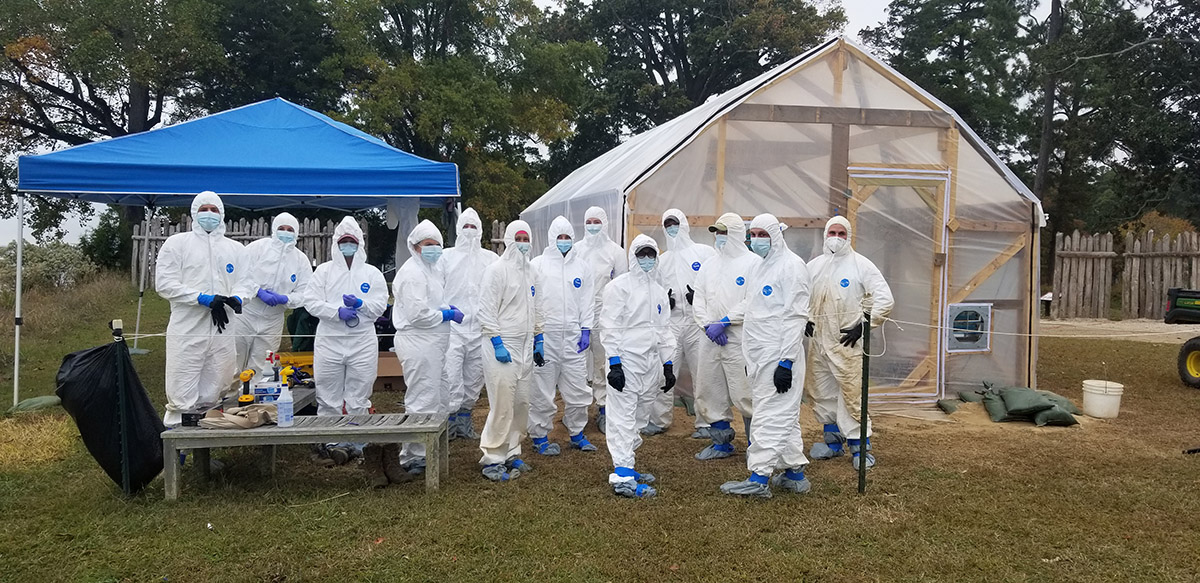
Our archaeologists build burial structures prior to beginning excavations in order to protect human remains from the weather and from local wildlife. Inside the structure, the team wears Tyvek suits, gloves, masks, and surgical booties to protect the remains from the archaeologists themselves. The bones will be sampled for DNA testing and it is of the utmost importance that the excavators’ DNA does not contaminate the colonists’.
Before raising the first wall the team is laying down ground control points (GCPs), markers indicating precise latitude/longitude and elevation that provide reference points for photography, photogrammetry, and mapping. Our archaeologists discovered in past years that there are substantial inaccuracies created when placing the GCPs once the burial structure’s walls are already in place. The team uses surveying equipment to mark the location of the GCPs and the equipment is much less accurate when used within the confines of a building. These GCPs will help accurately record the burials and the myriad of other features within the bounds of the burial structure.

A slew of features sit inside the structure’s footprint, ranging from the early 1600s to 1861. The burials are likely the oldest features here, but near the southern edge of the dig area sits a mud and stud building, missed during the excavations of the early 2000s because its soil stains are so faint. Mud and stud buildings were built at Jamestown early in its history and this could possibly be one of the colony’s earliest. The form is native to the Lincolnshire area of England, and colonists from that region — including Captain John Smith — were building what they were familiar with back home. Our archaeologists are excited to learn all they can about the building and will excavate it completely at a later date.

Other 17th-century features here include two fence lines, one ca. 1630s and another one that dates after 1660. A palisade, with postholes still visible, runs through the excavation area, as does a slot trench which dates to around the turn of the 18th century. Finally, a posthole from a late 17th-century structure with a brick wine cellar sits on the extreme western edge of the excavation area. This building was discovered while following James Fort’s western palisade wall in 2004 and was found to contain multiple intact wine bottles.
James Fort sits on high ground and the Confederates and enslaved workers unknowingly built Fort Pocahontas on the same high ground in 1861. A knee wall from the Civil War fort partially sits within the burial structure’s bounds. Finally, evidence of earlier archaeology can also be found here. A portion of an excavation square dug by the National Park Service in the 1950s is located on the eastern edge of the burial structure and some of our own completed burial excavations from earlier this century can also be seen. One of these burials contained three individuals, the only known instance of this at Jamestown.
The large number of features means our archaeologists have their work cut out for them. Unfortunately, during burial excavations the team is under tight deadlines, as they have to complete tasks prior to the arrival of outside experts. Geophysicist and Archaeologist Peter Leach from GSSI (Geophysical Survey Systems, Inc.) and Biological Anthropologist Dr. Ashley McKeown from Texas State University are arriving to help our archaeologists with ground-penetrating radar (GPR) and in situ analysis respectively. The team needs to complete sections of the excavations before their arrival so that these outside experts’ can hit the ground running.

The burial structure is modular, meaning it’s made out of individual frame segments that can be bolted together to create differently-shaped buildings. The team has taken this approach the past couple of years to save money (the frame segments will be unbolted and stored for next year) and make it easier to build. Each segment can be carried by one person versus the several people required to carry and place a fully constructed wall. The team has also made improvements to the roof to make it more waterproof. Hopefully the weather will be cool in the coming weeks as the semi-transparent plastic sheeting covering the structure creates a greenhouse effect inside. Once they’re in their Tyvek suits it can be uncomfortably warm, but the team has installed two portable air conditioning units this year to make the environs more pleasant.
In the lab, Senior Conservator Dan Gamble and Conservator Jo Hoppe continue their work on Surrey-Hampshire Border ware. This type of ceramic, plentiful at Jamestown, was created in the border region of Surrey and Hampshire counties in England. The collections team is creating the reference collection for this ceramic type and many vessels are being sent to the conservation team for treatment prior to inclusion in the collection. Their hard work is paying off as some of the objects pulled from the Archaearium museum for retreatment have completed their course of conservation and are going back on display. The small pipkin Jo was working on last month is back in the Archaearium — nearly complete now — as is a small brown plate conserved by intern Evan Grant, a master’s anthropology student from The University of Cincinnati.

According to Senior Curator Leah Stricker, who is leading the Surrey-Hampshire Border ware reference collection project, 28 vessels of the type were recorded in the Jamestown database at the beginning of the process. After about 5 months of work, there are 64 recorded vessels, and the team has pulled and labeled about 30% of the total number of cataloged sherds from the artifact archive on the Vault’s second floor. Leah says there is a method to the madness of pulling the sherds. First, sherds from features that included already mended vessels were pulled, with the hope that additional mends to the existing objects could be found. Next, sherds from features that simply have a lot of Surrey-Hampshire Border ware or features where crossmended ceramics are often found were pulled. Ultimately, all 6000+ sherds of Surrey-Hampshire Border ware will be part of the mending and database updating project. Jamestown’s Surrey-Hampshire Border ware collection is dominated by ceramics used for cooking and eating. So far, there are 14 pipkins — vessels used to cook food in a fire — and 13 dishes among the mended objects.
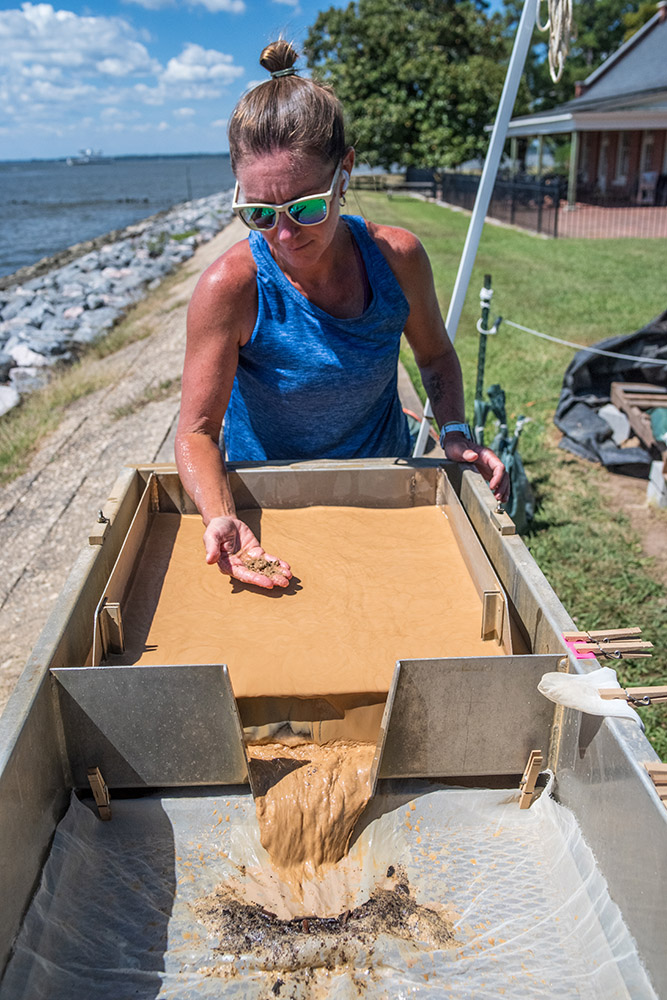
If you’ve come by Jamestown the past few years you might have run into Assistant Curator Lindsay Bliss on the Seawall, using a flotation machine to process soil samples collected over the life of the project. Flotation uses water to separate artifacts by density and is especially useful in finding seeds and other botanicals. It takes anywhere from one to three hours to process each sample, and over the past four years she’s processed over 950 samples. She has found countless artifacts over the years, including botanicals that help us understand what the colonists were eating and what the environment was like at Jamestown in the 17th century. Thanks to her hard work we are now caught up and ready for new samples from the archaeologists in the field.
A multitude of bricks were excavated from the “West Flag” dig this year, and Associate Curator Lauren Stephens, our resident expert on construction materials, has measured and weighed 174 pounds of them. These bricks were hand-made but the team hasn’t yet found any distinguishing features that might help date them (and as a result, the features they were found in).

A tiny glass object, measuring about 1/4″ x 1/8″ was found at the Seawall this month and is being analyzed and conserved in the lab. It’s blue and has a spiral shape. The team hasn’t been able to make a positive identification yet. Perhaps it is a piece of jewelry or a decorative element to a glass drinking vessel. Our collections team is researching its identity. The blue color may be caused by the presence of cobalt, likely added intentionally by the glassmaker. Senior Conservator Dr. Chris Wilkins plans on using Jamestown’s X-ray fluorescence spectrometer to determine its chemical composition. Upon observation through a microscope, Chris noted crystal formations over the entirety of the object. These are likely unintentional byproducts of the glass creation process.

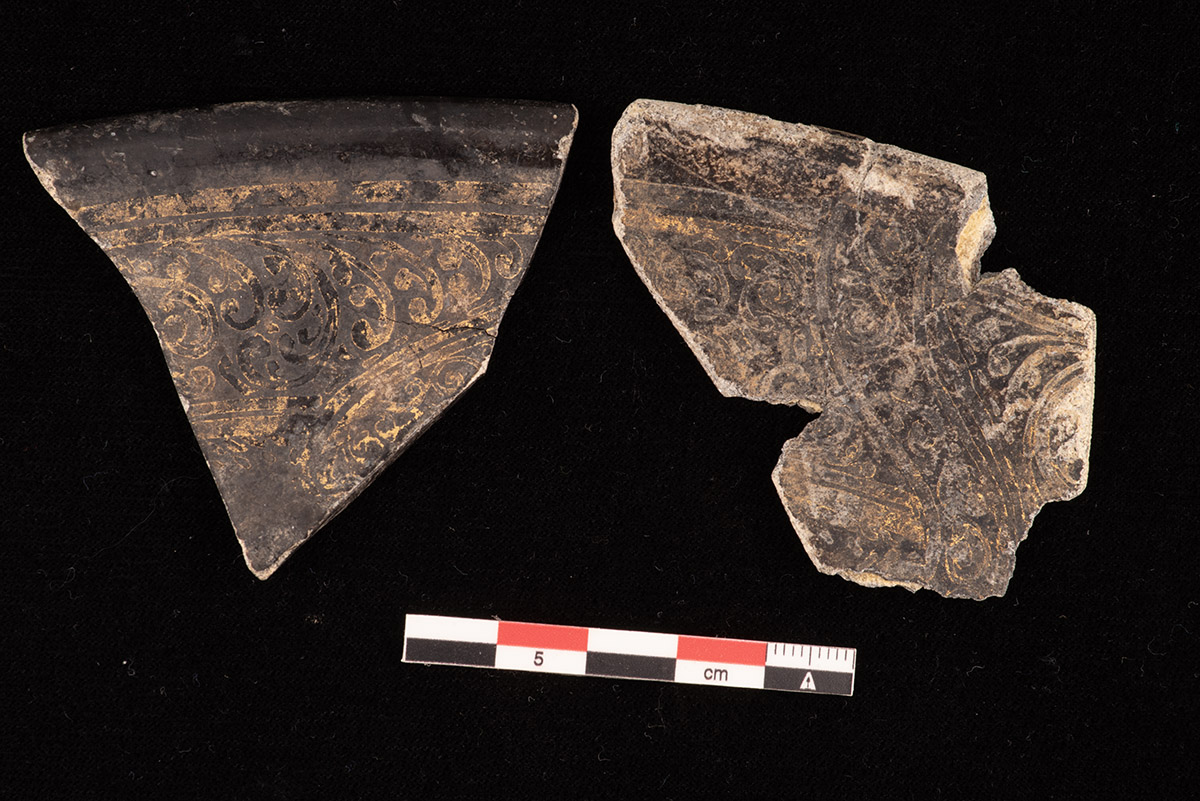
More and more pieces of a gilded glass plate are turning up in the artifact archive. Gilding is quite rare in the Jamestown collection, as is gold of any form. The plate was originally clear with a heavy green tint but is opaque now and appears almost black, other than the ornate gold designs on its surface. These new pieces have been sent to Conservator Jo Hoppe for treatment. The glass was in bad shape, with surface layers that were inclined to flake off at the slightest touch. Jo’s first step was to stabilize the glass so that it can be handled safely. She put the glass in a vacuum chamber along with a beaker containing a 5% B72 solution. As the solution off-gassed, it adhered to the glass, creating a thin barrier that stabilized it and protects it from the environment.
As with doctors, conservators want to “first, do no harm” and this is how Jo approached the treatment of the gilding on the dish. It is extremely fragile, and soil has adhered to it during its 400 years underground. She chose not to remove the soil because doing so could possibly damage the gilding. It can be frustrating to conservators to leave soil or other contaminants on an artifact but sometimes that is in the best interest of the object.
dig deeper
related images
-

- The Archaeology team takes a group shot at the Seawall excavations.

-

- The Seawall excavations

-

- Archaeological Field Technician Katie Griffith and Staff Archaeologist Ren Willis help survey features in the Seawall excavations.

-

- The Seawall excavations

-

- Archaeological Field Technician Katie Griffith uses a Munsell soil color chart to categorize soil excavated at the Seawall dig.

-

- Staff Archaeologist Ren Willis and Archaeological Field Technician Eleanor Robb excavate at the Seawall dig while Archaeological Field Technician Natalie White screens soil for artifacts.


-

- Staff Archaeologist Ren Willis draws the layer profile of the south wall of the Seawall exavations.

-

- Jamestown’s archaeologists get muddy mixing the soil and water to make screening easier.

-

- The Midlands Purple butter pot in situ

-

- Staff Archaeologist Ren Willis holds a pipe made of local clay she found at the Seawall excavations.

-

- Archaeological Field Technician Katie Griffith holds a partial case bottle she found at the Seawall excavations.

-

- Volunteer Patrick Shaver screens soil from the Seawall excavations, searching for artifacts.

-

- A heavily corroded fishhook found at the Seawall dig site

-

- Two sherds of Portuguese faience found at the Seawall excavations

-

- Archaeological Field Technician Katie Griffith shares the latest finds with visitors at the Seawall excavations.

-

- Objects caught during water screening of soil from the Seawall excavations

-

- A screen of artifacts from the Seawall dig

-

- A tray of artifacts found at the Seawall excavations

-

- Senior Curator Leah Stricker investigates artifacts found at the Seawall excavations.

-

- Shot and other lead objects found at the Seawall dig

-

- A projectile point found at the Seawall dig

-

- A Nueva Cadiz bead found at the Seawall excavations

-

- A projectile point tip found at the Seawall excavation area.

-

- A sherd of tin-glazed earthenware found at the Seawall excavations

-

- A sherd of redware bearing a decorative yellow slip found at the Seawall dig.

-

- A rim sherd of a lead glazed earthenware vessel found at the Seawall excavations

-

- A red and white striped bead found at the Seawall excavations

-

- A pipe stem (center) made from European clay bears fleur-de-lis impressions

-

- Four small glass beads caught during screening of soil from the Seawall excavations

-

- Two projectile points found at the Seawall dig

-

- An unidentified lead object found at the Seawall excavations

-

- The archaeology team prepares the excavation area at the 1607 Burial Ground.

-

- A map of the burial excavation area. The three burials to be excavated this year are in yellow.

-

- Outside contractor Tim Schmidt uses a backhoe to help Staff Archaeologist Ren Willis and Senior Staff Archaeologist Anna Shackelford remove the backfilled modern layers at the burial excavations area.

-

- A drone shot of the James Fort area with the burial excavation area in the foreground

-

- Senior Staff Archaeologist Mary Anna Hartley gives an archaeology tour.

-

- Senior Curator Leah Stricker reviews Surrey-Hampshire Border ware in the Jamestown collection.

-

- The tiny unidentified glass object found at the Seawall excavations

-

- A magnified image of the tiny glass object showing the white star-like crystals that formed during its manufacture.

-

- Collections intern Evan Grant conserves a Surrey-Hampshire Border ware dish.

-

- The Surrey-Hampshire Border ware dish before and after mending/treatment by collections intern Evan Grant. It was found in James Fort’s first well.

-

- Flooding September 24, 2026